
Could your property’s original fuse box be the silent weak link in your home’s safety? Whilst many Newcastle homes still rely on traditional wire-fuse systems, these ageing components weren’t designed to handle the demands of 2026 living, from EV chargers to high-powered modern appliances. If you’re considering replacing old fuse boards Newcastle, you likely feel a mix of concern over potential fire risks and confusion regarding the latest technical standards. It’s a common worry; nobody wants to deal with the disruption of electrical work or the jargon associated with modern circuitry.
We understand that your priority is a safe, compliant home that protects your family without unnecessary stress. This guide will clarify why upgrading to a modern consumer unit is essential under the BS 7671:2018+A4:2026 regulations, specifically focusing on how components like Surge Protection Devices (SPDs) and Arc Fault Detection Devices (AFDDs) work to keep you safe. You’ll discover exactly what to expect during the installation process and how the correct certification ensures your property remains insured and market-ready. We’ll take a look at the transition to 18th Edition Amendment 4 standards and how a professional upgrade provides lasting peace of mind.
Key Takeaways
- Identify why the “rewirable” fuses common in Newcastle’s Victorian and Edwardian properties fail to meet modern safety requirements and how they increase fire risks.
- Explore the technical advantages of modern metal-clad consumer units and why choosing RCBOs over standard RCDs provides superior protection for your household.
- Learn the importance of a pre-installation EICR when replacing old fuse boards Newcastle to detect hidden issues like deteriorating vulcanised rubber insulation.
- Understand the legal necessity of Part P certification and why hiring a NAPIT or NICEIC registered professional is vital for your home insurance and future house sale.
- Discover how a methodical installation process, including clear circuit labelling, ensures a smooth transition to a system ready for modern appliances and EV chargers.
Understanding the Risks of Outdated Fuse Boards in Newcastle Homes
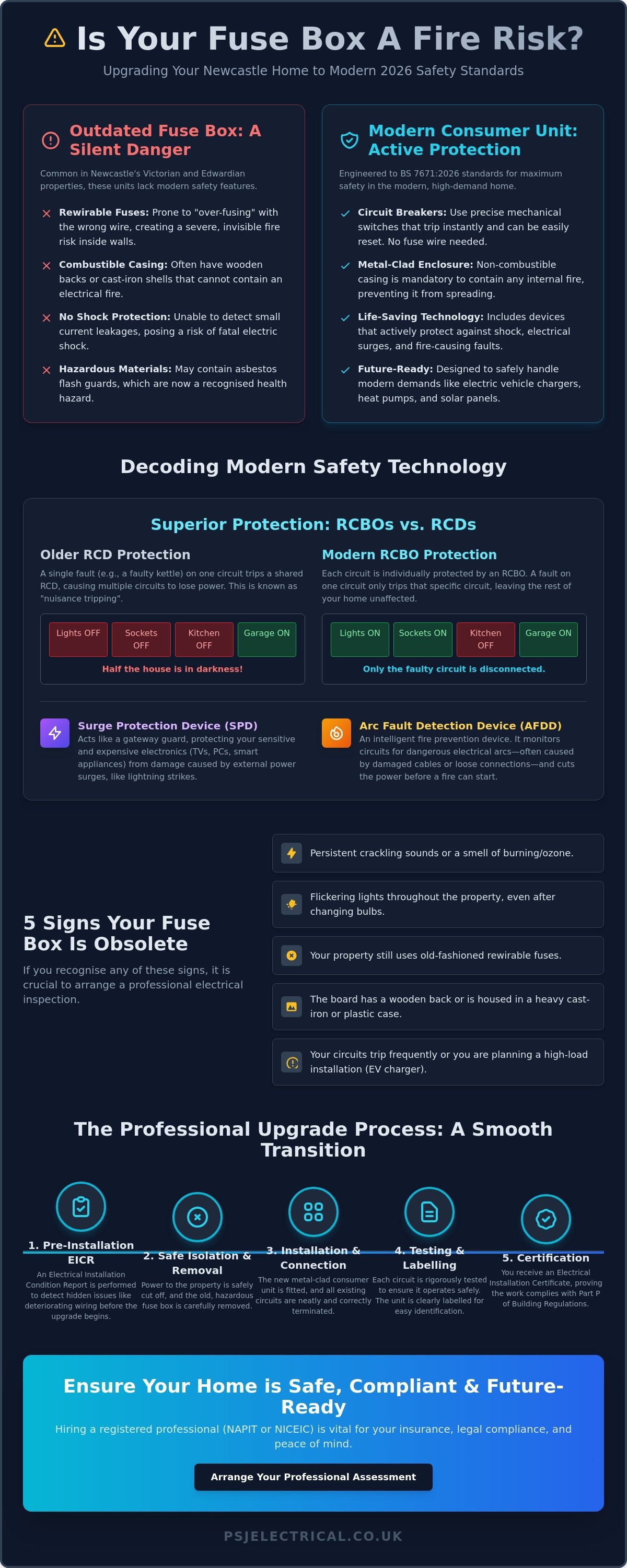
Many homeowners in Newcastle view their fuse box as a “set and forget” component, yet the technology within these units has changed fundamentally over the last few decades. A traditional fuse board relies on a simple piece of wire designed to melt when a circuit draws too much current. In contrast, a modern consumer unit uses sophisticated mechanical switches called circuit breakers. Whilst the old system might still “work,” it lacks the precision required to protect modern households. It is a passive system in an era that demands active protection.
Newcastle’s architectural heritage, particularly the Victorian and Edwardian terraces in areas like Jesmond and Heaton, often houses these ageing rewirable systems. A significant danger arises from “over-fusing,” where a homeowner inadvertently uses a thicker gauge of fuse wire than a circuit is designed to handle. If a lighting circuit meant for 5 Amps is fitted with 30 Amp wire, the wire won’t melt during a fault, but the cables hidden in your walls might. This creates an invisible fire risk that traditional boards are incapable of preventing. These older units are also often unable to detect small leakages of electricity, which can lead to fatal electric shocks. Understanding UK electrical wiring standards is helpful here. It highlights how the industry has moved away from simply protecting the building’s infrastructure towards protecting the lives of its inhabitants.
Signs Your Newcastle Property Has an Obsolete Board
Identifying an outdated unit is often a matter of visual inspection. If your board has a wooden back or is encased in a heavy cast-iron shell, it is likely over forty years old. Many of these installations also contain “asbestos flash guards,” which were standard safety features at the time but now represent a hazardous material. You should also listen for physical symptoms. Crackling sounds or a persistent smell of ozone or burning are clear indicators that the internal components are failing. If you notice flickering lights even after changing the bulbs, it’s time to consider replacing old fuse boards Newcastle homeowners often overlook these subtle warnings until a total failure occurs. Many of these warning signs are precisely the kind of hidden hazards that a professional electrical system health check North East specialists recommend is designed to uncover before they escalate into emergencies. It is better to be proactive than to wait for an emergency.
Why 2026 Standards Demand More Than Just “Working” Electrics
The shift in UK safety regulations, specifically the move towards BS 7671:2018+A4:2026, reflects our changing relationship with electricity. In the 1970s, a home might have only powered a handful of lights and a television. Today, our infrastructure must support high-demand technologies like EV chargers and solar panel systems. Modern consumer units are designed to protect sensitive electronic devices from power surges and to disconnect power in milliseconds if a fault is detected. Simply having “working” electrics is no longer enough to meet the rigorous safety requirements of 2026. These updated standards prioritise active fire prevention and life safety over basic circuit protection.
Modern Consumer Units: Key Features and 2026 Safety Regulations
When you decide on replacing old fuse boards Newcastle, you aren’t just swapping one box for another; you’re upgrading to a precision-engineered safety hub. Modern consumer units must now be housed in non-combustible, metal-clad enclosures according to BS EN 61439-3 standards. This design is specifically intended to contain potential fires within the unit itself, a critical advancement highlighted by Electrical Safety First as a major factor in reducing domestic fire risks. Beyond the casing, the 2026 regulations place a heavy emphasis on sophisticated internal components like Arc Fault Detection Devices (AFDDs). These intelligent breakers monitor the “signature” of the electricity, identifying dangerous arcing caused by damaged cables or loose connections before a fire even starts.
RCDs vs. RCBOs: Preventing Nuisance Tripping
A common frustration with older “split-load” RCD boards is that a minor fault on one circuit, like a faulty toaster, can plunge the entire house into darkness. This happens because multiple circuits share a single Residual Current Device (RCD). Modern installations favour individual RCBOs (Residual Current Breaker with Overcurrent). With this setup, only the faulty circuit trips, whilst the rest of your home remains powered. Homeowners sometimes worry that a new board trips more often than their old one. It’s a common myth that this indicates a problem with the new unit. In reality, it means the system is working correctly. It is detecting tiny leakages of current that your old fuse board was simply too insensitive to notice. This same principle applies whether you are in a city-centre flat or considering a consumer unit upgrade in Darras Hall, where premium properties equally benefit from the superior circuit isolation that individual RCBOs provide.
Surge Protection and Future-Proofing
Our homes are now filled with expensive electronics, from smart TVs to home servers, all of which are vulnerable to “spikes” in the Newcastle power grid. Surge Protection Devices (SPDs) are now a mandatory consideration in new consumer units under BS 7671:2018+A4:2026. They act as a high-speed bypass, diverting excess voltage safely to the ground during a transient event. This protection is essential if you are planning a solar panel installation Newcastle, as these systems involve sensitive inverters that require stable electrical environments.
Future-proofing is about more than just current safety; it’s about ensuring your home can grow. A well-planned upgrade provides the spare capacity needed for future EV charger additions or loft conversions without requiring another full board replacement. If you’re unsure whether your current system can handle your next home improvement project, it’s worth speaking with a local specialist to assess your property’s specific electrical capacity.
Is a Fuse Board Upgrade Enough? Comparison with Full Property Rewiring
When homeowners consider replacing old fuse boards Newcastle, they often expect the new unit to be a standalone solution for their home’s electrical health. However, installing a modern, highly sensitive consumer unit can sometimes act as a “Safety Reveal.” Because modern RCBOs are designed to detect even the slightest leakage of current, they may trip immediately upon installation if the existing hidden wiring is degraded. This isn’t a fault with the new board; rather, the board is finally highlighting insulation defects that your old rewirable fuses were simply too insensitive to notice. It’s the difference between a blurry old photograph and a high-definition image where every flaw becomes visible.
In many of Newcastle’s older properties, we still encounter vulcanised rubber (VRI) or lead-sheathed cables. These materials have a finite lifespan and often become brittle or perish over time. If your cables are failing, a new fuse board is merely a “plaster on a wound.” Whilst the board provides better protection, it cannot fix the underlying danger of perishing insulation inside your walls. A thorough inspection of the cable condition is essential before any upgrade to determine if a simple component swap is sufficient or if the property requires more extensive modernisation to meet 2026 safety standards. Commissioning a formal electrical installation condition report EICR before proceeding is the most reliable way to establish the true health of your existing wiring and identify any hidden defects that could affect the performance of your new consumer unit.
When to Choose a Fuse Board Upgrade
An upgrade is typically the most sensible path if your home already has modern PVC-insulated cabling in good condition, which is common in properties built or rewired after 1970. It is an ideal way to enhance safety and ensure compliance without the significant disruption of lifting floorboards or chasing into plasterwork. This approach is often a mandatory requirement before carrying out minor works, such as installing a new electric shower or adding extra kitchen sockets, as the existing earthing and protection must be verified as safe first.
When a Full Rewire is Unavoidable
There are certain red flags that indicate a board upgrade won’t be enough. If you notice “green goo” (a sticky green liquid caused by plasticiser migration) inside your sockets or switches, the wiring itself is chemically reacting and needs replacement. Similarly, homes where the wiring is over 40 years old often lack a consistent circuit earth, which is a fundamental safety requirement. For a deeper look into these scenarios, you can read our guide on full house rewiring North East. In these cases, a full system replacement is the only way to guarantee long-term stability and peace of mind for your family.
The Installation Process: Replacing Your Fuse Box in the North East
Replacing a consumer unit is a structured engineering task rather than a simple “box swap.” In Newcastle, where property types range from traditional Tyneside flats to sprawling modern detached homes, the process begins with a comprehensive pre-installation survey or an Electrical Installation Condition Report (EICR). This initial assessment is vital to ensure the existing circuits are healthy enough to support a new unit. For instance, older properties in areas like Gosforth or Fenham often feature original wiring that may require minor remedial work before the new board can be safely energised. We don’t just change the box; we ensure the entire system is fit for purpose.
The transition follows a methodical sequence to ensure safety and precision:
- Circuit identification: Every cable is identified and labelled to ensure the new switchgear is accurately mapped to your home’s layout.
- Physical installation: The old unit is removed and replaced with a modern, fire-rated metal consumer unit that meets current fire safety standards.
- Dead-testing: Rigorous checks are performed whilst the power is off to verify insulation resistance and circuit continuity.
- Live-testing: Once energised, we verify that safety devices like RCBOs and SPDs operate within the required milliseconds during a fault.
- Certification: Final issue of the Electrical Installation Certificate (EIC) and the mandatory Part P notification to Building Control.
What to Expect on the Day
A professional installation for replacing old fuse boards Newcastle typically takes between 4 and 6 hours. Unlike “quick fixes” that might overlook essential testing, a thorough upgrade requires the power to be switched off for the majority of the day. You should prepare by keeping fridge and freezer doors closed and ensuring any home office equipment is safely shut down to avoid data loss. Our engineers will need access to every socket, light fitting, and switch in the property to perform the final safety checks required by law. It’s a thorough process, but it’s the only way to guarantee the safety of your installation.
Certification and Local Authority Notification
On completion, you will receive an Electrical Installation Certificate (EIC). This document is your legal proof that the work complies with the latest BS 7671:2018+A4:2026 standards and is often a prerequisite for home insurance validity. Because this work is “notifiable” under Part P of the Building Regulations, PSJ Electrical Engineers Ltd manages the notification to the local authority on your behalf. You’ll receive a Building Regulations Compliance Certificate through the post shortly after. These documents are essential when you eventually come to sell your Newcastle home, as they provide the necessary “paper trail” for surveyors and buyers. If you’re ready to ensure your property is fully compliant, you can contact our team for a detailed quote.
Choosing a Qualified Newcastle Electrician for Your Consumer Unit Upgrade
Selecting the right professional for replacing old fuse boards Newcastle is the final, most critical component of your home’s electrical modernisation. Whilst many contractors offer a basic “box swap,” it is essential to verify that your installer is a NAPIT or NICEIC Approved Contractor. These registrations are not merely badges; they are your guarantee that the work is performed to the highest standards of safety and remains legally compliant with Part P of the Building Regulations. Choosing a qualified expert ensures that the rigorous testing discussed in previous sections is carried out correctly, protecting both your property and your insurance validity.
A lower quote often indicates that essential steps, such as the pre-installation health check or the final certification, may be omitted. At PSJ Electrical Engineers Ltd, we leverage over 19 years of industry experience to navigate the specific challenges of older North East housing stock. Whether your home is a traditional terrace or a modern build, this seasoned expertise allows us to identify potential issues before they become costly emergencies, providing a level of care that “quick-fix” installers often lack. Our methodical approach ensures that every connection is secure and every circuit is verified against the latest 2026 standards.
Why Local Expertise Matters
Our deep roots in the region mean we understand the local supply characteristics and power grid quirks unique to Newcastle, Consett, and Durham. This local presence is particularly valuable if you are considering further upgrades, such as renewable energy solutions North East, where a holistic understanding of your home’s electrical capacity is required. As a family-run firm, we provide a personalised service that larger national companies cannot match, ensuring you have a reliable, local point of contact for future maintenance or advice.
Get a Professional Assessment
Instead of settling for an unverified estimate, invest in a thorough electrical assessment that provides a clear picture of your home’s safety. PSJ Electrical Engineers Ltd provides transparent, fixed-price quotes that cover everything from the initial survey to the final Building Control notification, with no hidden extras. To ensure your home is ready for the demands of 2026 and beyond, you can organise your fuse board replacement Newcastle by contacting our team today. We are committed to providing a safe, reliable service that stands the test of time.
Securing Your Home’s Electrical Future
Upgrading to a 2026-standard consumer unit provides vital protection against fire and electrical surges whilst ensuring your property meets current legal requirements. Whether you’re managing the nuances of a period terrace or preparing for future renewable technology, the transition from outdated rewirable fuses to modern RCBOs is a fundamental step in property maintenance. When it comes to replacing old fuse boards Newcastle homeowners deserve a service that prioritises transparency and precision. It’s about more than just a new box; it’s about ensuring the underlying infrastructure of your home is robust and reliable.
As a NAPIT Approved Contractor with over 19 years of local experience, we specialise in the sensitive modernisation of North East homes. Every installation we perform includes comprehensive testing and the necessary Part P certification as standard; this ensures your electrical system is not only safe but also fully compliant for future house sales or insurance purposes. We take pride in our methodical approach and our commitment to high-caliber workmanship. Don’t leave your home’s safety to chance. Book your professional fuse board upgrade in Newcastle today and enjoy the peace of mind that comes with a professionally certified installation. We look forward to helping you secure your home for years to come.
Frequently Asked Questions
Is it a legal requirement to replace my old fuse board in 2026?
It is not a retrospective legal requirement to replace an existing fuse board simply because the regulations have changed. However, if you are planning significant electrical modifications or if an Electrical Installation Condition Report EICR identifies the board as unsafe, an upgrade becomes mandatory to ensure compliance with BS 7671:2018+A4:2026. Landlords must also ensure their properties meet specific safety standards to remain legally compliant for tenancies.
How much does it cost to replace a fuse board in Newcastle?
The total investment for replacing old fuse boards Newcastle depends on several variables, including the number of circuits in your home and the condition of the existing wiring. Factors such as the requirement for additional earthing or the installation of advanced safety devices like AFDDs will also influence the final cost. We provide transparent, fixed-price assessments to ensure you understand the requirements for a safe, modern installation before any work begins.
How long does a fuse box replacement take to complete?
A professional consumer unit replacement typically takes between 4 and 6 hours to complete. This timeframe allows for the physical swap of the unit and the rigorous dead-testing and live-testing required by UK safety regulations. Whilst a “quick swap” might seem appealing, the majority of the time is spent verifying that every circuit in your home is safe to be energised by the new protection devices.
Will my power be off during the whole installation process?
Yes, your electricity will be switched off for the majority of the installation process. This is a mandatory safety requirement for our engineers to perform the physical replacement and the initial dead-testing. We recommend preparing by keeping fridge and freezer doors closed and ensuring any sensitive electronic equipment is fully powered down. We always aim to restore power as efficiently as possible once the final safety checks are verified.
Why does my new consumer unit trip more often than the old one?
Modern consumer units are designed to be significantly more sensitive than older rewirable fuse systems. If your new board trips more often, it is likely because it is detecting tiny electrical leakages or “earth faults” that your old board ignored. This sensitivity is a safety feature designed to prevent electric shocks and fires. It often highlights minor defects in older appliances or hidden wiring that require professional attention. If you are concerned about recurring faults, arranging a comprehensive electrical system health check North East homeowners trust can help diagnose whether the issue lies with your appliances, your wiring, or another underlying cause.
Can I replace a fuse board myself if I am competent at DIY?
No, replacing a consumer unit is not a DIY task and is classified as “notifiable work” under Part P of the Building Regulations. This means the work must be carried out by a qualified professional registered with a competent person scheme like NAPIT. Attempting this yourself is not only dangerous but can lead to significant fines and will likely invalidate your home insurance policy and future house sales.
Does a new fuse board require a full house rewire?
A new fuse board does not automatically necessitate a full house rewire. If your existing cables are in good condition, a board upgrade is a cost-effective way to modernise your home’s safety. However, if the installation process reveals that your wiring is perishing or lacks a proper earth, a rewire may be recommended to ensure the new protection devices can function correctly and safely.
What paperwork should I receive after a fuse board upgrade?
Upon completion, you should receive an Electrical Installation Certificate (EIC) from your electrician. This document details the results of all safety tests performed on your circuits. Additionally, you will receive a Building Regulations Compliance Certificate directly from your competent person scheme provider. These documents are vital for insurance purposes and are essential when you decide to sell your Newcastle property in the future.