
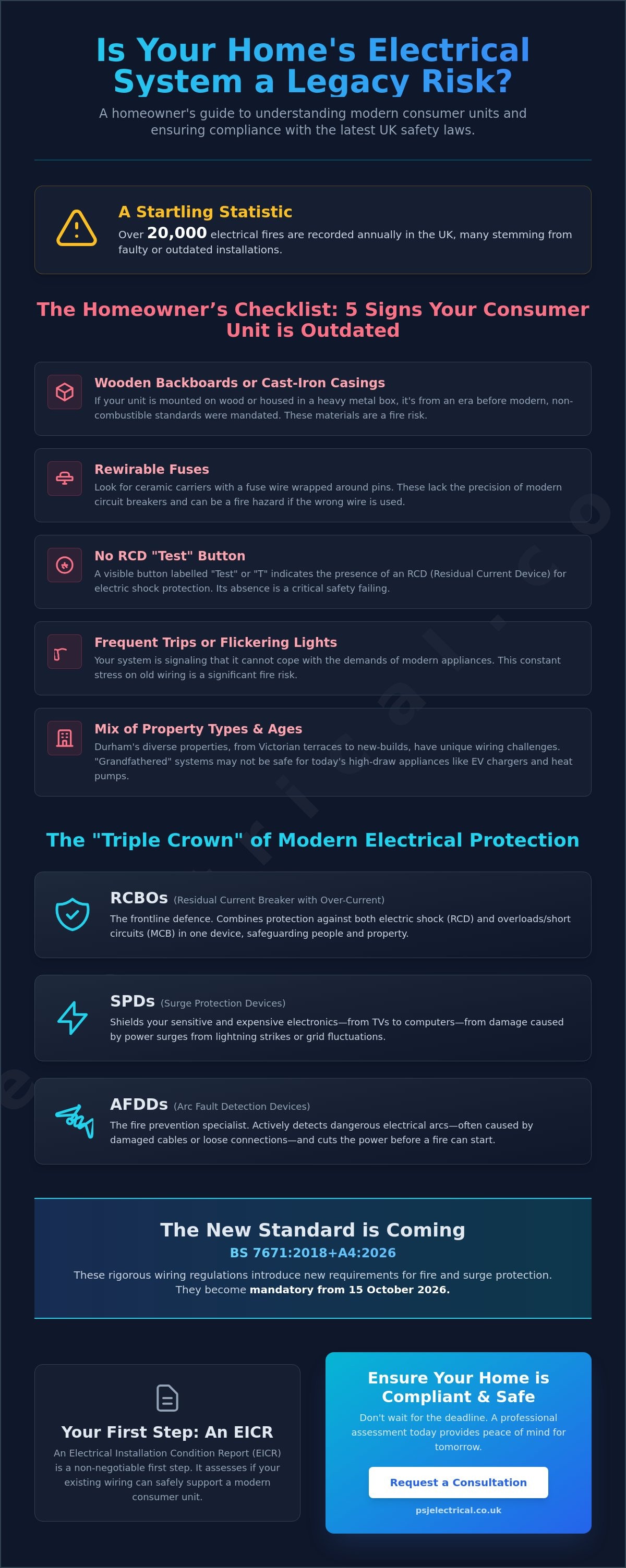
Is the electrical board tucked away in your utility cupboard still a reliable guardian, or has it become a legacy risk under the latest UK safety laws? It’s natural to feel a sense of anxiety regarding older wiring, particularly when you consider that the majority of the 20,000 electrical fires recorded annually in the UK stem from faulty products or outdated installations. If you’ve noticed frequent trips or flickering lights, you’re likely questioning if it’s time for a fuse box replacement Durham homeowners can rely on to meet the heavy demands of modern technology.
We believe in building trust through technical transparency, which is why we’ve simplified the mandatory BS 7671:2018+A4:2026 regulations that become mandatory from 15 October 2026. This guide provides a clear, expert perspective on essential safety features like Arc Fault Detection Devices (AFDDs) and 30mA RCD protection. You’ll gain a thorough understanding of whether your current consumer unit is legally compliant for 2026, giving you the peace of mind that comes from a safe and professionally maintained home.
Key Takeaways
- Identify the physical warning signs of an obsolete electrical board, such as wooden backboards or cast-iron casings, which indicate your home is overdue for an upgrade.
- Learn how the latest safety amendments impact your property and why a professional fuse box replacement Durham service is essential for maintaining legal compliance.
- Discover the “Triple Crown” of modern electrical protection—RCBOs, SPDs, and AFDDs—and how these components shield your home from fires and power surges.
- Understand why a comprehensive Electrical Installation Condition Report (EICR) is a non-negotiable first step to ensure your existing wiring can support a modern consumer unit.
- Gain insight into the professional installation process, from safe isolation to final certification, ensuring your household remains protected for years to come.
Understanding Fuse Box Replacement in Durham: Is Your Property Compliant?
Many homeowners in the North East still use the term “fuse box” to describe their electrical distribution board. Whilst the name is familiar, it refers to an era of rewirable wire and ceramic carriers that is increasingly incompatible with modern life. In professional circles, we now refer to this as a consumer unit. This is not just a change in terminology; it represents a fundamental shift in how we protect our homes. A modern consumer unit acts as the central nervous system of your property’s safety, managing complex electrical loads that simply didn’t exist thirty years ago.
Durham presents a unique challenge for electrical safety. Our region features a diverse mix of properties, from timber-framed historic buildings in the city centre to post-war terraces and rapid new-build developments in Consett. Each requires a tailored approach. A Victorian terrace in Gilesgate often retains original “quirks” like shared neutrals or a lack of proper earthing, which differ significantly from the requirements of a modern detached home. When considering a fuse box replacement Durham residents must account for these structural nuances to ensure full compliance with current UK electrical wiring standards.
At PSJ Electrical Engineers Ltd, we’ve spent over 19 years navigating these local complexities. Compliance isn’t a static target. The 18th Edition Wiring Regulations, specifically the BS 7671:2018+A4:2026 amendments, have introduced rigorous requirements for fire protection and surge management. Our experience ensures that every installation doesn’t just pass an inspection today but remains robust for the decade ahead.
The Evolution of Electrical Safety in County Durham
In the 1980s, a standard home might have powered a television, a fridge, and a few light bulbs. Today, the same wiring is often expected to handle air fryers, heat pumps, and EV chargers. These high-draw appliances place immense stress on old systems. Whilst 1980s rewirable fuses were designed to melt slowly under a sustained overload, 2026 circuit breakers react in milliseconds to prevent fire. A modern consumer unit is the central nervous system of home safety, proactively monitoring for faults before they become emergencies.
Why “Grandfathered” Systems May Still Be Dangerous
A common misconception amongst Durham homeowners is that if the lights are on, the system’s safe. However, “it still works” isn’t a valid safety metric in electrical engineering. Older systems lack the sensitivity to detect minor arc faults or power surges that can destroy sensitive electronics. Many older terraced properties in our area still feature wooden backboards or cast-iron casings. These materials are combustible and fail to meet the non-combustible enclosure requirements mandated by current regulations. Relying on “old but gold” equipment in a digital age is a risk that modern safety features are designed to eliminate.
The Ultimate Homeowner’s Checklist: 5 Signs Your Consumer Unit is Outdated
If you’re unsure about the state of your home’s electrical system, take a torch and head to your utility cupboard or under-stairs storage. A quick inspection often reveals whether a professional fuse box replacement Durham is a matter of urgency or simply a future consideration. Whilst these units often stay hidden for years, their physical condition tells a story of safety or neglect. Following government guidance on electrical safety is the best way to protect your family and your property investment.
When homeowners consider a fuse box replacement Durham, they often start by looking for these five critical indicators of an obsolete system:
- Wooden Backboards or Cast-Iron Casings: If your unit is mounted on wood or housed in a heavy metal box, it dates back to an era before modern fire-retardant standards.
- Rewirable Fuses: Look for ceramic carriers with wire wrapped around pins. These often contain asbestos flash guards and lack the precision of modern circuit breakers.
- Lack of an RCD “Test” Button: If there is no button labelled “test” or “T,” your board likely lacks Residual Current Device protection, which is essential for preventing fatal shocks.
- Flickering Lights: If your lights dim momentarily when the kettle or washing machine starts, your circuits are struggling to manage the load.
- Frequent Tripping: A board that “pops” regularly without a clear faulty appliance is usually a sign of internal degradation or an overloaded system.
Visual Red Flags You Can Spot Today
The “old-fashioned” look of 1970s boards is more than just an aesthetic issue. These units often feature mixed-brand components that have been added over decades; a practice that can lead to poor connections and overheating. A lack of clear labelling is another sign of poor maintenance history. If you cannot identify which switch controls which room, it suggests the system has not been professionally reviewed in years. This lack of clarity is dangerous during an emergency when you need to isolate power quickly.
Operational Issues That Signal Impending Failure
Do you smell ozone? If you notice a faint scent of burning plastic or a peculiar crackling sound emanating from your distribution board, these are immediate warning signs that require expert attention. Modern electronics, such as OLED televisions and high-end computers, are particularly sensitive to the “dirty power” or voltage fluctuations produced by old boards. To understand more about how these issues affect your property, you may find our Electrical System Health Check North East guide useful for debunking common safety myths. If your checklist has raised concerns, it may be time to speak with a local specialist to discuss a modern upgrade.
Beyond Simple Fuses: Modern Safety Features You Need in 2026
A modern distribution board is no longer just a collection of fuses; it’s evolved into a sophisticated safety computer designed to protect your home from 21st-century electrical stresses. When we discuss a fuse box replacement Durham homeowners often ask why modern units are more complex than the boards of the 1990s. The answer lies in the “Triple Crown” of modern protection: Residual Current Devices (RCD/RCBO), Surge Protection Devices (SPD), and Arc Fault Detection Devices (AFDD). These components work in unison to provide a level of security that was technically impossible just a few decades ago.
Adhering to the Best Practice Guide for Consumer Unit Replacement ensures that your installation meets the highest industry standards. At PSJ Electrical Engineers Ltd, we prioritise high-quality components because we understand that longevity and reliability are the foundations of home safety. By choosing premium internal parts, we ensure that your system remains robust against the increasing demands of smart home technology and renewable energy integrations.
Why Surge Protection (SPD) is Non-Negotiable Now
Durham’s local grid, whilst reliable, can still experience subtle voltage fluctuations and spikes caused by lightning strikes or industrial switching elsewhere on the network. In the past, these spikes might have blown a light bulb, but today, they can instantly destroy a £1,000 OLED TV, a high-end computer, or a smart fridge. An SPD acts as a lightning rod for your sensitive electronics, diverting excess voltage away from your devices. When you consider the cumulative cost of replacing all your smart gadgets, the inclusion of an SPD during a fuse box replacement Durham project becomes a very sensible investment in asset protection. For a full breakdown of what your upgrade investment covers, our guide on the cost of new consumer unit UK installations explains exactly what factors influence the final price.
AFDDs: The 2026 Standard for Fire Prevention
Standard circuit breakers are excellent at detecting short circuits, but they don’t always catch small, persistent “arcs” or sparks. These arcs are often caused by loose wiring connections, damaged cables, or even rodents chewing through insulation behind walls. Arc Fault Detection Devices (AFDDs) use microprocessors to analyse the electrical waveform and identify the specific signature of a dangerous arc. This technology is particularly vital in older Durham properties where timber frames or aged insulation can act as tinder for a fire. The peace of mind offered by automated arc detection means that your system is actively hunting for fire risks before they can ignite, providing a level of protection that traditional fuses simply cannot match.
The Professional Installation Process: What to Expect from a Durham Electrician
Understanding the logistical steps of a fuse box replacement Durham provides homeowners with the reassurance that their property is being handled with technical precision. A professional installation is not a simple swap of boxes; it is a methodical process of testing, upgrading, and certifying your home’s entire electrical distribution. We approach every project with a commitment to transparency, ensuring you understand exactly how your system is being brought up to the latest 2026 standards.
The installation follows a structured four-step path to ensure nothing is left to chance:
- Step 1: Initial Inspection and EICR. We begin by assessing the condition of your existing cables. This identifies any underlying faults that must be rectified before the new unit is commissioned.
- Step 2: Safe Isolation. Your power is safely disconnected, and the legacy equipment is removed. We ensure all circuits are clearly identified and prepared for the new consumer unit.
- Step 3: Installation and Testing. The modern unit is mounted, and every individual circuit is reconnected and rigorously tested. This verifies that the safety features discussed earlier will trip exactly when required.
- Step 4: Certification. Once the work is complete, we issue the necessary safety certificates and notify Local Authority Building Control on your behalf.
Why the EICR is the Starting Point
A new consumer unit is a sophisticated piece of safety technology. Fitting it to dangerous or degraded old wiring is a significant risk that can lead to constant tripping or even electrical failure. This is why the team at PSJ Electrical Engineers Ltd insists on a thorough Electrical Installation Condition Report (EICR) Guide as the foundation of our work. This report serves as a health map of your home, allowing us to identify and fix issues like poor earthing or damaged insulation before they become expensive problems. For Durham landlords, this document is also a legislative necessity for maintaining a legal tenancy.
Certification and the “Part P” Requirement
Attempting a DIY fuse box change is not only dangerous; it is illegal under UK Building Regulations. Because this work is notifiable, it must be carried out by a registered professional who can provide a Building Regulations Compliance Certificate. Without this documentation, your home insurance may be invalidated, and you’ll likely face significant delays or costs when trying to sell your Durham property. Professional certification adds tangible value to your home by proving to future buyers that the electrical system is safe, modern, and fully compliant. If you are ready to secure your home’s future, you can book your safety assessment today to get started.
Choosing PSJ Electrical for Your Durham Fuse Box Upgrade
Selecting a contractor for your fuse box replacement Durham is a decision rooted in trust and technical competence. At PSJ Electrical, we bring over 19 years of dedicated experience to every project across Durham, Consett, and Newcastle. We don’t believe in aggressive sales tactics or high-pressure pitches. Instead, we offer a quietly confident approach based on high-calibre workmanship and transparent communication. Our team specialises in complex upgrades, ensuring that whether you require a simple unit swap or a full domestic re-wire, the result is precise, durable, and safe.
Local Expertise for Durham Homeowners
Our deep roots in the community mean we understand the specific electrical challenges faced by residents in Durham City, Consett, and Stocksfield. We recognise that invite-only tradespeople must respect the homes they enter. This is why we maintain a strict commitment to tidiness, ensuring we “make good” any surfaces and leave your property as clean as we found it. For those living in specific residential enclaves, our Consumer Unit Upgrade Guide for Darras Hall provides tailored advice for larger, high-specification properties.
Future-Proofing Your Property
A modern consumer unit is the foundation of a sustainable home. By upgrading today, you create the capacity for future technologies that can lower your energy bills and carbon footprint. A compliant board is often the first requirement for a successful Solar Panel Installation. We ensure your new unit includes “spare ways,” which are empty slots that allow for the seamless addition of EV chargers or battery storage systems at a later date. This forward-thinking approach saves you from the expense of further structural electrical changes in the coming years whilst ensuring your property remains a leader in energy efficiency.
Safety is not a temporary fix; it is a long-term commitment to your family’s protection. By choosing a local expert who understands both traditional craftsmanship and 2026 safety standards for your fuse box replacement Durham, you gain the stability of a reliable installation that will serve your home for decades. We take pride in delivering peace of mind through engineering excellence, ensuring every Durham home we touch is a safer place to live.
Securing Your Durham Home for the 2026 Standards
Ensuring your property meets the latest safety standards is about more than just legal compliance; it’s about protecting your household from the rigorous demands of modern technology. We’ve explored how transitioning to a modern consumer unit provides active fire prevention through AFDD technology and shields your expensive electronics from unpredictable grid surges. A professional fuse box replacement Durham is the essential first step in preparing your property for future innovations like solar energy or electric vehicle charging.
As an NICEIC Approved Contractor with over 19 years of North East experience, PSJ Electrical specialises in full re-wires and high-specification safety upgrades. We take pride in delivering technical excellence and transparent advice without the high-pressure sales tactics found elsewhere. If you’re ready to gain full peace of mind regarding your home’s electrical health, our team is available to provide expert guidance and thorough assessments.
Request a Professional Fuse Box Assessment in Durham
Your property’s safety is a long-term investment, and we look forward to helping you ensure it remains a secure environment for years to come.
Frequently Asked Questions
How much does fuse box replacement cost in Durham?
The price of a new installation varies based on the size of your property and the complexity of the existing wiring. Factors such as the need for earthing upgrades or remedial repairs to old circuits will influence the final amount. Because every Durham home is unique, we provide a detailed quote following a professional site survey to ensure complete transparency and accuracy before any work begins. For a comprehensive overview of what influences pricing across the UK, our cost of new consumer unit UK price guide provides a detailed breakdown of the 2026 standards and what your investment covers.
How long does it take to replace a consumer unit?
A standard installation typically takes between four and eight hours to complete. This timeframe allows for the physical swap of the unit and the rigorous testing required for certification. If your property has a high number of circuits or if we encounter legacy wiring issues during the initial inspection, the process may extend into a full day to ensure everything is safe and compliant.
Will my power be off during the fuse box replacement?
Yes, your electricity will be switched off whilst the work is carried out. Safety is our priority, and we must isolate the supply to remove the old equipment and install the new unit. We recommend planning for a few hours without power; we can often provide a temporary supply for essential items like your fridge or Wi-Fi router to minimise the disruption to your day.
Is a fuse box replacement the same as a house rewire?
No, these are two different electrical services. A fuse box replacement Durham focuses solely on the central distribution board that manages your power. A full rewire is a much larger project that involves replacing every cable, socket, and light switch throughout the entire house. A new board is often part of a rewire, but it can be done as a standalone upgrade if your current wiring is healthy.
Do I need a new fuse box to install an EV charger in Durham?
Yes, installing an EV charger usually necessitates an upgrade to a modern consumer unit. 2026 regulations require specific safety devices like Type A RCDs and Surge Protection to handle the high, sustained load of a vehicle. Older boards rarely have the physical space or the technical capacity to support these additions safely, making a modern board essential for a reliable and compliant charging setup.
Can I replace my own fuse box if I am good at DIY?
No, you should never attempt to replace a distribution board yourself. This task is classified as “notifiable work” under Part P of the Building Regulations, meaning it must be certified by a registered professional. DIY attempts are illegal, dangerous, and will likely invalidate your home insurance policy whilst making it difficult to sell your property in the future. Professional installation ensures your home remains safe.
What is the difference between a fuse box and a consumer unit?
A consumer unit is the modern, high-tech version of an old-fashioned fuse box. Whilst many homeowners still use the term fuse box replacement Durham when searching for help, modern units use circuit breakers and safety devices like RCDs that react in milliseconds. These modern components provide significantly better protection against electric shocks and fires than the old rewirable fuses found in legacy systems across the North East.
Will a new fuse box stop my lights from flickering?
A new board can resolve flickering if the issue stems from loose connections or an overloaded system within the unit itself. However, flickering is sometimes caused by faults in the local grid or simple bulb failures. During the initial inspection, we identify the root cause to ensure a new installation is the correct solution for your home rather than just a temporary fix.