
Most homeowners believe that choosing the right panels is the hardest part of going green, but the real secret to a high-performing system lies in the electrical infrastructure beneath your tiles. You’re likely researching solar panel installation Durham because you want to take back control of your energy bills, yet it’s natural to feel some hesitation regarding the North East weather or the standard of workmanship you might receive. We understand that this is a significant investment in your property’s future and that you need more than just a sales pitch; you need technical certainty.
This comprehensive, engineer-led checklist provides a professional roadmap to ensure your home is perfectly prepared for a seamless transition to renewable energy. We’ll guide you through the essential steps to verify your property’s suitability, from assessing roof orientation to understanding how the 0% VAT incentive and current Smart Export Guarantee rates affect your long-term return on investment. By following this structured approach, you’ll gain the clarity needed to secure lower energy bills and the peace of mind that comes from a safe, high-standard installation.
Key Takeaways
- Assess your roof’s orientation and structural integrity to ensure it can support the weight of a PV system whilst maximising energy capture.
- Choose high-performance Tier 1 panels and the correct inverter type for a successful solar panel installation Durham, specifically tailored to the local climate.
- Understand the technical stages of the installation day, from secure scaffolding to ensuring weather-tight seals on your roof rails.
- Protect your investment with regular visual inspections for debris and local pests, ensuring your generation levels remain consistent over time.
- Learn how the holistic engineering approach of PSJ Electrical Engineers Ltd integrates solar technology with your home’s existing electrical infrastructure and fuse box capacity.
Pre-Installation Checklist: Is Your Durham Property Solar-Ready?
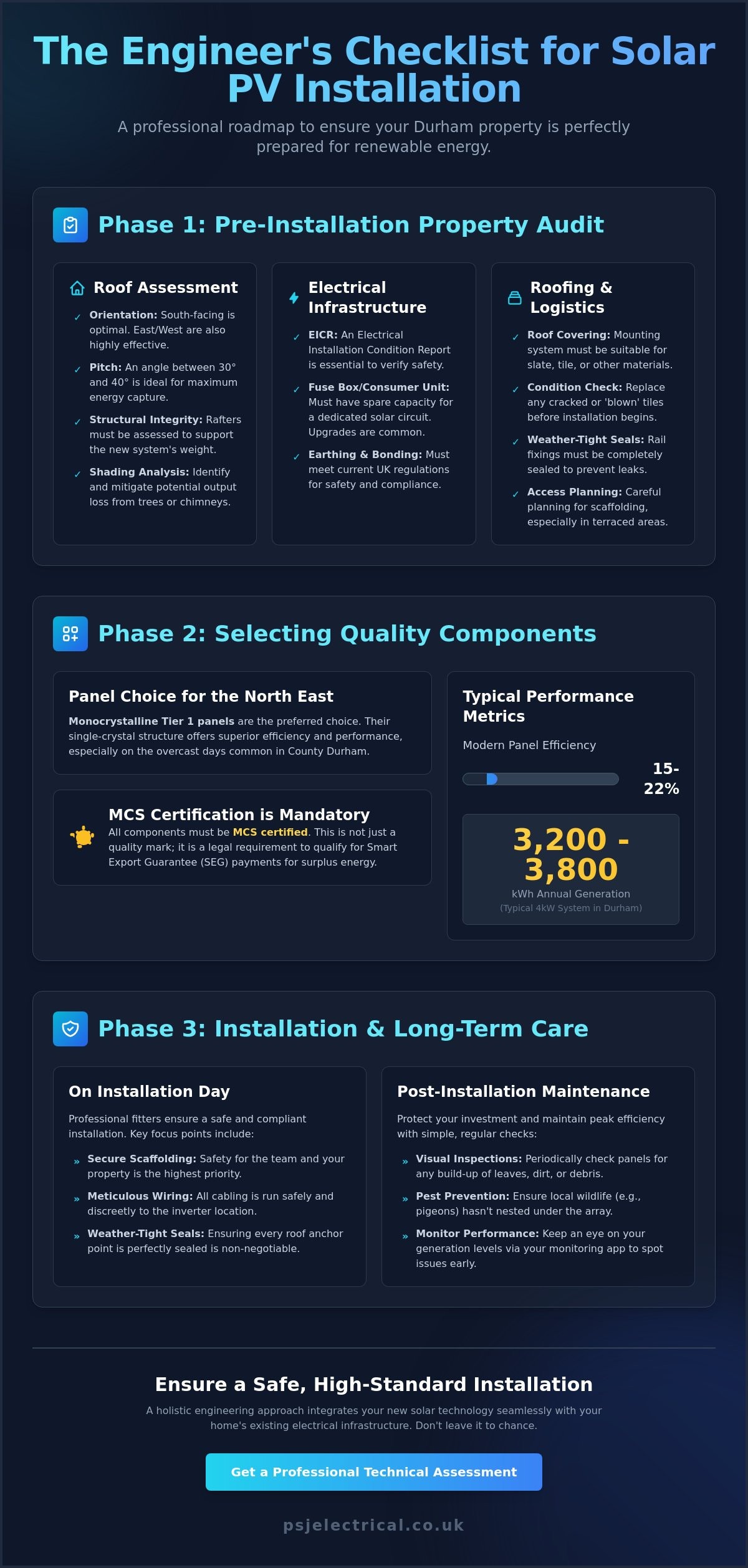
Before committing to a solar panel installation Durham homeowners must first look inward at their property’s existing health. It’s easy to get caught up in the technology of photovoltaic (PV) cells, but the efficiency of your system starts with a solid foundation. We begin every project by assessing the roof’s orientation and pitch. Whilst a south-facing roof remains the gold standard for maximum generation, many Durham homes with east or west-facing roofs still achieve excellent results by capturing energy during the morning or evening peaks. A pitch of between 30 and 40 degrees is ideal, though our engineering approach allows for adjustments to suit the unique architecture of the North East.
Beyond orientation, we must verify the structural integrity of your roof timbers. A standard solar array adds a significant “dead load” to your property; your rafters must be capable of supporting this weight for decades. We also conduct a thorough shading analysis. In historic Durham, shadows from large trees, local landmarks, or even neighbouring chimneys can significantly dampen output. Identifying these obstacles early allows us to design a layout that bypasses shading or utilizes micro-inverters to mitigate the impact on the rest of the array.
The Electrical Infrastructure Audit
Your existing wiring is the heartbeat of your renewable energy system. A comprehensive EICR is an essential first step to ensure your home can safely handle the increased load. We often find that older properties in the city require a fuse box replacement or an upgrade to the earthing and bonding systems to meet current UK wiring regulations. If your current consumer unit lacks the spare capacity for a dedicated solar circuit, it will need modernising to ensure your solar panel installation Durham is both safe and compliant with 2026 standards.
Roofing and Structural Readiness
The type of roof covering determines the specific mounting system we use. Whether your home features traditional slate common in Durham heritage properties or modern interlocking tiles, the rail system must be weather-tight. We carefully inspect for “blown” or cracked tiles that might fail under the pressure of installation; these must be replaced before the rails are fixed. Logistics also play a part; many terraced areas in the city centre have narrow access, requiring careful planning for scaffolding to ensure safety without obstructing the street or your neighbours’ driveway.
The Components Checklist: Selecting Quality for the North East Climate
Selecting hardware for the North East requires a pragmatic understanding of our local weather patterns. We don’t design systems for the Mediterranean; we design them for Durham, where low-light performance and structural resilience are paramount. For a successful solar panel installation Durham, every component must carry the Microgeneration Certification Scheme (MCS) mark. This certification isn’t just a badge of quality; it is a mandatory requirement if you intend to access Smart Export Guarantee (SEG) payments for the surplus energy you send back to the grid. Understanding the solar panel installation process helps you appreciate why we prioritise Tier 1 components that offer long-term stability rather than short-term savings.
A standard 4kW system in Durham can generate between 3,200 and 3,800 kWh of electricity per year. However, reaching these figures depends heavily on the efficiency of your hardware. Modern residential panels typically offer an efficiency of 15-22%, but their ability to perform on overcast days is what truly defines their value in County Durham. If you are unsure which hardware configuration suits your roof, our team can provide a technical assessment of your home’s specific requirements.
Panel Efficiency and Durability
Monocrystalline panels have become the preferred choice for Durham homeowners in 2026 due to their superior space efficiency and sleek appearance. These panels are constructed from a single crystal structure, which allows electrons more room to flow, resulting in better performance during the cloudy spells common in Northern England. We also look for panels with high salt mist resistance. Whilst Durham is inland, the prevailing winds can carry corrosive elements from the coast that affect the longevity of the frame and glass. High-quality panels should maintain a low power degradation rate, typically ensuring they still produce at least 80-85% of their original output after a 25-year lifespan.
Inverters and Battery Storage Solutions
The inverter is the “brain” of your system, converting the Direct Current (DC) from your panels into the Alternating Current (AC) used by your appliances. For roofs with complex shading issues, which we identified in the previous section, micro-inverters or optimisers are often the best solution. These allow each panel to operate independently, so a shadow on one chimney doesn’t drop the output of the entire array. Integrating battery storage allows you to maximise self-consumption by storing power for evening use. This setup is particularly effective when paired with EV charging points, creating a closed-loop energy ecosystem where your car runs on the sun. Most modern systems now include smart monitoring software, giving you real-time data on your generation and storage levels via a mobile app. Business owners in the region looking to apply similar engineering principles at scale can explore how commercial solar panel installers Newcastle approach large-scale system design and grid integration.
Installation Day Checklist: What to Expect from Professional Fitters
On the morning of your solar panel installation Durham, the process begins with the arrival of the scaffolding team. For many homes in the city, especially those in terraced areas or with shared driveways, we establish clear safety boundaries to protect your property and vehicles. This physical setup is the first of several technical stages that turn your roof into a power plant. Once the scaffold is signed off, the fitting team begins the installation of the mounting system. They fix stainless steel or aluminium brackets directly to your roof rafters, ensuring every penetration is weather-sealed to prevent future leaks.
Inside the property, the electrical team focuses on the DC wiring path. They run cables from the roof array down to the inverter location, which is usually situated in a loft space, garage, or utility room. This hardware is the critical link in understanding how solar energy is converted to electricity for your home. Finally, the system is connected to your consumer unit, and we manage the necessary G98 or G99 notifications to the Distribution Network Operator (DNO). In our region, this is Northern Powergrid, and this registration is essential for you to legally export surplus power back to the grid.
Health and Safety Protocols
Our teams arrive with full trade accreditations and up-to-date insurance, which you are welcome to verify upon their arrival. Working at height is a high-risk activity, so we strictly adhere to safety harness protocols and edge protection standards. During the final connection to your fuse box, there will be a brief period where we must isolate your power. We coordinate this “shut down” with you in advance, typically lasting between 30 and 60 minutes, to minimise disruption to your daily routine.
Commissioning and Handover
Once the physical work is complete, we move into the commissioning phase. We test the string voltages and ensure the system is generating at its predicted kilowatt-peak (kWp) capacity. You won’t be left with a complex system you don’t understand; we provide a full walkthrough of the generation meter and any mobile monitoring apps. Your handover pack includes your MCS certificate, which is vital for your Smart Export Guarantee (SEG) application, along with all component warranties and user manuals for your records.
Post-Installation Maintenance Checklist for Maximum Efficiency
Ownership of a renewable energy system begins the moment your fitters leave the site. Whilst the hardware is designed for longevity, maintaining the high performance of your solar panel installation Durham requires a proactive approach to stewardship. We recommend a visual inspection of your array at least once a year to check for debris or biological growth. Monitoring your generation stats via your mobile app is equally vital; this allows you to establish a “baseline” of performance, making it easy to identify any sudden drops that might suggest a technical fault or significant shading.
Durham winters bring their own set of challenges, particularly regarding heavy snow build-up. Whilst panels are designed to shed snow as they warm up, a thick layer can completely halt generation. We advise homeowners to allow the snow to slide off naturally where possible, as manual clearing can often lead to accidental scratches on the glass surface. To ensure the system remains safe and efficient for its entire 25-year lifespan, you should schedule a professional electrical health check every three to five years to verify all connections and safety components.
Cleaning and Debris Management
The UK’s frequent rainfall usually performs a “natural rinse” of your panels, but this is rarely enough to remove stubborn bird droppings or lichen. Pigeons are a common issue amongst Durham homeowners, often seeking the warmth beneath the panels for nesting. We strongly recommend the installation of “pigeon skirts” or mesh guarding during the initial fit; without these, nesting material can trap moisture and debris against your roof tiles, leading to long-term damage. When cleaning is required, use only plain water and a soft cloth; you must avoid abrasive chemicals or pressure washers, as these can strip the delicate self-cleaning coating from the glass.
Long-term Electrical Maintenance
The electrical side of your system requires just as much attention as the panels themselves. Over time, DC isolators and external cabling can suffer from UV degradation or moisture ingress, even with high-quality components. It is essential that your fuse box remains in peak condition to handle the constant throughput of solar energy; any signs of overheating or loose connections should be addressed immediately by a professional. Finally, keep your system’s firmware updated; manufacturers often release software patches for smart inverters and battery storage units that improve efficiency and security. Schedule a professional inspection by reaching out to our technical team today.
Why PSJ Electrical Engineers Ltd is Durham’s Trusted Choice for Solar PV
With over 19 years of electrical engineering experience across the North East, PSJ Electrical Engineers Ltd provides a level of technical depth that goes beyond simple panel fitting. We believe that a successful solar panel installation Durham homeowners can rely on must be treated as a major electrical upgrade rather than a bolt-on accessory. Our team takes a holistic approach to every project, ensuring that your property’s entire infrastructure is fit for purpose before the first bracket is fixed to your roof. This methodical process ensures your system is not only efficient but also inherently safe for decades to come.
We understand the hesitation many feel regarding the standards of workmanship in the renewable sector. By choosing a local firm with a long-standing reputation, you avoid the risks associated with “solar cowboys” who prioritise speed over safety. Our qualified professionals handle every aspect of the process, from bespoke system design to the final commissioning. We pride ourselves on transparency, providing clear explanations of the technical requirements without the aggressive sales tactics often found elsewhere in the industry.
Engineering Excellence vs. Simple Fitting
Our extensive background in full property re-wires gives us a unique advantage. We don’t just understand the panels; we understand the cables, the consumer units, and the complex earthing requirements that underpin a safe installation. We never outsource our electrical work to third-party contractors, meaning every wire is pulled and every connection is made by a member of our own trusted team. This commitment to in-house expertise ensures we maintain the high standards of durability and precision that our clients expect from a professional engineering firm.
Local Knowledge, Local Support
From our permanent base in the North East, PSJ Electrical Engineers Ltd serves Durham, Consett, and the surrounding areas with genuine local insight. This proximity is particularly valuable when navigating the specific planning considerations required for Durham’s many conservation areas and heritage buildings. Homeowners in nearby areas can also benefit from our dedicated solar panel installation Consett planning guide, which covers the specific structural and regulatory requirements for properties across that part of County Durham. We provide ongoing support long after the installation is complete, giving you the peace of mind that a specialist is always nearby should you need assistance with your system or future battery upgrades. If you are ready to secure your energy future with a system built to last, you can request a professional solar survey from PSJ Electrical Engineers Ltd today.
Secure Your Energy Independence with Technical Certainty
Transitioning to renewable energy represents a significant commitment to your property’s future efficiency and market value. By following this comprehensive checklist, you have moved from initial roof assessments and component selection to understanding the vital logistics of installation and long-term maintenance. This structured approach ensures that your home is not just solar-ready but optimised for the specific environmental conditions of the North East, providing clarity on everything from structural loads to the necessity of bird proofing.
When you are ready to move from planning to execution, PSJ Electrical Engineers Ltd offers the technical certainty required for a safe and high-performing solar panel installation Durham. With over 19 years of electrical engineering experience and full MCS accreditation, our team ensures that every connection is precise and every system is built for longevity. We invite you to Book Your Expert Solar Survey in Durham to receive a bespoke assessment tailored to your home’s unique electrical needs. Start your journey toward energy independence with a local partner dedicated to craftsmanship and technical excellence.
Frequently Asked Questions
Do I need planning permission for solar panels in Durham?
Most residential installations fall under “permitted development” and do not require formal planning permission. However, you must consult the local planning authority if your property is a listed building or situated within one of Durham’s conservation areas. Restrictions also apply if the panels protrude more than 200mm from the roof slope or if the installation exceeds the highest point of the roofline.
How much can I actually save on my energy bills with solar in the North East?
Savings depend on your specific energy usage, but a typical 4kW system in Durham generates between 3,200 and 3,800 kWh of electricity per year. By consuming the power you generate and exporting the surplus through the Smart Export Guarantee, you can significantly lower your annual costs. Homeowners who maximise their self-consumption during daylight hours often see the most substantial reduction in their monthly bills.
Is my roof strong enough for solar panels?
Most modern and traditional Durham roofs are structurally capable of supporting a solar array, but a professional survey is essential to verify this. We conduct a technical assessment of your roof timbers to ensure they can safely handle the “dead load” of the photovoltaic panels and mounting rails. If any structural weaknesses are identified in the rafters, we provide clear guidance on the reinforcements required before the work begins.
What happens to my solar panels when it is cloudy or snowing in Durham?
Solar panels continue to generate electricity on cloudy days by utilising diffused daylight, though their output is naturally lower than in direct sunlight. During the winter months, heavy snow can temporarily block generation if it covers the entire array. Most snow slides off the glass surface as the panels warm up, and our selection of high-performance cells ensures reliable generation even in the variable light conditions of the North East.
Do I need a battery with my solar panel installation?
A battery is not a mandatory requirement, but it is a highly effective way to increase your energy independence. Without storage, any electricity you do not use during the day is sent back to the grid. Integrating a battery into your solar panel installation Durham allows you to store that surplus power for use in the evening, which is particularly advantageous for households with high nighttime energy demands.
How long does the actual installation take?
A standard residential solar installation is typically completed within one to two working days. If your project includes additional components such as battery storage or an EV charger, the timeline may extend to three days. This duration covers the full process from scaffolding erection and roof mounting to the final electrical connections and the commissioning of your monitoring software.
Will solar panels increase the value of my Durham home?
Installing solar panels can increase a property’s value by an average of 4-6% based on current market trends. Prospective buyers in the North East are increasingly attracted to homes with high EPC ratings and lower long-term running costs. A professionally installed system is viewed as a premium upgrade to the property’s infrastructure, providing a competitive edge in the local housing market.
What is the MCS certificate and why is it important?
The Microgeneration Certification Scheme (MCS) certificate is an essential document that proves your system meets strict quality and safety standards. It is a mandatory requirement for anyone wishing to apply for Smart Export Guarantee (SEG) payments from their energy supplier. This certificate provides peace of mind that your installation has been carried out by accredited professionals using hardware that is tested for durability and performance.