
With potential fines for non-compliance rising to £40,000 as of May 2026, treating landlord electrical safety certificates Newcastle as a mere tick-box exercise is a risk no property owner should take. You likely understand the vital importance of keeping your tenants safe, yet the pressure of the current five-year renewal surge and the strict enforcement of selective licensing can feel quite daunting. It’s natural to feel concerned about the technical shorthand used in safety reports or the possibility of being quoted for unnecessary remedial work after receiving a confusing C1 or C2 classification.
This article provides the professional clarity you need to ensure your properties remain fully compliant whilst keeping your investment protected. We will break down the latest legal requirements under the 18th Edition wiring regulations, explain exactly what those report codes mean for your maintenance schedule, and outline how to secure reliable certification from qualified engineers who value transparency and precision over hidden costs. By the end of this guide, you’ll have a clear roadmap for managing your electrical obligations with total confidence.
Key Takeaways
- Understand the mandatory legal requirements for 2026 and how to protect your property portfolio from significantly increased penalties for non-compliance.
- Prepare effectively for the inspection process by learning how to coordinate with tenants and what engineers look for during a thorough visual assessment.
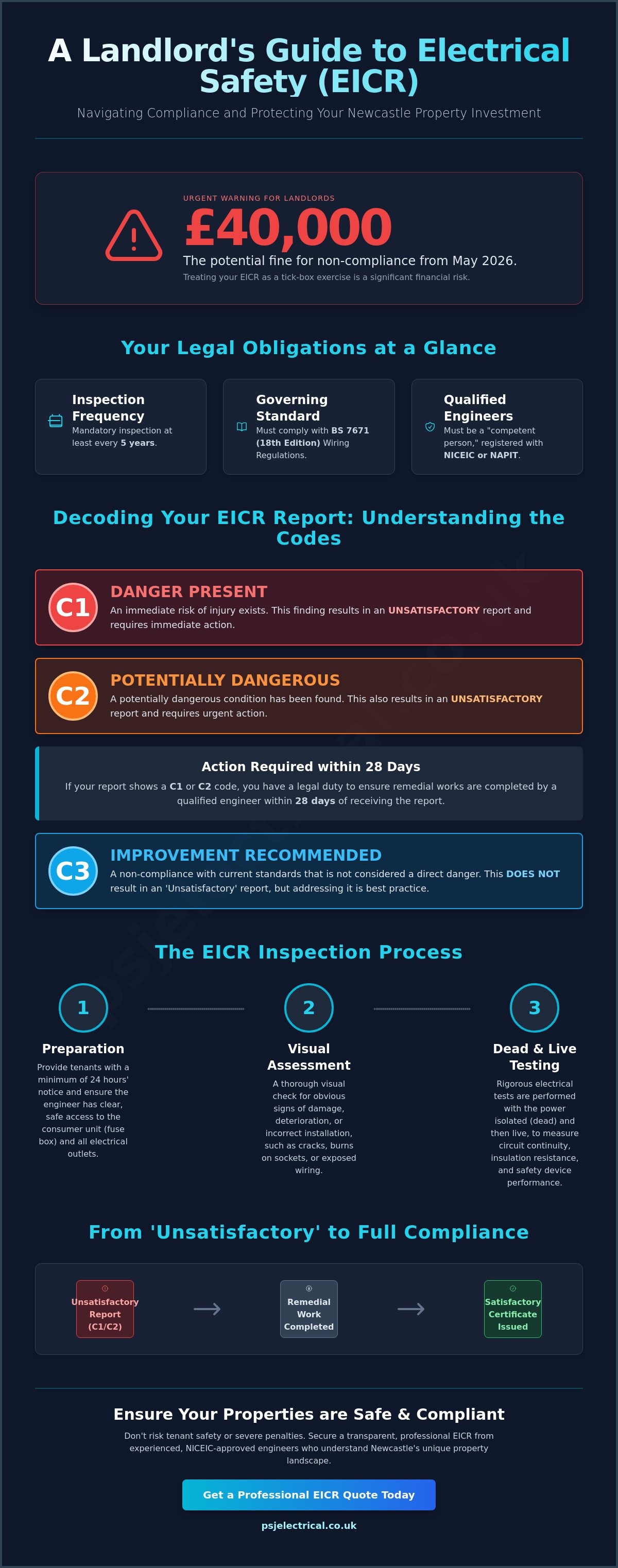
- Learn to interpret the technical C1, C2, and C3 codes on landlord electrical safety certificates Newcastle to identify which faults require immediate action within 28 days.
- Gain insights into the specific electrical nuances of local property types, ranging from traditional Tyneside flats in Jesmond to modern luxury homes in Darras Hall.
- Discover how to navigate the transition from an ‘Unsatisfactory’ report to full legal compliance through clear, transparent remedial works without hidden charges.
What is a Landlord Electrical Safety Certificate (EICR)?
An Electrical Installation Condition Report (EICR) is a formal document produced following a comprehensive assessment of the electrical systems within a property. Whilst many property owners refer to these documents simply as landlord electrical safety certificates Newcastle, the technical reality is a rigorous, step-by-step examination of the fixed wiring, sockets, and consumer units. The primary goal of this inspection is to identify any deficiencies against the UK standard for the safety of electrical installations, known as BS 7671. As of 2026, these reports are no longer a suggestion for diligent owners; they’re a fundamental legal requirement that ensures every tenant in the North East lives in a home free from avoidable electrical hazards.
The transition from a recommended practice to a mandatory one was driven by safety advocates such as Electrical Safety First, who campaigned to standardise protections across the private rented sector. Today, the EICR serves as your primary evidence that you’ve met your duty of care as a landlord. It provides a clear, technical snapshot of the installation’s condition, highlighting issues like overloaded circuits or lack of earthing that aren’t visible to the naked eye. By adhering to the 18th Edition of the IET Wiring Regulations, these inspections provide a consistent benchmark for safety across all types of domestic dwellings.
The Legal Requirements for Newcastle Landlords
Under the Electrical Safety Standards in the Private Rented Sector (England) Regulations 2020, landlords must ensure that every fixed electrical installation is inspected and tested at least every five years. This 5-year rule is a maximum limit; certain older properties or those with high tenant turnover might require more frequent checks to maintain safety. Newcastle City Council actively monitors compliance, particularly within selective licensing areas. Failing to provide a valid report can lead to severe financial penalties. While the standard fine has historically been capped at £30,000, current data from May 2026 indicates that local authorities can now impose fines of up to £40,000 for the most serious or repeated breaches.
Who is Authorised to Carry Out EICR Testing?
Not every electrician possesses the specific qualifications or equipment required to produce a valid EICR. The regulations state that the inspector must be a competent person, which in practice means they should be registered with a government-approved body such as the NICEIC or NAPIT. These organisations ensure that the engineer stays updated on the latest technical standards. When managing older Newcastle properties, such as Victorian terraces or converted Tyneside flats, an engineer’s experience is just as vital as their accreditation. Professionals with over 19 years of local experience understand the specific quirks of regional housing stock, allowing them to provide more accurate assessments. Always ask to see a current ID card and proof of professional credentials before any work begins on your rental property.
The EICR Inspection Process: What Happens During Testing?
The process of securing landlord electrical safety certificates Newcastle begins long before an engineer arrives at the property. Effective coordination is essential; landlords must provide tenants with at least 24 hours’ notice, ensuring the engineer has clear access to the consumer unit and all electrical points. This preparation ensures the inspection remains efficient and thorough. According to the official government guidance for landlords, these inspections are vital for identifying risks that aren’t immediately apparent during a standard tenancy changeover. Safety is the priority here.
Once on-site, the inspection follows a methodical three-stage approach. It starts with a comprehensive visual assessment to spot obvious signs of thermal damage or deterioration. Next, the engineer performs ‘dead testing’ whilst the power is safely isolated, measuring insulation resistance and circuit continuity. Finally, ‘live testing’ verifies that the system reacts correctly under fault conditions. Modern homes in the North East often feature integrated technology such as EV chargers or solar PV systems. A professional EICR must now account for these high-load additions to ensure the existing infrastructure isn’t being overstressed.
Visual Checks and Common Hazards
During the visual phase, engineers look for equipment that no longer meets current safety standards. This often includes outdated ‘rewireable’ fuses or consumer units with wooden backings, which pose a significantly higher fire risk than modern metal-clad units. We also examine sockets and switches for cracks or signs of overheating, particularly in high-use areas like communal hallways or kitchens. In bathrooms, the proximity of electrical points to water sources is strictly assessed to ensure compliance with specific zone requirements.
Technical Testing: Ensuring the System Reacts Safely
This phase moves beyond what the eye can see to verify the underlying science of the installation. RCD (Residual Current Device) testing is perhaps the most critical element, as these devices are designed to disconnect the power in milliseconds if a fault is detected. This prevents fatal electric shocks. We also check the integrity of the earthing and bonding, ensuring that any stray current has a safe path to the ground. If you’re unsure when your last full inspection took place, you can speak with our technical team to clarify your current obligations.
The final step involves compiling a digital report that details every finding. This document provides a transparent record for your files and serves as proof of compliance should Newcastle City Council or your insurance provider request it. It’s a comprehensive health check for your property’s wiring.
Understanding Your Report: C1, C2, and C3 Codes Explained
The results of your inspection are summarised in a final classification of either ‘Satisfactory’ or ‘Unsatisfactory’. Receiving the latter can be stressful, but it simply means that specific issues must be addressed to bring the property up to current standards. When you receive your landlord electrical safety certificates Newcastle, the presence of even a single C1 or C2 code will result in an immediate unsatisfactory outcome. This classification serves as a formal notice that the installation does not meet the safety requirements of the 18th Edition wiring regulations.
Newcastle landlords must adhere to a strict 28-day window to complete any necessary remedial work once a fault is identified. This timeline is legally binding and begins from the date of the inspection. Communicating these findings to your tenants requires a balanced approach. It’s best to explain that the inspection is a proactive part of your commitment to their safety. If an ‘Unsatisfactory’ result occurs, reassure them that a professional plan is already in place to resolve the issues within the legal timeframe, ensuring their home remains a safe environment.
The ‘Big Three’ Fault Codes
Understanding the grading system is essential for prioritising repairs and managing your maintenance budget effectively. The codes are defined as follows:
- Code C1 (Danger Present): This is the most severe result, indicating an immediate risk to life. An engineer will often isolate the affected circuit or equipment immediately to prevent injury or fire.
- Code C2 (Potentially Dangerous): This indicates a fault that is not an immediate threat but could become dangerous if a further fault were to occur. This requires urgent remedial action within 28 days to achieve compliance.
- Code C3 (Improvement Recommended): This code identifies areas where the installation could be modernised to meet current best practices. Crucially, a C3 does not result in an ‘Unsatisfactory’ report and does not legally require immediate work.
The ‘FI’ (Further Investigation) Result
An ‘FI’ result occurs when an engineer identifies an issue that cannot be fully assessed during the initial inspection. This is common in complex North East HMOs where certain circuits might be inaccessible or hidden behind structural elements. An FI result is technically an ‘Unsatisfactory’ outcome because the safety of the circuit cannot be verified. Resolving this typically requires a more targeted investigation to confirm the system’s integrity. Once the investigation is complete and any necessary repairs are made, a ‘Satisfactory’ certificate can then be issued, confirming the property is fully compliant with local safety standards.
Newcastle Property Context: Safety Challenges in Local Housing
Newcastle’s rental market is defined by its architectural diversity, yet this variety presents distinct challenges for electrical safety. In areas like Jesmond and Gosforth, Victorian terraces often retain original features that, whilst aesthetically pleasing, can hide antiquated wiring systems. Issuing landlord electrical safety certificates Newcastle for these period properties requires a deep understanding of how historical installations have been modified over the decades. It’s common to find ‘DIY’ additions amongst the older stock where previous owners have extended circuits without proper bonding or earthing, creating hidden risks for current tenants that only a seasoned engineer would identify.
In contrast, the high-consumption luxury homes found in Darras Hall and Ponteland face different technical pressures. These properties often feature advanced lighting systems, multiple kitchen appliances, and increasingly, high-load additions like EV chargers. During an EICR, we must verify that the existing consumer unit and main supply can handle these cumulative loads without the risk of overheating. A thorough assessment ensures that the infrastructure supporting these modern comforts remains robust and reliable for the long term, providing peace of mind for both landlord and tenant.
Tyneside Flats and Shared Services
Tyneside flats present a unique regional puzzle due to their shared structural nature. It isn’t unusual for electrical services, particularly earthing arrangements, to be interlinked between the upper and lower dwellings. This complexity often requires careful coordination to ensure that a fault in one property doesn’t compromise the safety of the other. Newcastle City Council maintains a rigorous stance on HMO licensing, where clear evidence of separate, safe electrical supplies is a prerequisite for approval. Identifying these interlinked supplies is a critical part of our inspection process in these traditional North East homes.
Modernising Newcastle’s Rental Portfolios
As landlords look to future-proof their investments, the integration of green technology has become more prevalent. Adding Solar PV installations or EV chargers adds a new layer of complexity to the EICR testing procedure, as these systems must be correctly isolated and tested to ensure they don’t interfere with the property’s standard safety devices. We specialise in assessing how these modern additions interact with existing wiring, ensuring that your transition to a more sustainable rental offering doesn’t compromise safety standards. If you own a period property in Newcastle, booking a specialist safety check today is the most effective way to navigate these local challenges and ensure full legal compliance.
Remedial Works and Achieving Compliance with PSJ Electrical
Receiving an ‘Unsatisfactory’ outcome on an inspection can be a source of stress for any property owner. However, this result is simply a professional roadmap toward a safer building. With a 19-year track record in the North East, we specialise in resolving the complex issues that often arise during the process of securing landlord electrical safety certificates Newcastle. Our approach is built on transparency; we provide clear, fixed-price quotes for all necessary remedial works. You won’t encounter hidden ‘add-ons’ or unexpected fees after the testing is complete, as we believe in building long-term trust through honest, upfront communication.
In some instances, a targeted repair may not be sufficient to meet modern safety standards. If an installation is fundamentally degraded or contains hazardous materials like lead-sheathed cabling, a full house rewiring North East might be the only viable and safe option for long-term property modernisation. We always provide a detailed technical justification if such a significant step is required. Once all C1 and C2 faults are cleared, we issue the final ‘Satisfactory’ certificate. This document is your proof of compliance, confirming that your rental property meets the rigorous standards required by the 18th Edition wiring regulations.
Efficient Consumer Unit Upgrades
Many ‘Unsatisfactory’ reports in Newcastle stem from outdated or dangerous fuse boards. Replacing these with modern, metal-clad consumer units is often the most efficient way to achieve compliance. We integrate Surge Protection Devices (SPDs) into these new units to safeguard your tenants’ expensive electronic equipment from power spikes. Every installation we perform is meticulously logged and certified with the relevant local building control, ensuring your records are always up to date and legally robust.
The PSJ Difference: Engineering Excellence
Our extensive background in full property re-wires provides us with a unique perspective as EICR inspectors. We understand the intricacies of how electrical systems age, allowing us to identify potential failures before they become dangerous. We also recognise that our workplace is your tenant’s home. Our engineers are committed to maintaining a clean environment and ensuring minimal disruption whilst work is carried out. This professional, service-oriented attitude is why so many landlords trust us with their landlord electrical safety certificates Newcastle. Secure your property and your peace of mind today; contact PSJ Electrical for your Newcastle EICR.
Securing Your Property Portfolio for the Future
Managing the electrical safety of a rental property is an ongoing commitment that extends far beyond a five-year inspection cycle. By understanding the nuances of fault codes and the specific requirements of North East housing, you can ensure your maintenance strategy is both legally robust and cost-effective. Maintaining valid landlord electrical safety certificates Newcastle is a vital step in protecting your investment from heavy penalties whilst providing a safe, reliable home for your tenants.
As an NICEIC Approved Contractor with over 19 years of industry experience, we bring a level of precision to every assessment that only specialists in full property re-wires can offer. We are here to help you navigate technical reports with transparency and professional integrity, ensuring every remedial step is clearly explained. Book Your Professional EICR Inspection in Newcastle today to ensure your properties meet the highest safety standards. We look forward to helping you achieve total peace of mind with your rental properties.
Frequently Asked Questions
How much does a landlord electrical safety certificate cost in Newcastle?
Costs for landlord electrical safety certificates Newcastle typically depend on the property’s size and the total number of circuits requiring assessment. A studio flat will naturally involve less testing time than a large Victorian terrace with multiple floors. It is vital to secure a transparent quote that includes a comprehensive breakdown of the inspection process to ensure your legal obligations are met without unexpected administrative charges.
Do I need an EICR if I am only renting out a single room in my house?
Yes, resident landlords renting out a single room still have a legal duty of care to ensure the electrical system is safe for their lodgers. Under the current regulations, private landlords must provide a valid certificate for any tenancy. Ensuring your home meets these standards protects both your lodger and your property from potential electrical hazards, maintaining the same rigorous safety benchmarks as a full-house rental.
What happens if my tenant refuses access for the electrical safety check?
Landlords must demonstrate they have taken all reasonable steps to comply with the safety regulations. If a tenant refuses access, you should document every attempt to arrange the inspection, including emails, letters, and phone logs. Most local authorities, including Newcastle City Council, recognise that you cannot force entry, but having a clear paper trail of your efforts is essential to avoid being held liable for non-compliance.
Is a PAT test the same as an EICR for Newcastle landlords?
No, a PAT (Portable Appliance Testing) check is entirely separate from an EICR. Whilst an EICR assesses the fixed wiring, sockets, and consumer unit of the building, PAT testing focuses on moveable items like kettles or fridges provided by the landlord. Both contribute to a comprehensive safety strategy, but only an EICR satisfies the specific legal requirements for landlord electrical safety certificates Newcastle.
Can I carry out the remedial works myself if my property fails the EICR?
It is strongly discouraged and often legally insufficient to carry out remedial works yourself unless you are a qualified, registered electrician. To achieve a ‘Satisfactory’ outcome, the repairs must be certified by a competent person who can issue the necessary Minor Works or Electrical Installation Certificates. Using a registered professional ensures that all work is logged correctly with building control and meets the current BS 7671 standards.
How long does a typical EICR inspection take for a 3-bedroom house in Durham?
A thorough inspection for a standard 3-bedroom property in Durham usually takes between three to four hours to complete. The exact duration depends on the complexity of the circuits and the accessibility of the consumer unit and various outlets. An engineer who finishes in significantly less time may not be performing the essential dead and live testing required to identify hidden faults within the walls or ceiling voids. If you manage properties across the region, our dedicated guide to EICR testing Durham provides further detail on local compliance requirements for 2026.
Do new build properties in Newcastle still need an EICR every 5 years?
New build properties generally don’t require a separate EICR for the first five years of their life. Instead, the Electrical Installation Certificate (EIC) issued upon the completion of the build serves as proof of safety for that initial period. Once that five-year window has passed, you must then arrange for a standard EICR to be carried out to maintain your legal compliance and ensure the system hasn’t deteriorated.
Will the power be turned off during the electrical safety inspection?
Yes, the electrical supply will need to be isolated for a significant portion of the inspection. This allows the engineer to perform ‘dead testing’ on the circuits to check for insulation resistance and continuity without risk. We recommend notifying your tenants in advance so they can plan around the temporary loss of power, ensuring that sensitive electronic equipment, such as routers and computers, is safely shut down before the testing begins.