
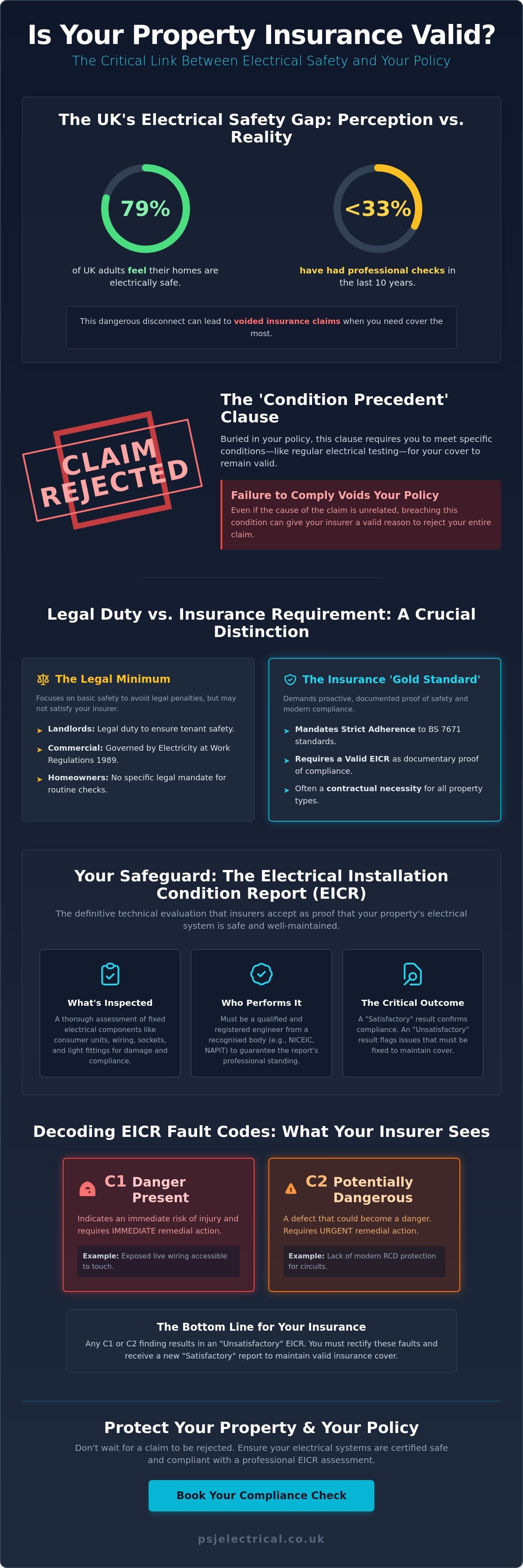
A 2026 study by the Institution of Engineering and Technology found that whilst 79% of UK adults feel their homes are electrically safe, fewer than a third have had their systems checked by a qualified professional in over ten years. You likely assume that paying your premiums is enough to keep your property protected, but failing to keep up with electrical testing for insurance purposes can leave you vulnerable to claim rejection. Many homeowners and landlords in areas like Darras Hall and Wynyard are surprised to find that their coverage depends entirely on maintaining up-to-date documentation. It’s a common anxiety. However, it’s also one that’s easily managed with the right professional oversight.
This guide explains how professional testing acts as your primary safeguard, ensuring your policy remains valid and your property stays fully covered if the worst should happen. You’ll discover the critical differences between basic legal mandates and the specific risk-mitigation conditions set by insurers. We will also provide a clear preview of the latest BS 7671:2018+A4:2026 regulations and the necessary steps to secure a valid Electrical Installation Condition Report (EICR) from a qualified North East engineer.
Key Takeaways
- Learn how “Condition Precedent” clauses in your policy can lead to claim rejection if your electrical documentation is outdated or missing.
- Understand how regular electrical testing for insurance purposes ensures your property remains compliant with the latest UK safety regulations and standards.
- Discover why a “Satisfactory” EICR result is essential for maintaining your cover and how to address findings before they affect your policy validity.
- Identify the unique testing requirements for North East commercial premises and high-value homes to avoid gaps in your professional liability or buildings insurance.
- Follow a practical preparation checklist to review your policy’s maintenance warranties and locate necessary certificates before your engineer arrives.
Why Electrical Testing is Critical for Insurance Validity
Property insurance is essentially a contract of mutual trust, but that trust is underpinned by specific safety obligations. Insurers view regular electrical safety testing as the “MOT” for your building’s infrastructure. Just as you wouldn’t expect a car insurance payout if the vehicle was unroadworthy, your building’s policy often relies on the electrical system being maintained to modern standards. As we move through 2026, the industry has seen a distinct shift. Insurers are no longer treating electrical maintenance as a suggestion; they’re treating it as a non-negotiable requirement for both residential and commercial sectors.
One term you’ll often find buried in policy documents is “Condition Precedent.” In plain English, this means a specific condition must be met before the insurer is legally obligated to pay a claim. If your policy states that electrical testing for insurance purposes must be conducted every five years, failing to produce a “Satisfactory” certificate after a fire or power surge could give the insurer a valid reason to void your cover entirely. It doesn’t matter if the fault was unrelated to the specific circuit that caused the issue; the breach of the condition itself is often enough to jeopardise the entire claim.
The Consequences of Non-Compliance
When a claim is filed, especially for fire damage, a Loss Adjuster is appointed to investigate the cause and verify that the policyholder has exercised “reasonable care.” They’ll immediately ask for your maintenance records. Imagine a retail unit in Newcastle city centre suffering a distribution board fire. If the owner cannot provide a current Electrical Installation Condition Report (EICR), the Loss Adjuster may conclude that the fire was preventable through routine inspection. In such cases, the claim is frequently rejected, leaving the business owner to cover the full cost of repairs and business interruption out of their own pocket.
The Difference Between Legal Duty and Insurance Requirements
There’s often confusion between what the law requires and what your insurer demands. Whilst homeowners aren’t legally forced to have an EICR in the same way landlords are, many high-value or specialist insurance policies make it a contractual necessity. For commercial property owners, the Electricity at Work Regulations 1989 places a legal duty on employers to ensure electrical systems are safe. However, the benchmark for “safety” in the eyes of an insurer is strict adherence to BS 7671 standards. Meeting the bare minimum of the law might keep you out of court, but only professional certification will keep your insurance valid. Insurers want proof that your system is not just “working,” but compliant with the latest 2026 safety amendments.
Understanding the EICR: The Gold Standard for Insurance Compliance
An Electrical Installation Condition Report (EICR) is a thorough technical evaluation of a building’s hidden circuits and fixed components. During the inspection, an engineer examines the consumer unit, wiring, and accessories to detect any wear, damage, or design flaws that could pose a risk. For those arranging electrical testing for insurance purposes, this report is the primary evidence of compliance. Insurers typically mandate that these reports are produced by NICEIC or NAPIT registered contractors, as these bodies provide the technical oversight that guarantees the report’s accuracy and professional standing.
Property age is a significant factor in these assessments. Period homes in Durham or traditional estates in Yarm often contain older wiring systems that may have reached the end of their safe working life. Even if the lights appear to be functioning correctly, the lack of modern safety features like RCD protection can result in an “Unsatisfactory” outcome. If you are unsure about your current certification status, booking a professional EICR assessment with PSJ Electrical Engineers Ltd ensures you identify these risks before they affect your insurance cover.
Decoding the EICR Classifications (C1, C2, C3)
The report uses specific codes to categorise the severity of any discovered faults. A C1 code indicates immediate danger, such as exposed live wiring, and requires instant rectification to prevent injury. A C2 code denotes a potentially dangerous condition that, whilst not an immediate threat, could become hazardous under certain conditions. Insurers generally require C1 and C2 issues to be resolved within 28 days to maintain policy validity. A C3 code suggests an improvement is recommended. While a C3 doesn’t necessarily fail the report, addressing these points shows the insurer that you are proactive about property maintenance.
How Often Should Testing Be Carried Out?
Testing intervals are determined by the building’s use and the specific risk profile it presents. Commercial premises usually require an inspection every five years, whereas industrial environments often move to a three-year cycle due to higher electrical loads and harsher conditions. These requirements align with the duty of care established under The Electricity at Work Regulations 1989. For domestic properties, insurers are increasingly moving away from the traditional ten-year recommendation, often insisting on a five-year check or a new report whenever there is a change of tenancy or occupancy.
Commercial vs. Domestic: How Insurance Requirements Differ
Whilst the technical process of an EICR remains consistent, the weight an insurer places on the results varies significantly between sectors. For North East business owners, electrical testing for insurance purposes is often a non-negotiable prerequisite for obtaining public or employer liability cover; for further guidance on such policies, Just Quote Me offers a detailed guide on what this protection entails. In the domestic market, the requirement is frequently more subtle, appearing in the fine print of high-value policies or as a condition of a mortgage offer. Understanding these distinctions is vital to ensuring your property remains protected and your premiums remain competitive.
One common hurdle for new homeowners is the “Homebuyer Trap.” Many insurers now refuse to confirm buildings insurance on older properties until a satisfactory EICR is provided. This creates a stressful bottleneck during the exchange of contracts. If the report identifies serious defects, the insurer may exclude fire damage from the policy until remedial work is completed. It’s a similar story for those with “Buy-to-Let” mortgages; lenders often mandate regular testing to protect their investment, making a valid safety certificate just as important as the gas safety record.
Commercial Sector Nuances
In high-traffic environments like Newcastle’s retail and hospitality sectors, the risk profile is naturally higher. Insurers for these businesses typically require a full EICR every five years, but they also look closely at portable appliance testing (PAT). Whilst fixed wire testing covers the building’s skeleton, PAT testing ensures that the equipment plugged into it won’t trigger a public liability claim. Manufacturing hubs in the North East face even stricter scrutiny. Because industrial machinery places immense strain on electrical circuits, insurers often demand more frequent testing intervals to mitigate the risk of fire or production downtime. Demonstrating a proactive approach to maintenance through regular certification can often lead to lower insurance premiums, as it proves to the provider that you are a low-risk client.
Residential Insurance and High-Value Properties
For owners of larger or period properties in areas like Durham, Stocksfield, or Ponteland, insurance requirements are notably more stringent. High-value home insurance policies often include “maintenance warranties” that specifically mention electrical safety. If a property has not been upgraded in several decades, the insurer may view the aging infrastructure as a ticking time bomb. DIY electrical work is another significant red flag; if an electrical fire occurs and the investigation reveals uncertified modifications, the claim will almost certainly be rejected. Whilst a full rewire is a major project, it is often the only way to satisfy insurers of an older property’s safety. Providing proof of modern wiring and a new fuse box installation is frequently the deciding factor in securing comprehensive cover for a historic home. Homeowners in this position may also benefit from exploring renewable energy solutions North East specialists recommend, as upgrading to solar panels or battery storage systems requires a certified electrical foundation that simultaneously satisfies insurer requirements. For Stocksfield homeowners considering this route, working with professional solar panel fitters Stocksfield residents trust ensures that any new renewable installation meets the latest MIS 3002 V6.0 standards and is built on a fully certified electrical base.
Preparing for an Inspection: A Step-by-Step Compliance Checklist
Moving from understanding the theory of electrical testing for insurance purposes to practical application requires a methodical approach. By preparing your property and documentation in advance, you can streamline the inspection process and ensure that your insurer receives the exact proof of maintenance they require. Following a structured checklist not only saves time but also demonstrates the “reasonable care” that loss adjusters look for during a claim investigation.
- Step 1: Review your policy. Search your insurance documents for “Electrical Maintenance,” “Warranty,” or “Safety Conditions” clauses. These sections specify how often your insurer expects a professional inspection to occur.
- Step 2: Gather existing records. Locate your previous EICR or any installation certificates for recent work, such as a fuse box replacement or EV charger installation. This establishes a clear timeline of professional oversight.
- Step 3: Conduct a visual pre-check. Note any obvious issues like flickering lights, sockets that feel warm to the touch, or circuit breakers that trip frequently. Identifying these early allows you to brief your engineer more effectively.
- Step 4: Secure an accredited engineer. Ensure your chosen contractor is registered with a recognised body like the NICEIC. This guarantees the report will be accepted by all major UK insurance providers.
- Step 5: Schedule remedial works. If the report returns C1 or C2 codes, arrange for repairs immediately. Most insurers require these to be resolved within 28 days to maintain continuous cover.
Finding the Right Contractor in the North East
It is often tempting to choose the lowest quote for testing, but non-accredited “cheap” testers may produce reports that insurers simply won’t recognise. Using a local expert in areas like Newcastle or Consett ensures a rapid response and a deeper understanding of regional property types, from city-centre retail units to rural estates. Before your engineer arrives, ask if they provide digital copies of the report and if they are qualified to the latest BS 7671:2018+A4:2026 standards. When you are ready to ensure your property meets these rigorous benchmarks, you can book your comprehensive EICR with our experienced team.
Record Keeping and Documentation
A “Satisfactory” EICR is a powerful asset during insurance renewals and can often be used as a bargaining tool to negotiate better terms or lower premiums. We recommend storing both a physical copy in your building’s safety file and a digital version in a secure cloud folder for instant access during a claim. Once any necessary remedial works are finished, your engineer should provide a “Letter of Compliance.” A Letter of Compliance is a formal document issued by your engineer after remedial works are finished, confirming that all previously identified C1 and C2 faults have been rectified to the required safety standards. This document, alongside your original EICR, completes the chain of evidence your insurer needs to confirm your policy’s validity.
Professional Electrical Testing with PSJ Electrical Engineers Ltd
PSJ Electrical Engineers Ltd brings nearly two decades of technical proficiency to the North East property market. We recognise that electrical testing for insurance purposes requires a level of detail that goes beyond basic safety checks. Our approach involves a deep dive into the system’s integrity, providing the robust documentation that high-value insurers and commercial underwriters demand. Whether we are conducting a landlord EICR or assessing a large-scale industrial facility, our focus remains on precision and transparency. Every inspection is handled by a seasoned professional who understands that a “Satisfactory” result is the foundation of your building’s financial and physical security.
Our commitment to safety standards is reflected in our comprehensive approach to documentation. We provide clear, plain-English explanations alongside technical shorthand to ensure that both property owners and insurance loss adjusters can easily interpret the findings. This level of detail is particularly important when adhering to the stricter 2026 compliance landscape. By choosing PSJ Electrical Engineers Ltd, you are partnering with an NICEIC-registered firm that prioritises the longevity of your installation alongside its immediate safety.
While we focus on the North East UK market, such high standards of professional certification are a global benchmark. For instance, in the United States, Triumph Electrical Contracting Inc. provides the expert licensed electrical services required to keep New York City properties safe and fully compliant with local insurance and safety regulations.
Serving Darras Hall, Newcastle, Durham, and Beyond
Our engineers are familiar with the specific architectural nuances of the region, from the substantial homes in Darras Hall to the commercial hubs of Newcastle and Durham. This local insight allows PSJ Electrical Engineers Ltd to act swiftly when a report returns an “Unsatisfactory” result. We don’t just identify the faults; we provide the engineering solutions needed to bring your property back into full compliance. This transition from a failed report to a safe, insured property is handled with the quiet confidence and reliability that has defined our service for over 19 years, ensuring your insurance cover remains uninterrupted and your liability is managed.
Beyond Testing: Full Electrical Solutions
Modern property upgrades like solar panel installation or EV chargers require a solid electrical foundation to be both safe and insurable. PSJ Electrical Engineers Ltd provides a comprehensive service that covers everything from initial testing to necessary hardware upgrades like fuse box replacement. By choosing a single, accredited partner for your electrical testing for insurance purposes and any subsequent remedial work, you maintain a clear and consistent safety record that simplifies the insurance renewal process. We invite you to secure your property’s future with a professional assessment that blends traditional values of craftsmanship with a forward-thinking attitude toward modern industry standards.
Contact PSJ Electrical Engineers Ltd to organise your insurance-approved electrical test today.
Securing Your Property and Policy Validity
Maintaining a rigorous schedule for electrical testing for insurance purposes is the most effective way to safeguard your property against the technicalities of policy rejection. As we have explored, the difference between a successful claim and a costly dispute often rests on the presence of a “Satisfactory” EICR and a clear trail of remedial work. By addressing potential hazards before they escalate, you satisfy the specific “Condition Precedent” clauses that underpin modern insurance contracts, ensuring that your buildings or business cover remains robust and enforceable.
PSJ Electrical Engineers Ltd provides the technical authority and local experience needed to navigate these complex requirements. As an NICEIC Approved Contractor with over 19 years of specialist involvement in North East property safety, we ensure your documentation is precise, transparent, and fully compliant with current regulations. Protecting your investment requires more than just paying a premium; it requires the absolute certainty of a safe and certified installation. Book your professional EICR with PSJ Electrical Engineers Ltd today to secure your property’s future with confidence.
Frequently Asked Questions
Is an EICR a legal requirement for my business insurance?
Whilst an EICR is a legal requirement for employers under safety legislation, it is a contractual necessity for most business insurance policies. Insurers include specific clauses that mandate regular inspections to prove the electrical system is maintained to a safe standard. Failing to produce a valid report during a claim investigation often allows the provider to void the policy based on a breach of these specific maintenance terms.
How long does an electrical safety certificate last for insurance purposes?
A standard Electrical Installation Condition Report typically remains valid for five years in commercial settings and up to ten years in owner-occupied domestic properties. However, insurers frequently set their own stricter intervals, sometimes requiring checks every three years for high-risk industrial sites. You should always verify the specific testing and maintenance duration stated in your policy schedule to ensure your coverage remains continuous and valid.
Will my home insurance claim be rejected if I don’t have an EICR?
Your claim could be rejected if the insurer determines that the incident resulted from a lack of reasonable maintenance. Whilst many standard home policies don’t explicitly demand an EICR upfront, they all require you to keep the property in a good state of repair. If an electrical fire occurs and you cannot provide evidence of professional testing, the loss adjuster may argue that you failed to mitigate known risks.
Can any electrician carry out testing for insurance purposes?
Insurers typically require that electrical testing for insurance purposes is performed by a contractor registered with an approved regulatory body like the NICEIC or NAPIT. From October 2026, electricians must also hold a formal Level 3 inspection and testing qualification to carry out these reports. Using a non-accredited individual may result in a certificate that your insurance provider refuses to recognise as valid documentation for your policy.
What happens if the electrical test identifies a fault (C1 or C2)?
Any C1 (Danger Present) or C2 (Potentially Dangerous) faults must be rectified before the installation is deemed “Satisfactory.” A C1 fault requires immediate isolation to prevent injury, whilst C2 issues usually need resolving within 28 days to satisfy the insurer’s safety criteria. Once the remedial work is finished, your engineer will issue the necessary certification to confirm the property is once again compliant and fully covered.
Does my insurance cover the cost of the electrical testing itself?
Insurance policies rarely cover the cost of routine electrical testing, as these inspections are considered part of your standard property maintenance responsibilities. The expense of the EICR and any subsequent remedial work is the responsibility of the property owner or policyholder. However, investing in these regular checks is significantly more cost-effective than facing the total loss of a claim payout due to a failure to demonstrate compliance.
Are there specific requirements for older properties in the North East?
Older properties in the North East often contain legacy wiring systems, such as lead-sheathed or vulcanised rubber cables, which insurers view as high-risk. These installations are more likely to require frequent monitoring or a fuse box replacement to meet modern safety benchmarks. If your property was built before 1970 and hasn’t been rewired, your insurer may insist on a more comprehensive inspection before confirming or renewing your cover.
How much notice do I need to give for a commercial EICR inspection?
We recommend booking your inspection at least four to six weeks in advance, particularly as the 2026 surge in EICR renewals has increased demand for qualified engineers. For commercial premises, this lead time allows you to coordinate the necessary power shutdowns with your staff and operations. Early booking ensures you receive your documentation well before your current insurance policy expires or enters its renewal phase.