
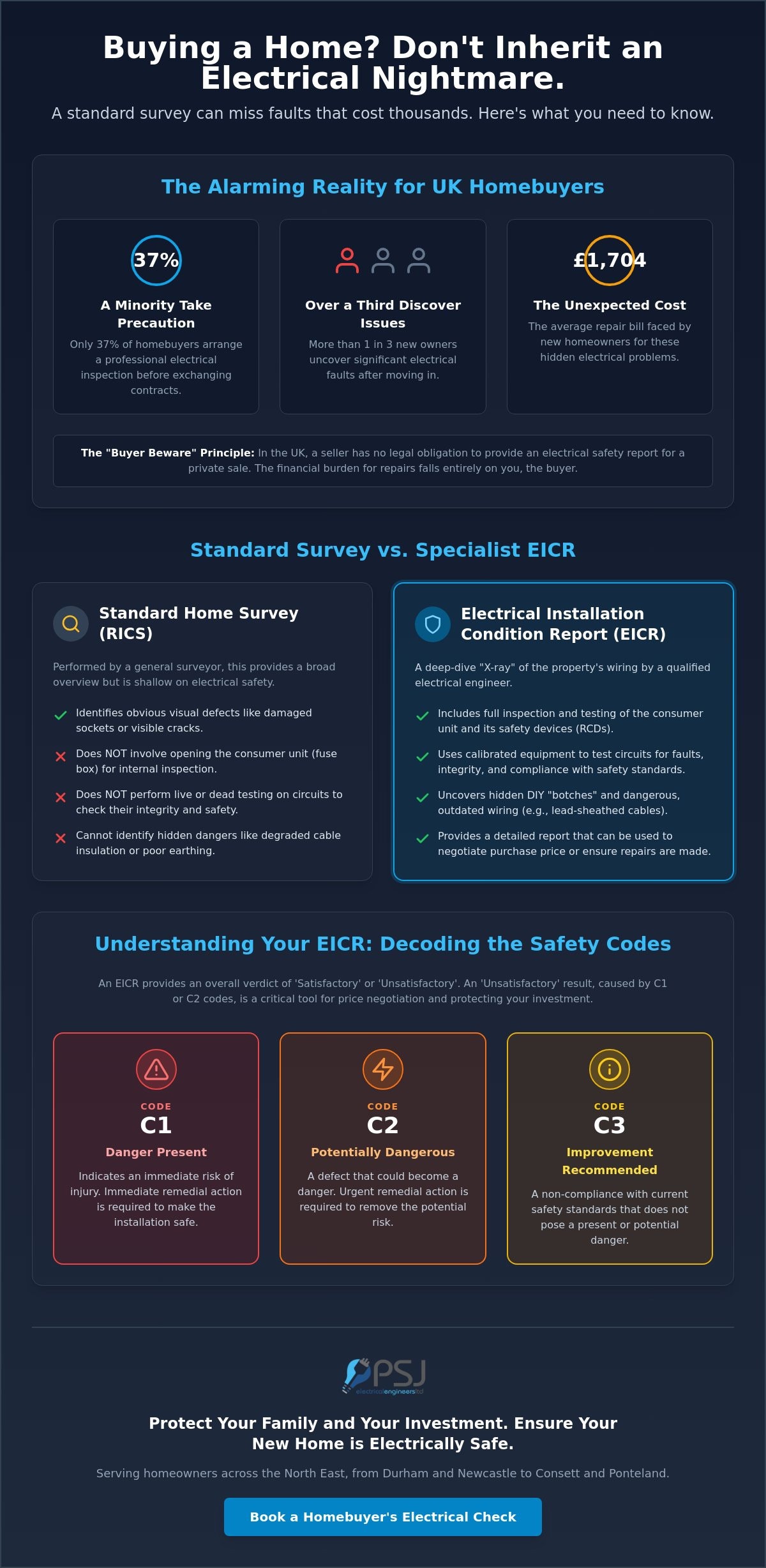
Did you know that only 37% of homebuyers arrange for a professional inspection of a property’s wiring before they exchange contracts? It’s a startling figure when you consider that over a third of new owners discover significant electrical faults after moving in, often facing an average repair bill of £1,704. You’re likely feeling the weight of the house-buying process and perhaps assuming that your general surveyor’s report covers the essentials. It’s natural to feel anxious about the hidden costs of an older property, which is why a specialist electrical safety check for homebuyers is such a critical step in your journey.
This guide explains how a technical inspection protects your family and your investment. We’ll clarify the difference between a standard home survey and a professional Electrical Installation Condition Report; we’ll also explore how the latest BS 7671:2018+A4:2026 regulations affect your purchase whilst ensuring you know what to look for on a report. By the end of this article, you’ll have a clear path to achieving total peace of mind and the evidence needed to negotiate a fair price if repairs are required.
Key Takeaways
- Understand why standard RICS surveys are often insufficient for identifying hidden electrical hazards whilst ensuring your future home is truly safe.
- Learn how a specialist electrical safety check for homebuyers provides a comprehensive “X-ray” of the property’s wiring using calibrated testing equipment.
- Discover how to decode C1, C2, and C3 safety codes to identify dangerous faults and use the findings as a strategic tool during price negotiations.
- Identify the critical signs of an outdated fuse box and learn why modern safety standards are essential for the long-term stability of your investment.
- Find out what an “Unsatisfactory” verdict means for your contract exchange and how it helps you avoid the burden of unexpected rewiring costs.
Why a Standard Home Survey Often Misses Critical Electrical Faults
When you’re in the process of purchasing a new home, the standard RICS Level 2 or 3 survey is usually your first port of call. Whilst these reports are excellent for spotting structural cracks or damp, they are fundamentally limited when it concerns the hidden wiring. A general surveyor isn’t a qualified electrician; they’ll typically look for obvious damage to sockets or an ancient-looking fuse box, but they won’t open the consumer unit or test the circuits. This is why a specialist electrical safety check for homebuyers, formally known as an Electrical Installation Condition Report (EICR), is vital for a truly informed purchase.
The principle of “caveat emptor” or “buyer beware” is particularly relevant during a property transaction. In the UK, there’s no legal obligation for a seller to provide a valid EICR for a private sale. If you discover that the property requires a full rewire after you’ve moved in, the financial burden falls entirely on your shoulders. In the North East, we frequently encounter properties where decades of DIY “botches” have been hidden behind freshly painted walls. These amateur additions often bypass safety standards, creating a silent risk that only a professional can identify.
The Difference Between a General Survey and an EICR
A general surveyor’s remit is broad but shallow. They might note that the lights work, but they can’t tell you if the earthing is sufficient or if the insulation around the cables is degrading. A specialist electrical engineer performs a series of rigorous electrical safety tests, including dead testing to check circuit integrity and live testing to ensure safety devices trip correctly during a fault. This methodical approach identifies non-compliant work that might have been installed by previous owners without the necessary building control certificates, ensuring your investment is grounded in reality rather than guesswork. For a thorough understanding of what this documentation involves, our electrical installation report FAQ guide explains the full scope of what a formal report covers and how to interpret its findings.
Specific Risks in North East Housing Stock
Our region has a diverse architectural heritage, which is reflected in our housing stock. However, this often presents unique challenges for modern electrical standards. In the terraced streets of Durham and Newcastle, or the older stone-built properties in Stocksfield, many homes still contain remnants of original wiring systems. We often find issues in Consett and Ponteland properties built before 1970, where lead-sheathed or vulcanised rubber (VRI) cables are still in use. These materials degrade over time and can become a significant fire risk. An electrical safety check for homebuyers ensures that these historical hazards are identified before you commit to the purchase, allowing you to plan for necessary upgrades like a fuse box replacement or a full rewire.
What Does a Homebuyer’s Electrical Safety Check (EICR) Actually Cover?
A professional inspection is a methodical process that evaluates the entire electrical infrastructure of a property. It goes beyond the surface. Whilst a seller might have updated the light switches to modern brushed chrome, the wiring behind them could still be decades old. A comprehensive electrical safety check for homebuyers provides a clear, technical snapshot of the system’s health, ensuring that every circuit is capable of handling the demands of modern living without overheating or failing.
The process involves a series of physical inspections and technical tests. Engineers use calibrated equipment to verify that the installation remains safe for continued use. This includes checking for any signs of wear and tear, identifying potential fire hazards, and ensuring that the property complies with the latest safety standards. You can use a Home Electrical Safety Checklist to understand the basic hazards we look for, but a professional EICR provides the deep technical data required for a property purchase.
The Role of the Consumer Unit and RCDs
The consumer unit, or fuse box, is the heart of your home’s electrical system. During an inspection, we assess whether it meets current safety standards, particularly regarding Residual Current Devices (RCDs). These life-saving components are designed to trip the power instantly if a fault is detected, preventing fatal electric shocks. If the property you’re eyeing still uses an old-fashioned wooden-backed fuse board or lacks RCD protection, it’s a significant safety concern. Many buyers find that replacing old fuse boards Newcastle is one of the first essential upgrades they negotiate before moving in.
Fixed Wiring and Circuit Integrity
Testing the fixed wiring is arguably the most critical part of an electrical safety check for homebuyers. Since cables are hidden within walls and under floorboards, their condition is impossible to judge visually. We perform insulation resistance tests to ensure the protective coating on the wires hasn’t perished. We also check for continuity in the earthing system, which provides a safe path for electricity in the event of a fault. If these tests reveal failing insulation or poor connections, it may indicate that the property requires a full house rewiring North East. Identifying these issues early allows you to request a specialist inspection and use the findings to adjust your offer accordingly.
Finally, the inspection covers all accessible points of the system. This includes:
- Earthing and Bonding: Verifying that the gas and water pipes are correctly grounded.
- Socket and Switch Assessment: Checking for heat damage, loose connections, or broken components.
- Light Fittings: Ensuring that pendants and recessed spots are safe and correctly installed.
- Hazard Identification: Spotting exposed live parts or evidence of previous electrical fires.
Comparing Inspection Types: Visual vs. Full EICR
There’s a common misconception that a quick walk-through of a property is sufficient to judge its electrical health. In reality, a visual inspection and a full Electrical Installation Condition Report (EICR) are worlds apart in terms of depth and protection. Whilst a visual check might identify a cracked socket or an obviously aged fuse box, it’s merely a surface-level assessment. A specialist electrical safety check for homebuyers acts as an “X-ray” for the home, using calibrated diagnostic equipment to see through the walls and floorboards where the real risks often reside.
Relying solely on a visual check can lead to a dangerous sense of false security. A property might have been recently renovated with modern switches and light fittings, yet the underlying circuits could be dangerously overloaded or improperly earthed. A professional EICR is a methodical, time-intensive process. For a typical three-bedroom home, a thorough engineer will spend several hours performing tests; any “inspection” that’s completed in thirty minutes is likely missing the critical technical data you need to make a safe investment.
When is a Visual Check Enough?
A visual-only inspection is rarely sufficient for an established property. It’s generally only appropriate for very recent new-build homes that are still covered by their original Electrical Installation Certificate. However, even in high-specification areas like Darras Hall or Wynyard, we’ve found that luxury properties often undergo significant post-purchase modifications. Whether it’s a new kitchen extension or a sophisticated home cinema system, these additions aren’t always installed to the required standards. Even in the most prestigious postcodes, a full report is the only way to ensure that previous owners haven’t left behind a legacy of non-compliant work.
The Depth of a Full Condition Report
A full EICR is governed by the 18th Edition Wiring Regulations (BS 7671), the gold standard for electrical safety in the UK. The process is divided into two distinct phases to ensure every component is tested under realistic conditions. During the “dead testing” phase, the power is safely isolated so we can measure insulation resistance and continuity without risk. This is followed by “live testing,” where we measure the disconnection times of safety devices like RCDs. This ensures that, if a fault ever occurs after you move in, the system will react instantly to prevent a fire or a fatal shock. This level of detail provides the total peace of mind that a cursory glance simply cannot offer. If you also own or manage a business premises in the region, the same rigorous standards apply — commercial EICR testing North East follows an equally comprehensive process governed by the updated BS 7671:2018+A4:2026 regulations.
Understanding the Results: Codes, Costs, and Negotiation
Once the engineer completes the electrical safety check for homebuyers, you’ll receive a formal document that classifies every observation made during the inspection. This isn’t merely a pass or fail certificate; it’s a technical record of the installation’s condition at that specific moment. The most significant part of the report is the “Overall Assessment of Installation,” which will be marked as either “Satisfactory” or “Unsatisfactory.” An unsatisfactory result is a pivotal moment in your property purchase, as it provides documented evidence that the home requires immediate investment to meet modern safety standards.
Receiving an unsatisfactory report shouldn’t necessarily be a reason to withdraw your offer, but it should certainly change your approach. It transforms a hidden liability into a transparent, manageable negotiation point. By understanding the specific codes within the report, you can differentiate between essential life-saving repairs and simple recommendations for future modernisation.
C1, C2, and C3 Fault Codes Explained
Every observation in the report is assigned a code to help you prioritise repairs. These categories are strictly defined by industry standards:
- C1 (Danger Present): This indicates an immediate risk to life. It might involve exposed live parts or a fault that could cause an electric shock or fire at any second. The engineer will usually take immediate action to make the site safe.
- C2 (Potentially Dangerous): These are urgent issues that don’t present an immediate threat but could become lethal if a fault occurs. A lack of RCD protection often falls into this category.
- C3 (Improvement Recommended): These items don’t comply with the latest regulations but aren’t considered unsafe. They are suggestions for how the system could be modernised.
An “Unsatisfactory” verdict is triggered by the presence of any C1 or C2 codes, both of which require remedial action before the system can be declared safe. If you’d like a deeper explanation of how these codes are applied within a formal electrical installation report, our 2026 FAQ guide covers every classification in plain English alongside the latest regulatory changes.
The Homebuyer’s Negotiation Strategy
The report serves as a powerful tool during the conveyancing process. If the inspection reveals significant faults, you can use a professional quote for the remedial works to negotiate a reduction in the house price. We strongly advise against allowing a seller to “patch up” faults using their own handyman. You require a certificate from a qualified specialist to ensure the work meets BS 7671 standards, protecting both your family and your future resale value.
For those purchasing in the region, reviewing EICR testing Durham offers specific advice on local compliance and the standards you should expect. Beyond immediate safety, the report helps you plan for future upgrades. If you’re considering solar panels or EV chargers, the inspection will confirm if the existing infrastructure can support these technologies. If the report highlights deficiencies, you can request a technical consultation to get an accurate cost for the necessary remedial works, ensuring your negotiation is backed by expert data.
Securing Your Investment with PSJ Electrical Engineers Ltd
Choosing a specialist to conduct an electrical safety check for homebuyers is a decision that impacts both your financial security and your family’s wellbeing. At PSJ Electrical Engineers Ltd, we bring over 19 years of technical expertise to every inspection we perform across the North East. Our reputation is built on a foundation of professional reliability and a commitment to high-calibre workmanship, ensuring that every client feels they are in safe, capable hands during what can be a stressful property transaction. We avoid the hype of aggressive sales tactics, focusing instead on providing a grounded, transparent service that prioritises safety and standards.
We understand that a house purchase is likely the most significant investment you’ll ever make. Our team serves a wide area, including Newcastle, Durham, Consett, Ponteland, and Stocksfield, providing the local knowledge that’s vital when assessing the unique challenges of regional housing stock. We don’t just provide a list of technical codes; PSJ Electrical Engineers Ltd delivers clear, plain-English reports that empower you to make informed decisions before you exchange contracts. This methodical approach ensures that hidden liabilities are brought to light, allowing you to move forward with quiet confidence.
Our Approach to Homebuyer Reports
Our engineers adopt a methodical mindset, treating every property as if we were purchasing it for ourselves. This thoroughness means we go beyond surface-level aesthetics to perform a comprehensive assessment of all accessible circuits and fixed equipment. Whilst some providers might rush through a cursory check, PSJ Electrical Engineers Ltd takes the time required to ensure every technical detail is documented according to the latest BS 7671 standards. If we identify a fault, we don’t leave you to decipher the report alone. Our engineers are available to explain the implications of our findings directly, providing the transparency you need to navigate negotiations with total peace of mind.
Next Steps for Homebuyers
Timing is critical when arranging an electrical safety check for homebuyers. We recommend booking your inspection as early as possible in the conveyancing process, ideally well before you reach the point of exchange. This gives you ample time to review the findings and, if necessary, obtain professional quotes for remedial work like a fuse box replacement or a full rewire. Additionally, our reports help you plan for the future. If you intend to install solar panels or EV chargers, we can confirm if the existing infrastructure is ready for these technologies. You can book your professional electrical safety check with PSJ Electrical Engineers Ltd today to ensure your new home is safe, compliant, and a sound investment for years to come.
Moving into Your New Home with Confidence
Purchasing a property is a significant commitment, and ensuring the electrical system is sound shouldn’t be left to chance. As we have explored throughout this guide, a standard survey often misses the hidden complexities of a property’s wiring, whilst a specialist electrical safety check for homebuyers provides the technical depth required to protect your investment. By identifying potential hazards before you exchange contracts, you gain the strategic leverage needed to negotiate repairs or price adjustments, ensuring you aren’t burdened with unexpected costs after moving in.
As an NICEIC Approved Contractor with over 19 years of industry experience, PSJ Electrical Engineers Ltd specialises in providing the thorough property re-wires and safety reports necessary for modern living. Our methodical approach ensures every circuit is tested and every fault is explained in plain English, giving you the clarity to move forward. We take pride in our high-calibre workmanship and our commitment to the long-term safety of families across the North East.
Ensure your new home is safe — book your Homebuyer EICR today. We look forward to helping you secure your future home with the technical precision and reliable service you deserve.
Frequently Asked Questions
Is an electrical safety check a legal requirement when buying a house?
No, there’s no legal obligation for a private homebuyer to arrange an inspection, nor is a seller legally required to provide one. Whilst landlords must have an EICR performed every five years by law, owner-occupiers aren’t bound by the same rules. It’s a voluntary step that provides essential protection for your investment and family safety before you commit to the purchase.
How much does an EICR for a homebuyer typically cost in the North East?
The cost of a report depends on the size of the property and the number of electrical circuits that require testing. A larger home with more complex wiring takes longer to inspect thoroughly, which is reflected in the final fee. We recommend requesting a tailored quote that accounts for the specific age and scale of the property you’re planning to buy.
How long does it take to carry out a full electrical safety check?
A methodical inspection usually takes between two and four hours for a standard three-bedroom home. Larger properties or older buildings with intricate wiring systems may require more time to ensure every circuit is tested correctly. We don’t believe in rushing these checks, as a thorough assessment is the only way to guarantee the system’s integrity.
Can I carry out an electrical safety check myself?
No, you shouldn’t attempt to perform this check yourself. A valid electrical safety check for homebuyers must be conducted by a qualified and competent person, such as an NICEIC Approved Contractor. Professionals use specialised, calibrated equipment to perform technical tests that identify hidden faults, which are impossible to spot through a simple visual DIY inspection.
What happens if the electrical safety report comes back as “Unsatisfactory”?
An “Unsatisfactory” verdict indicates that the engineer found C1 or C2 faults that pose a danger. These issues must be repaired before the installation can be declared safe for continued use. You can use this formal report as a tool to negotiate the house price or request that the seller carries out the necessary remedial work before the exchange of contracts.
Will the electrician need to turn off the power during the inspection?
Yes, the power must be switched off for a significant portion of the visit. This isolation is necessary for the “dead testing” phase, where we measure insulation resistance and circuit continuity without risk. We always aim to work efficiently to ensure that the power is restored as soon as the critical safety tests are complete.
Does a new-build house need an electrical safety check?
Most new-build properties won’t require an EICR if they’re less than five years old and have a valid Electrical Installation Certificate. However, if the property has been modified or extended since it was built, a specialist electrical safety check for homebuyers is still recommended. It ensures that any post-construction work meets the required safety standards before you move in.
Should I get an EICR if I am planning to install solar panels or an EV charger later?
Yes, this is a very sensible approach. An inspection confirms whether your existing consumer unit and main earthing are capable of supporting the additional load of solar panels or an EV charger. Identifying these requirements early allows you to factor the cost of any necessary upgrades into your initial home-buying budget, avoiding expensive surprises later on. If you also own a business property in the region, be aware that commercial EICR testing North East carries its own distinct compliance requirements and penalty structures under the 2026 regulations.