
Could your business afford a £40,000 fine for a simple lapse in electrical documentation? With the recent increase in non-compliance penalties and the massive wave of renewals due this year, staying ahead of commercial EICR testing North East has become a critical priority for every local enterprise. It is a significant responsibility that often brings a sense of unease, especially as the industry moves toward stricter standards in 2026.
It is natural to feel concerned about the potential for business downtime or the confusion surrounding the new BS 7671:2018+A4:2026 “Orange Book” regulations. You want to ensure your premises are safe and legally sound, yet you likely worry that a thorough inspection might lead to unexpected costs or operational hurdles. This guide provides a comprehensive roadmap to help you navigate these updates with total confidence and zero stress. We will break down the essential 2026 compliance checklist, explain the new mandatory qualification requirements for electricians, and provide a clear strategy for managing any necessary repairs whilst keeping your business running smoothly.
Key Takeaways
- Understand the updated legal framework for 2026, including the latest amendments to BS 7671, to protect your business from substantial non-compliance fines.
- Follow our comprehensive preparation checklist for commercial EICR testing North East to streamline the inspection process and reduce the time engineers spend on-site.
- Learn how to manage power availability by distinguishing between live and dead testing phases, ensuring minimal disruption to your daily operations.
- Decode the technical safety ratings in your report, from C1 to C3, to create a clear and manageable roadmap for any required remedial works.
- Benefit from the peace of mind that comes with 19 years of local expertise in Consett, Newcastle, Sunderland, and Durham for all your electrical safety requirements.
Commercial EICR Testing North East: Mandatory Standards in 2026
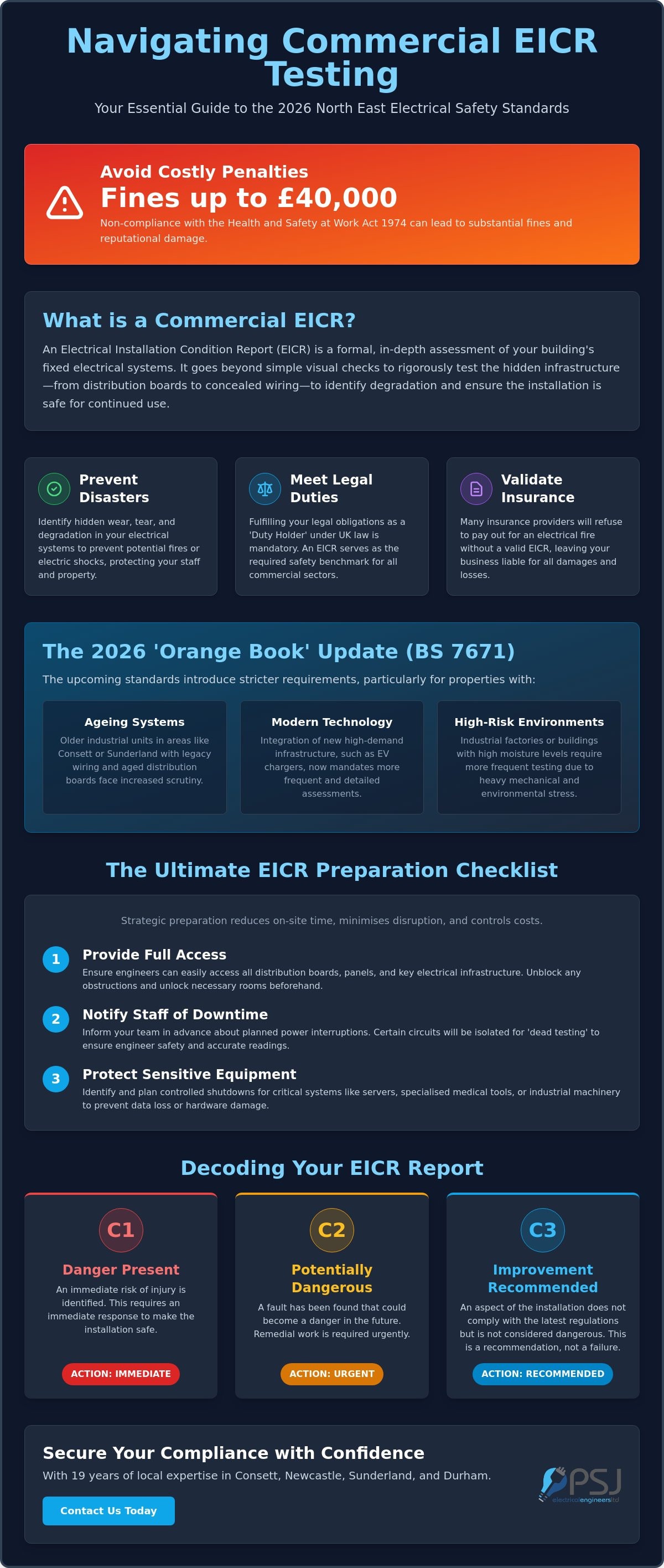
A commercial EICR is a formal, in-depth assessment of a building’s fixed electrical installation. It focuses on the hidden infrastructure that powers your business, from the distribution boards and circuit breakers to the wiring concealed within walls and ceilings. Unlike simple visual checks, commercial EICR testing North East involves rigorous physical testing to identify wear, tear, or degradation that could lead to fire or electric shock. It’s the most reliable way to ensure your electrical systems remain safe for continued use.
This process is governed by strict UK electrical wiring standards, specifically BS 7671. Whilst the 18th Edition has long been the baseline, the transition to the 2026 “Orange Book” standards adds new layers of scrutiny for modern technologies. For businesses operating in Newcastle or Durham, maintaining a valid certificate isn’t just about safety; it is often a non-negotiable requirement for insurance validity. Without a current report, many providers will refuse to pay out in the event of an electrical fire, leaving the business owner liable for the damages.
Most commercial premises require a full inspection every five years. However, this is not a universal rule. High-risk environments, such as industrial factories or buildings with high moisture levels, often require more frequent testing to account for the heavy mechanical stress placed on their electrical systems. Staying ahead of these timelines ensures you aren’t caught out by sudden regulatory shifts or insurance audits.
Legal Obligations for North East Duty Holders
Identifying the “Duty Holder” is a vital first step for North East property managers. In most commercial lease scenarios, the responsibility for electrical safety falls on the person who has control over the premises, which is typically the employer or the building owner. Failure to comply with these obligations can result in severe penalties. As of late 2025, fines for non-compliance have reached up to £40,000, and the legal repercussions under the Health and Safety at Work Act 1974 can be even more damaging to a company’s reputation. The EICR serves as the mandatory safety benchmark for all UK commercial sectors, ensuring that installations are fit for purpose.
Why 2026 Standards Are Stricter for Businesses
The 2026 standards are particularly demanding for older industrial units in areas like Consett or Sunderland. These heritage buildings often house aged distribution boards that were not designed for the high-demand digital infrastructure of a modern office or factory. Recent updates now require more frequent assessments for properties with ageing systems or those integrating new tech like EV chargers. Integrating an electrical installation condition report eicr into your property management plan ensures that potential faults are caught before they cause a shutdown. Older units often hide “legacy” wiring that no longer meets modern safety thresholds, making professional oversight essential for long-term stability.
The Ultimate Commercial EICR Preparation Checklist
Effective preparation is more than just a courtesy to your engineer; it is a strategic approach to reducing on-site time and controlling costs. When an electrical engineer arrives for commercial EICR testing North East, their efficiency depends heavily on how quickly they can access your infrastructure. Delays caused by locked doors or blocked panels inevitably extend the duration of the inspection. By following a structured readiness plan, you ensure the process remains thorough whilst minimising the impact on your daily business activities.
Operational planning is the cornerstone of a stress-free inspection. You should notify your staff well in advance about potential power interruptions, as certain circuits will need to be isolated during the testing phases. It is equally vital to identify any sensitive electronic equipment, such as servers, specialised medical tools, or industrial machinery, that requires a controlled shut-down procedure. Taking these steps prevents data loss and protects your hardware from unexpected surges, ensuring you meet your obligations under The Electricity at Work Regulations 1989. If you have concerns about specific high-value assets, you can always speak with our specialist team to coordinate a phased testing schedule.
Physical Access and Site Readiness
The physical environment must be prepared to allow for an unhindered inspection. Engineers need immediate access to plant rooms, riser cupboards, and every distribution board on the premises. You should ensure that all relevant keys or access codes are available on the morning of the test. A common cause of delay is the storage of stock or office furniture in front of electrical panels; clearing these obstructions beforehand is essential. Additionally, if your facility has high-level lighting or equipment, please identify these areas early. This allows the engineer to arrange for specific access platforms or ladders, preventing a return visit that could increase your overall expenditure.
Administrative and Documentation Checklist
Providing a clear paper trail allows the engineer to understand the history of your installation. This context is invaluable for identifying recurring issues or tracking previous remedial works. Please gather the following documents before the site visit:
- Previous EICR Reports: These provide a baseline for the current assessment and highlight known areas of concern.
- Electrical Installation Certificates: These are necessary if you have had significant work or re-wires completed since the last full inspection.
- Asset Registers: A current circuit schedule or asset register helps the engineer map the system accurately.
- Site Maps: A simple floor plan highlighting the location of consumer units and main switch rooms saves significant time during the initial walkthrough.
Organising these details ensures that commercial EICR testing North East remains a smooth, professional exercise that supports your long-term compliance goals without unnecessary friction.
Minimising Business Disruption During Electrical Testing
A primary concern for many business owners is whether they will need to shut down entirely for the duration of the inspection. The short answer is no. Whilst commercial EICR testing North East does require some circuits to be isolated, a total operational blackout is rarely necessary. We understand that for a busy retail unit in Newcastle city centre or a manufacturing plant in Sunderland, every hour of lost productivity has a direct impact on the bottom line. Our approach focuses on a structured testing programme that keeps your business moving whilst we ensure your safety.
The inspection is divided into two distinct phases: “dead testing” and “live testing”. Dead testing requires specific circuits to be powered down so that we can measure continuity and insulation resistance without risk. Live testing occurs whilst the system is energised, allowing us to check the effectiveness of your earth fault loop impedance and the operation of RCDs. For larger facilities, such as those in Darras Hall or major office hubs, we often employ phased testing. This involves working through the building section by section, ensuring that while one area is being tested, the rest of the premises remains fully operational.
The best time to schedule your inspection depends heavily on your industry. Retailers often find that early morning sessions before opening are most effective, whereas manufacturing firms might prefer to align testing with planned maintenance periods. By coordinating these windows, we help you maintain full compliance without sacrificing your service standards.
Out-of-Hours and Weekend Testing Strategies
For many North East businesses, evening or weekend testing is the most logical choice to eliminate daytime disruption. Although out-of-hours labour can carry a different cost structure, a simple cost-benefit analysis often shows that this is far more economical than closing your doors during peak trading hours. We organise these sessions to suit the specific rhythms of local commerce, ensuring that our engineers are on-site when it is most convenient for you. This flexibility allows for a thorough inspection of main distribution boards, which often require a brief total power-down that would be impossible during a standard Tuesday afternoon.
Managing Power Outages in Commercial Environments
Managing the safety of fixed wiring also involves protecting the equipment connected to it. When assessing your installation, we remain mindful of the Electrical Equipment (Safety) Regulations 2016, which dictate how hardware should perform under test conditions. For IT-heavy environments, we work closely with your team to manage UPS (Uninterruptible Power Supply) systems, ensuring servers are safely shut down or bypassed before testing begins. Similarly, our EICR testing Durham services include specific protocols for essential refrigeration or security systems that cannot be powered down for extended periods. We use bypass procedures and temporary power solutions where necessary to keep your critical infrastructure protected throughout the process.
Decoding Your Report: Understanding C1, C2, and C3 Codes
Receiving your finished report can feel overwhelming if you aren’t familiar with the technical shorthand used by engineers. It is important to understand that commercial EICR testing North East is not a binary pass or fail exercise. Instead, it is a nuanced safety assessment that categorises the condition of your electrical installation using specific observation codes. If your report is marked as “Unsatisfactory”, it means that the inspector has identified issues that pose a risk to your staff or property, and these must be addressed to maintain your legal compliance and insurance validity.
Each observation in the report is assigned a code based on the severity of the risk. Whilst some codes require immediate action, others serve as professional advice to help you maintain the longevity of your system. Understanding these distinctions allows you to prioritise repairs logically, ensuring that your budget is spent where it matters most for safety. If you have recently received a report and aren’t sure where to start, you can get a professional review of your existing report from our technical team.
C1 and C2: Immediate and Potential Dangers
A C1 code is the most serious classification, indicating that a “Danger Present” has been identified. In these instances, there is an immediate risk of injury or fire, and the engineer will usually isolate the affected circuit right away to protect everyone on-site. You cannot ignore a C1; it requires an instant repair to make the installation safe. A C2 code denotes a “Potentially Dangerous” condition. Whilst not an immediate threat, it could become dangerous under fault conditions. For commercial leases and landlord electrical safety certificates Newcastle, a C2 code results in an unsatisfactory outcome, and you typically have a 28-day window to complete the necessary remedial works.
C3 and FI: Recommendations and Further Investigation
C3 codes are “Improvement Recommended” observations. These often appear when an installation is safe but does not meet the most recent 2026 standards, such as older wiring that lacks modern colour coding but remains functional. A C3 does not result in a failure, but it provides a valuable roadmap for long-term maintenance. Conversely, an FI code means “Further Investigation” is required. This happens when an engineer discovers a potential issue that cannot be fully assessed without deeper exploration or specialised equipment. These reports are essential for planning future capital expenditure, whether you are budgeting for a full house rewiring North East for a residential portfolio or a phased upgrade of a commercial distribution network. For a deeper understanding of how these codes are applied and what your electrical installation report means for your compliance obligations, our complete 2026 FAQ guide covers every aspect of the process in detail.
Securing Compliance with PSJ Electrical Engineers Ltd
PSJ Electrical Engineers Ltd has spent over 19 years building a reputation for technical excellence across the North East. We understand the specific demands placed on businesses in Consett, Newcastle, Sunderland, and Durham, where the mixture of heritage architecture and modern infrastructure requires a versatile and seasoned approach. When you choose us for commercial EICR testing North East, you aren’t just hiring a contractor; you are partnering with specialists who take a personal investment in the safety and longevity of your installation.
Our service is built on a foundation of quiet confidence and professional reliability. We avoid the aggressive sales tactics common in the industry, opting instead to provide clear, transparent advice based on the actual condition of your wiring. We handle the entire process from the initial assessment through to any certified remedial works that may be required to achieve a satisfactory result. This end-to-end management ensures that you have a single, accountable point of contact for all your compliance needs, giving you the peace of mind that your property is in safe, capable hands.
Our Approach to North East Commercial Safety
The local industrial landscape presents unique challenges that require more than just a basic understanding of regulations. From the thick stone walls of period properties in Durham to the complex, high-density wiring found in modern office hubs in Newcastle, our engineers possess the local knowledge to navigate these environments efficiently. We recognise that an older industrial unit in Sunderland has vastly different requirements than a new-build retail space in the city centre. Our focus remains on high-quality electrical upgrades and future-proof renewable energy solutions, including Solar Panel Installation and EV Chargers, to help your business meet its safety obligations whilst preparing for a sustainable future.
Booking Your 2026 Commercial EICR
Securing your certification for 2026 is a straightforward, methodical process designed to respect your operational schedule. We begin with a simple request for a quote, followed by a detailed site walk-through to understand the specific layout, access requirements, and scale of your installation. This preparation allows us to provide an accurate timeline and minimise any potential disruption to your staff. Once the inspection is complete, you will receive a comprehensive digital report and a formal compliance certificate that satisfies both legal and insurance requirements. Ensure your business is protected. Contact PSJ Electrical for a commercial EICR quote today.
Future-Proofing Your Business with Expert Compliance
Staying compliant in 2026 requires more than just a tick-box exercise. By following a structured preparation plan and understanding how observation codes impact your long-term maintenance, you can transform a mandatory inspection into a strategic asset for your property management. Navigating commercial EICR testing North East doesn’t have to be a source of stress when you have a clear roadmap for repairs and a professional strategy to keep your daily operations running without unnecessary friction.
PSJ Electrical Engineers Ltd brings over 19 years of electrical engineering experience to every project we undertake. As specialists in North East commercial compliance, we are fully accredited and insured for complex commercial projects, ensuring your business remains in safe, expert hands. We are committed to providing a thorough, transparent service that prioritises the safety and stability of your local enterprise through high-caliber workmanship and technical precision.
Book Your Professional Commercial EICR with PSJ Electrical
Taking the lead on electrical safety today ensures a more secure, compliant, and productive tomorrow for your business and your team.
Frequently Asked Questions
Is a commercial EICR a legal requirement for my business in 2026?
Yes, maintaining a valid EICR is a legal obligation under the Health and Safety at Work Act 1974 and the Electricity at Work Regulations 1989. Since the fine for non-compliance was increased to £40,000 in late 2025, ensuring your documentation is current is vital for avoiding legal action. It is also a standard requirement for most commercial insurance policies amongst North East enterprises.
How much does a commercial EICR cost for a North East office or shop?
The investment required for commercial EICR testing North East depends entirely on the scale and complexity of your electrical system. Factors such as the number of circuits, the age of the installation, and the ease of access to distribution boards all influence the final quote. We recommend a professional site walk-through to provide a precise, transparent estimate tailored to your specific premises.
How long does a commercial electrical inspection take to complete?
A commercial inspection can take anywhere from a few hours for a small retail unit to several days for a large-scale industrial facility. The duration is dictated by the number of circuits that require testing and the physical layout of the building. We provide a clear timeline during the initial booking process so you can plan your staffing and operations accordingly.
Can I stay open whilst the commercial EICR testing is being carried out?
You can typically remain open whilst the testing is carried out, provided a phased approach is used to manage power availability. By testing specific zones or circuits independently, we ensure that the majority of your building remains powered and operational. For businesses that cannot tolerate any daytime disruption, we also organise out-of-hours or weekend sessions to eliminate operational impact.
What happens if my commercial property fails the EICR test?
If your property receives an “Unsatisfactory” result, it means the inspector has identified C1 or C2 safety violations that pose a risk. You are legally required to have these faults repaired to bring the installation back to a safe standard, usually within a 28-day window. Once the remedial works are completed, you will be issued a certificate confirming that the installation is now compliant.
How often should commercial EICR testing be carried out in the UK?
Most commercial premises require a full EICR every five years to remain compliant with UK safety standards. However, certain high-risk environments or buildings with high occupancy levels may require more frequent inspections, sometimes every one to three years. Your previous report will usually state the recommended date for your next inspection based on the condition and age of your system.
Will the engineer need to turn off the power to my entire building?
Power is rarely turned off to the entire building simultaneously; instead, engineers isolate specific circuits for short periods for safety. This “dead testing” phase is necessary for measuring insulation resistance and continuity without risk. We work closely with your team to coordinate these brief outages, ensuring that critical systems like servers are managed correctly before any power is disconnected.
Does a commercial EICR cover portable appliances like kettles and laptops?
No, a commercial EICR focuses strictly on the fixed electrical installation, such as the wiring, sockets, and distribution boards. Portable items like kettles, laptops, and desktop printers fall under Portable Appliance Testing (PAT), which is a separate safety requirement. Whilst both are essential for workplace safety, they involve different testing procedures and produce separate documentation for your records.