
You might think Newcastle’s famous grey skies make solar power a poor investment; however, the North East actually offers the most affordable entry point for renewable energy in the entire UK. It’s understandable to feel hesitant when online price guides vary by thousands of pounds or when you’re unsure if a battery is truly necessary for your specific energy habits. This guide clarifies the actual cost of solar panels Newcastle homeowners can expect in 2026, including how local incentives and smart battery sizing can maximise your long-term savings.
We provide a professional breakdown of current market rates and the latest Smart Export Guarantee (SEG) payments, helping you move past the confusion of conflicting online data. You’ll discover how to leverage the 0% VAT incentive before it concludes in March 2027 and how to capture Newcastle’s 1,450 annual sunshine hours to power your home long after the sun sets. By the end of this guide, you’ll have the technical clarity needed to choose a local expert and secure your home’s energy future with quiet confidence.
Key Takeaways
- Understand why the current cost of solar panels Newcastle residents are quoted remains the most competitive in the UK, offering a unique window for regional investment.
- Learn how to evaluate Tier 1 solar panels and inverter technologies to ensure your system is built for longevity and high performance.
- Discover how to navigate the Smart Export Guarantee (SEG) and the 0% VAT incentive to significantly reduce your upfront costs and shorten your payback period.
- Gain a practical method for matching your battery storage capacity to your actual energy usage, ensuring you don’t overspend on unnecessary hardware.
- Recognise the importance of professional local installation to ensure your new solar PV system integrates safely and seamlessly with your home’s existing wiring.
Understanding the Cost of Solar Panels in Newcastle for 2026
Newcastle is currently leading a quiet revolution in domestic energy. Whilst many associate the North East with cooler climates, the region actually remains the most cost-effective area for solar adoption in the UK. This regional affordability, combined with the city’s 1,456 annual sunshine hours, ensures that the cost of solar panels Newcastle residents invest in provides a high level of efficiency and a faster path to energy independence than many other parts of the country.
2026 is a pivotal year for local energy independence due to a convergence of regulatory deadlines and environmental targets. The Energy Company Obligation 4 (ECO4) scheme is set to conclude on 31 March 2026, whilst the 0% VAT incentive on solar installations is scheduled to end in early 2027. These timelines, paired with the city’s ambitious Net Zero 2030 goals, mean that homeowners who organise their installations now are better positioned to secure long-term financial benefits before national support frameworks shift. Homeowners across the wider region, including those researching solar panel cost Sunderland providers are currently offering, face the same critical deadlines and stand to benefit from acting before these incentives conclude.
As more homeowners across the country look to secure their energy future, renewable energy specialists like MarGav Solar provide the professional consultancy and installation expertise needed to navigate these changing incentives and technical requirements.
Why Newcastle Homeowners are Switching to Solar
Reliability is a primary driver for this shift. Recent fluctuations in the UK energy market have left many households seeking stability. By generating your own electricity, you insulate your home from global price spikes whilst contributing to the Greener Newcastle initiative. Modern solar panel technology has evolved to perform exceptionally well in the ambient light conditions typical of the North East, ensuring that even on overcast days, your system remains productive. This transition is not just about environmental responsibility; it’s about creating a resilient home energy centre that supports the local landscape’s move away from fossil fuels.
Defining the Total Investment: More Than Just Panels
A professional installation involves more than just mounting hardware on a roof. We categorise the investment into three distinct pillars: high-grade hardware, skilled labour, and essential certification. Whilst national quotes might seem attractive, they often overlook the specific structural and electrical requirements of Tyneside’s diverse housing stock. Local expertise ensures that your system integrates safely with your existing consumer unit and meets all MCS standards required to access export tariffs. This thorough approach prevents the long-term expenses often associated with correcting poor workmanship from ‘solar cowboys’ who bypass local safety checks.
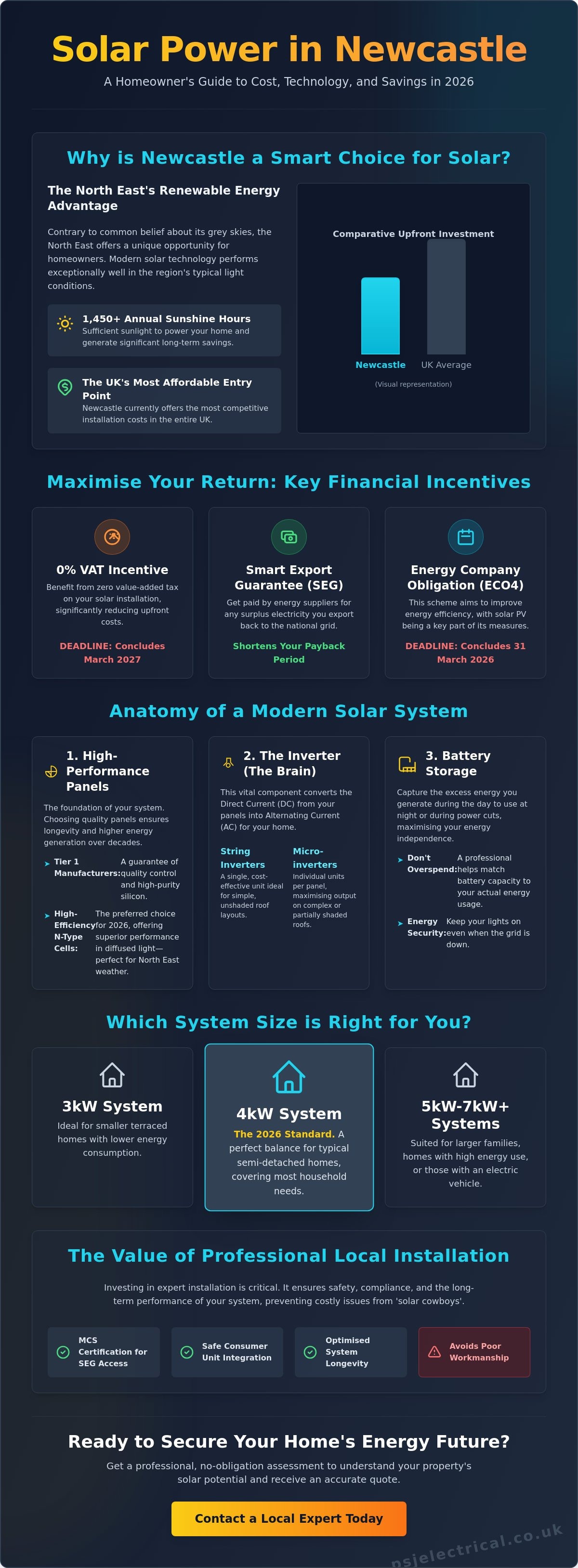
For a typical semi-detached home in Newcastle during 2026, a 4kW solar array remains the standard system size to balance upfront costs with meaningful household energy coverage.
Breaking Down the Investment: Panels, Inverters, and Battery Storage
Investing in renewable energy involves more than just selecting hardware for your roof. The cost of solar panels Newcastle residents pay is influenced by the synergy between high-grade components, technical design, and professional labour. Choosing Tier 1 panels is a standard recommendation for those seeking longevity, as these components are manufactured using high-purity silicon and rigorous quality control. High-efficiency N-type cells are becoming the preferred choice for 2026 because they offer superior performance in the diffused light conditions common to the North East, ensuring your system remains productive even on overcast days.
The inverter acts as the system’s brain, converting direct current into usable electricity for your home. You’ll generally choose between a single string inverter or individual micro-inverters. Whilst string inverters are often more cost-effective for simple roof layouts, micro-inverters provide better yields on properties with complex shading or multiple roof orientations. Professional electrical engineers in the North East ensure these components are sized correctly to your home’s peak demand, preventing the inefficiency that comes from mismatched hardware. Getting an accurate assessment of your roof’s potential is the first step in ensuring you don’t over-invest in panels you won’t fully utilise.
Solar Panel Costs by System Size
System sizing is rarely a one-size-fits-all calculation. A 3kW system might suffice for a smaller terrace, but larger 5kW or 7kW arrays are increasingly common for families with electric vehicles. Roof orientation plays a significant role; south-facing roofs remain the gold standard, but East-West configurations can provide a more consistent energy spread throughout the day. This balanced generation profile is often more useful for households that are occupied during daylight hours, as it aligns generation with real-time usage.
The Cost of Adding Battery Storage in Newcastle
Battery storage has transitioned from an optional extra to a core component of a modern energy system. It’s particularly valuable during Tyneside’s winter months when daylight hours are shorter and evening demand is higher. A 5kWh battery is often suitable for standard domestic use, whilst a 10kWh unit provides the capacity needed for homes with higher base loads or heat pumps. Bundling your battery with the initial panel installation is typically more economical than a separate retrofit. It allows for a shared hybrid inverter and a single visit from your installation team, which reduces the overall labour requirement. This integrated setup also simplifies your eligibility for the Smart Export Guarantee (SEG), enabling you to manage your exports more effectively when rates are most favourable.
Maximising ROI: Smart Export Guarantee (SEG) and Local Incentives
The financial viability of renewable energy in Tyneside has shifted from simple bill reduction to active revenue generation. Whilst the previous Feed-in Tariff is no longer available, the Smart Export Guarantee (SEG) allows you to sell surplus electricity back to the grid. In 2026, the market for export tariffs is highly competitive, with some providers offering fixed rates as high as 25p per kWh. By selecting a high-performance tariff, you ensure that every unit of energy generated by your array contributes to the overall cost of solar panels Newcastle homeowners seek to recoup through long-term performance.
Timing your installation is critical for maximising initial savings. The 0% VAT incentive on energy-saving materials remains a significant benefit, effectively providing a 20% discount on the total supply and installation price. However, this measure is scheduled to conclude on 31 March 2027. For households on lower incomes or those residing in less energy-efficient properties, the ECO4 scheme provides essential funding for solar upgrades. This scheme is active until 31 March 2026, making the current year a vital window for eligible residents to secure support before these national frameworks transition. The same opportunity applies to neighbouring communities, and those comparing the solar panel cost Sunderland installers are quoting will find that these VAT and ECO4 deadlines are equally relevant to their investment decisions.
Calculating Your Payback Period
Most professionally installed systems in the North East now achieve a break-even point within seven to ten years, though this timeline is often shorter for households with high daytime energy demands. Integrating battery storage accelerates this return by allowing you to use your own stored energy during peak evening hours when grid prices are highest. Securing a premium export rate of 24p per kWh significantly bolsters your annual returns, potentially shortening your total payback period by several years when compared to standard variable tariffs.
Newcastle Council and Regional Support
The Greener Newcastle initiative provides a framework for residents to understand their property’s potential through regional mapping and efficiency tools. Whilst most domestic solar installations fall under ‘permitted development’ and do not require formal planning permission, homeowners in Newcastle’s conservation areas, such as Jesmond or parts of Gosforth, should verify local requirements to avoid unexpected administrative costs. Accessing any financial incentive, including the SEG, requires your system to be commissioned by an MCS-certified installer. This certification serves as a guarantee of technical standards and is the primary document required by energy suppliers to approve your export payments.
How to Choose the Right Solar PV System for Your Property
Selecting the most effective system for your home requires a methodical approach that balances your current consumption with future energy requirements. The cost of solar panels Newcastle homeowners incur should be viewed as a technical upgrade to the property’s infrastructure rather than a simple hardware purchase. You should begin by reviewing your annual kWh usage via your smart meter to identify your base load. This figure represents the minimum electricity your home uses constantly for appliances like fridges and standby electronics, providing the necessary data to avoid over-sizing your array.
Before any panels are mounted, a thorough assessment of your home’s electrical health is essential to ensure safety and longevity. Older properties in the North East may require a full house rewiring North East homeowners often overlook until the point of installation. Integrating a high-output solar array and battery storage into an outdated fuse box can lead to safety risks or system failures. Ensuring your consumer unit and cabling meet current standards provides the stable foundation needed for renewable technology to operate at peak efficiency for decades.
Assessing Your Energy Profile
Your energy profile is unique to your daily routine and dictates the ideal battery capacity for your home. If your property is most active during the morning and evening, a larger battery is necessary to bridge the gap when generation is low. We also recommend future-proofing your system by considering the addition of EV chargers or heat pumps. These technologies significantly increase your total annual demand, and planning for them now prevents the need for costly system expansions in the future. Homeowners in the wider region can also benefit from following a structured approach to preparation; the solar panel installation Durham checklist we’ve developed provides an engineer-led roadmap that covers everything from roof orientation assessment to verifying your electrical infrastructure is ready for a seamless renewable energy transition.
The Installer Checklist: Questions to Ask
When vetting potential installers, focus on technical credentials and transparency rather than just the lowest quote. Ask if they are NAPIT or NICEIC registered electrical engineers and if they provide a full Electrical Installation Condition Report (EICR) upon completion of the works. Local specialists understand the specific impact of the Newcastle coastal climate on hardware and should offer specific warranties that reflect these environmental factors. This level of detail ensures that your investment is protected against the salt air and high winds typical of the Tyneside coast.
National firms often sub-contract the actual labour to the lowest bidder, which can lead to a lack of accountability and inconsistent workmanship. A local expert manages the project from the initial survey to the final certification, ensuring that every connection meets a high standard of precision. This personal investment in the quality of the outcome is what ensures the long-term reliability of your renewable energy system. If you are unsure about your home’s readiness, you can book a professional site survey to receive a clear, technical evaluation of your property’s potential.
Why Professional Local Installation is the Best Long-Term Value
The final calculation regarding the cost of solar panels Newcastle homeowners receive should account for the quality of the technical execution. Whilst national firms often prioritise volume, local specialists focus on the precision required for the North East’s specific coastal and urban environments. Avoiding the hidden expenses of ‘solar cowboys’, who may ignore proper cable routing or structural mounting, is vital for protecting your property’s value over the coming decades. A local presence means your support team is nearby should you need future maintenance or technical advice.
Integration is about more than just electricity generation; it is about ensuring your home’s infrastructure remains compliant with current safety regulations. PSJ Electrical Engineers Ltd takes a methodical approach by verifying that your consumer unit and existing circuits are robust enough for renewable energy loads. This process culminates in a comprehensive Electrical Installation Condition Report (EICR), providing you with the necessary certification to satisfy both insurance requirements and Smart Export Guarantee (SEG) providers. This level of technical rigour ensures your system operates at peak efficiency from day one.
The PSJ Electrical Engineers Ltd Difference: 19 Years of Engineering
Our heritage as Solar Panel Installers in Newcastle is built on nearly two decades of local engineering expertise. We prioritise safety and technical standards over the high-pressure sales tactics often found in the renewable sector. By managing every stage from the initial survey to the final PV commissioning, PSJ Electrical Engineers Ltd ensures that your system is a reliable, long-term asset. We believe in transparency, providing clear explanations of the work required without resorting to misleading marketing claims or technical jargon.
Your Next Steps to Energy Independence
Moving forward requires a bespoke assessment of your property in Newcastle, Ponteland, or Darras Hall. A professional site survey allows us to evaluate your roof’s structural capacity and electrical readiness in person rather than relying on generic satellite imagery. You will then receive a tailored proposal that clarifies the cost of solar panels Newcastle specific to your roof, alongside a detailed ROI forecast based on your actual energy habits. Preparing your home for a seamless installation day is the final step in securing your energy independence with confidence and professional peace of mind.
Securing Your Energy Independence in the North East
Transitioning to renewable energy in 2026 requires a balance of technical foresight and local expertise. We have examined how the 0% VAT incentive and the current Smart Export Guarantee rates make this a pivotal year for investment, especially when paired with correctly sized battery storage. Understanding the real-world cost of solar panels Newcastle homeowners can expect is merely the foundation; the enduring value of your system depends on its ability to integrate safely with your property’s electrical infrastructure whilst performing reliably in our unique North East climate.
Our team brings over 19 years of electrical engineering experience to every project, ensuring that your installation meets the highest safety standards as NAPIT and MCS accredited professionals. We take pride in serving our local communities across Newcastle, Durham, and the North East with a focus on longevity and technical excellence. If you’re ready to move away from energy price volatility and toward a resilient, self-sufficient home, we’re here to guide you through every technical detail of the process.
Get a bespoke Solar & Battery quote from Newcastle’s trusted engineers.
Taking control of your energy future is a significant step, and we’re here to ensure your transition to solar is managed with the care and professional expertise your home deserves.
Frequently Asked Questions
Are solar panels worth it in Newcastle given the cloudy weather?
Yes, solar panels are highly effective in Newcastle because modern photovoltaic technology generates electricity from diffused light as well as direct sunlight. With approximately 1,450 sunshine hours annually in the North East, your system remains productive throughout the year. Whilst peak generation occurs in summer, the cooler temperatures in Tyneside actually help panels operate more efficiently than they do in extreme heat.
How much does a 5kW solar system with a battery cost in the UK?
Industry data from 2026 indicates that a standard 4kW to 5kW system in the UK generally costs between £6,000 and £8,000 for the panels alone. Adding a battery typically increases the investment by £3,000 to £6,500 depending on the capacity and discharge rates required. The total cost of solar panels Newcastle residents pay is often lower than the national average due to the region’s competitive installation market.
Can I install solar panels on a listed building in Newcastle?
You must obtain Listed Building Consent from Newcastle City Council before installing solar panels on any protected property. Whilst most homes fall under permitted development, listed buildings and some properties in conservation areas face stricter aesthetic requirements. It’s best to consult with a planning officer or a specialist installer who understands local heritage restrictions before purchasing any hardware for the project.
How long does it take to install solar panels and a battery?
A standard domestic installation usually takes between one and two days to complete once the scaffolding is in place. The first day focuses on mounting the roof brackets and panels, whilst the second day is dedicated to the internal electrical work, including the inverter and battery storage setup. More complex properties or larger arrays may require additional time for technical commissioning and safety testing.
Do I need to upgrade my fuse box before getting solar panels?
An upgrade to your consumer unit is often necessary if your current fuse box is an older model that lacks modern safety features like RCD protection. To ensure your home handles the additional load of a solar PV system safely, our engineers assess your existing wiring during the initial survey. If a cost of solar panels Newcastle project requires a fuse box replacement, we integrate this into the technical plan.
What maintenance is required for solar panels in the North East?
Maintenance requirements are generally minimal because the tilt of the panels allows rainwater to wash away most dust and debris. We recommend a professional visual inspection every few years to check the integrity of the mounting system and the performance of the inverter. In coastal areas of the North East, ensuring that bird-proofing is correctly installed can also prevent debris from accumulating under the array.
Can I sell my excess solar energy back to the grid in Newcastle?
You can sell your surplus electricity back to the grid through the Smart Export Guarantee (SEG) scheme. To be eligible, your system must be installed by an MCS-certified professional and have a compatible smart meter to track the units exported. Rates vary between suppliers, so it’s advisable to compare different export tariffs regularly to ensure you are receiving the best possible return on your investment.
What happens to my solar panels during a power cut if I have a battery?
Most standard solar systems shut down during a power cut to prevent electricity from feeding back into the grid whilst engineers are working on repairs. This is a safety feature known as anti-islanding. If you require power during an outage, your battery must be specifically configured with an Emergency Power Supply (EPS) function at the time of installation to allow it to operate in “island mode.”