
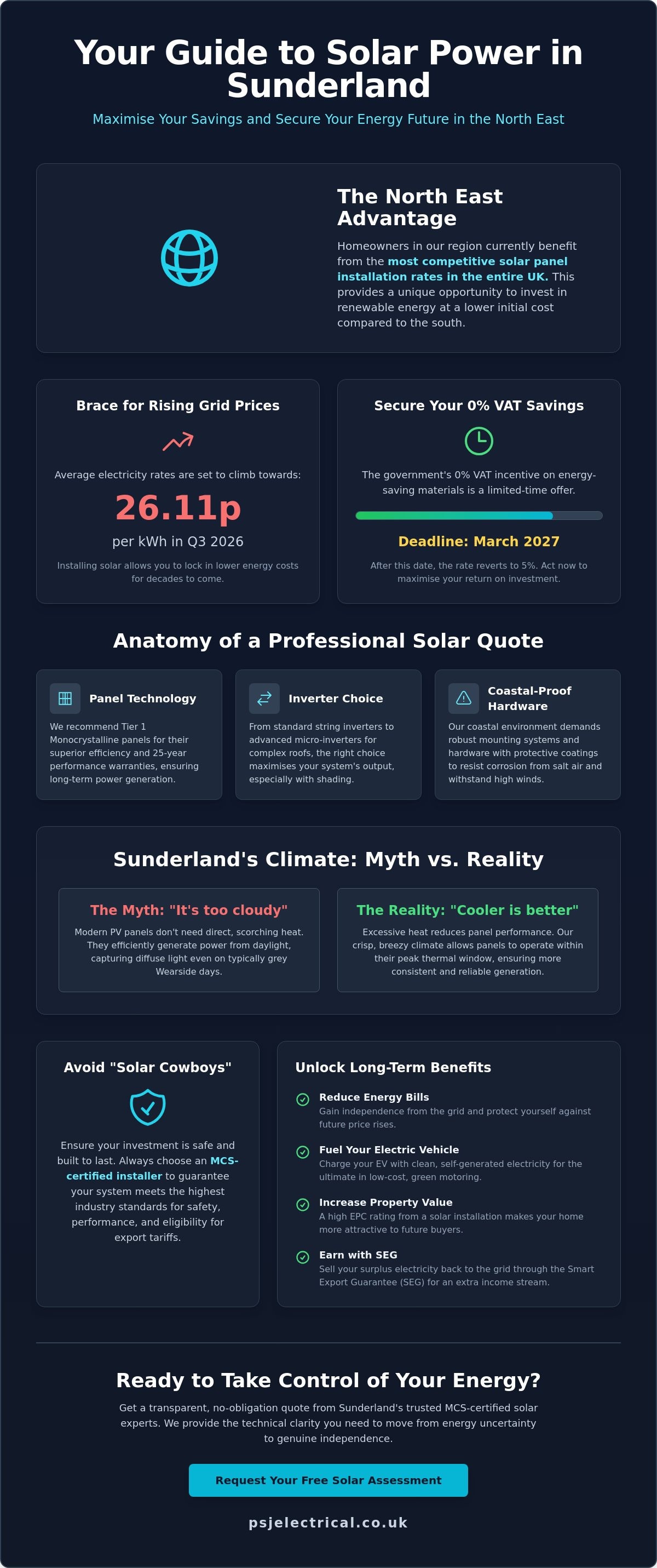
Did you know that homeowners in the North East currently benefit from the most competitive solar installation rates in the country? It is a significant regional advantage, yet many people still feel understandably cautious when researching the solar panel cost Sunderland providers are offering. You’re likely tired of seeing your electricity rates climb towards 26.11p per kWh whilst worrying if your roof can withstand the salt air and coastal winds of our region. It’s a common concern, especially when you want to ensure your investment is handled by a reliable local expert rather than an unqualified contractor.
We believe that transparency is the foundation of a high-caliber installation. This guide will show you how to maximise your return on investment by using the current 0% VAT incentives and high-efficiency hardware designed for the North East climate. You’ll learn how to navigate the latest Smart Export Guarantee rates and exactly what to look for in a professional, MCS-certified team. We’ll provide the technical clarity you need to move from energy uncertainty to genuine independence with a system built to last for decades.
Key Takeaways
- Discover why the North East currently offers some of the most competitive regional pricing for renewable energy installations in the UK.
- Learn how to accurately evaluate the solar panel cost Sunderland homeowners can expect by balancing system size with long-term panel efficiency.
- Understand how to leverage the 0% VAT incentive and Smart Export Guarantee (SEG) to accelerate your return on investment before tax rates change in 2027.
- Identify the essential electrical safety requirements, such as consumer unit compatibility, that ensure your solar PV system integrates safely with your home’s wiring.
- Gain professional insight into selecting an MCS-certified installer to avoid “solar cowboys” and ensure your system is built for coastal durability.
Understanding Solar Panel Cost in Sunderland for 2026
Sunderland isn’t exactly known for being a tropical paradise, but the idea that our region is too cloudy for renewable energy is a persistent misconception. Modern photovoltaic technology doesn’t require direct, scorching heat to generate electricity. Instead, it relies on daylight. Even on typical grey Wearside days, these systems capture diffuse light to power your home. Understanding how solar panels work helps clarify why our local climate is actually well-suited for high-efficiency generation. Ultimately, the total solar panel cost in Sunderland is a variable investment determined by the system’s kilowatt (kW) capacity and the specific durability of the hardware selected.
The year 2026 represents a critical window for homeowners. With the 0% VAT incentive scheduled to revert to 5% in March 2027, this is the final full year to secure maximum tax savings on your installation. A comprehensive quote involves more than just the panels themselves. It encompasses high-grade mounting hardware, professional scaffolding for safe access, MCS-certified labour, and the necessary electrical certifications. By investing now, you’re locking in lower operational costs before the Ofgem energy price cap rises to an average electricity rate of 26.11p per kWh in the third quarter of 2026. Interestingly, the North East remains the region with the lowest average installation costs in the UK, making the solar panel cost Sunderland residents pay more competitive than in the south.
Why Sunderland Homeowners are Switching to Solar
Wearside residents are increasingly looking for stability against volatile energy markets. As the average household energy bill remains high, solar provides a predictable ceiling on monthly outgoings. This shift is also driven by the rapid adoption of electric vehicles and electric heating in the North East. Integrating solar panels with an EV charger allows you to fuel your car with self-generated power, significantly reducing your reliance on the grid. Additionally, a high EPC rating achieved through solar adoption can enhance local property values, making your home more attractive to future buyers in a competitive market.
The Impact of the North East Climate on Generation
Our coastal environment presents unique challenges that standard budget installations often overlook. Salt air can be corrosive; therefore, we prioritise hardware with high-grade protective coatings and robust mounting systems designed to withstand North Sea gusts. Whilst Sunderland may have slightly fewer sunshine hours than the south coast, the cooler ambient temperatures in the North East actually improve panel efficiency. Overheating can reduce performance. Our crisp, breezy climate allows panels to operate at their peak thermal window more consistently than they would in hotter, stifling climates, ensuring reliable generation throughout the year.
Key Factors Influencing Your Solar PV Quote
When requesting a quote, you’ll find that several technical variables dictate the final investment. It isn’t just about the number of panels on the roof; it’s about matching the total kW output to your household’s unique consumption patterns. A system that is too small won’t offer the energy independence you desire, whilst an oversized system might extend your payback period unnecessarily. According to this Energy Saving Trust guide, understanding your annual electricity usage is the first step in determining the right scale for your project.
The solar panel cost Sunderland installers provide also reflects the quality of hardware. We recommend Tier 1 monocrystalline panels because they offer superior efficiency and durability compared to budget alternatives. In our coastal climate, cheap components are a false economy. Salt air and high humidity can lead to premature degradation, so we prioritise hardware backed by 25-year performance warranties. If you’re unsure which system size fits your roof, you can speak with our engineering team for a technical assessment of your property.
Inverter choice is another critical factor. Whilst string inverters are the standard for many, micro-inverters are often better for Sunderland’s varied architecture, especially if your roof suffers from shading from neighbouring chimneys or trees. Additionally, the complexity of your roof dictates the scaffolding requirements. A steep Victorian gable requires more intricate access planning than a modern semi-detached property, which naturally influences the labour and safety costs of the project.
Choosing Hardware for Longevity
Coastal properties face specific environmental stressors that standard budget installations often ignore. High-wind mounting systems are essential for homes near the seafront to prevent panel lift during winter storms. We also consider inverter placement carefully. Whilst external mounting is possible, housing the inverter in a garage or loft space often extends its lifespan by protecting it from the North East’s damp weather and salt-heavy air.
Battery Storage: Is the Extra Cost Worth It?
Adding a battery increases the initial outlay but often accelerates your return on investment by allowing you to use solar power after the sun goes down. This is particularly beneficial for those working during the day who consume most of their energy in the evenings. For residents in more rural areas of the North East, a battery also provides peace of mind by offering backup power during grid fluctuations. If you are researching regional options, you might find our guide on the cost of solar panels Newcastle homeowners expect useful for comparing local market rates. Homeowners in nearby County Durham communities may also benefit from reading our detailed solar panel installation Consett planning guide, which covers structural assessments, local permitted development rules, and SEG payment timelines relevant to the wider North East region.
Financial Incentives and Annual Savings for Wearside Residents
Whilst the initial investment is a primary consideration, the various financial incentives available in 2026 significantly offset the solar panel cost Sunderland homeowners face. The financial landscape for renewable energy has matured, moving away from simple subsidies toward sophisticated smart tariffs and tax breaks that reward efficient energy management. By combining these incentives, many residents in the North East find that their systems pay for themselves much faster than they originally anticipated.
The most immediate benefit is the Smart Export Guarantee (SEG), a government-mandated scheme that ensures you are paid for every unit of surplus electricity you send back to the National Grid. In Sunderland, where daylight hours are consistent despite the occasional cloud cover, a typical 3.5kWp system can generate a meaningful annual income. Revenue generated through Smart Export Guarantee (SEG) payments acts as a consistent annual rebate that directly contributes to the long-term profitability of your solar investment. Beyond the SEG, smart tariffs like Octopus Flux or Agile allow you to automate your battery storage to buy electricity when it is cheapest and sell it back during peak demand periods, further maximising your monthly savings.
The 0% VAT Rule Explained
The UK government currently supports solar adoption by applying a 0% VAT rate on the installation of energy-saving materials, including solar panels and battery storage. This incentive is confirmed to remain in place until 31 March 2027, making 2026 the final full year to take advantage of these significant savings before the rate is expected to revert to 5%. It is important to distinguish that this 0% rate only applies when the hardware and professional installation are provided as a single service; purchasing panels on a “supply-only” basis usually incurs the full 20% VAT rate, which often negates any perceived savings from a DIY approach.
Calculating Your Payback Period
In the North East, the average payback period for a standard solar PV system typically falls between 6 and 10 years. This window is narrowing as grid electricity prices continue to fluctuate, with the Ofgem price cap for late 2026 set at 26.11p per kWh. Every time the cost of importing energy rises, the value of the electricity you generate yourself increases, effectively “locking in” your energy costs at a much lower rate. For those on qualifying benefits or living in properties with an EPC rating of D or lower, it is also worth investigating the ECO4 scheme, which can provide substantial funding for solar installations in specific Sunderland postcodes.
Avoiding Hidden Costs: The Importance of Professional Electrical Integration
A successful solar project relies on more than just the quality of the photovoltaic cells on your roof; it depends entirely on the integrity of your home’s existing electrical network. Many homeowners focus solely on the solar panel cost Sunderland quotes provide, yet they overlook the technical requirements of connecting a high-load power generation system to an older property. A solar array is a sophisticated power station that must be integrated safely to prevent overheating, electrical faults, or system failure. We often find that the most reliable installations are those where the engineer takes a “whole-house” approach rather than treating the solar panels as a standalone appliance.
One of the most common hidden costs arises when a “solar-only” fitter ignores fundamental safety standards. For your system to be both legal and insurable, it must be installed by an MCS-accredited professional. This certification isn’t just a badge; it’s a requirement for accessing the Smart Export Guarantee (SEG) payments mentioned earlier and ensures your system meets rigorous UK safety standards. Without this, you may find yourself with a system that generates power but cannot legally be connected to the grid or covered by your home insurance provider. If you want to ensure every stage of your project meets the highest standards, our solar panel installation Durham checklist provides a comprehensive, engineer-led roadmap that North East homeowners can use to verify their property’s readiness before work begins.
The Role of the Consumer Unit
The consumer unit, or fuse box, is the heart of your home’s electrics. In many of Sunderland’s older properties, the existing equipment lacks the necessary safety features to handle the bi-directional flow of electricity that solar requires. Modern systems must comply with BS 7671 wiring regulations, which often necessitate the inclusion of Type A RCDs and surge protection devices to protect your sensitive electronics from voltage spikes. If your current system is outdated, you should consider replacing old fuse boards Newcastle and Sunderland specialists recommend before proceeding with your solar array. This ensures your home can safely manage the increased load and provides a stable foundation for your renewable energy investment.
Vetting Your Sunderland Solar Fitter
When choosing a contractor, it’s vital to ask about their experience with the specific electrical demands of the North East. We recommend requesting a comprehensive Electrical Installation Condition Report (EICR) before any panels are fixed to your roof. This report identifies any underlying wiring issues that could be exacerbated by a solar installation. Our extensive experience as solar panel installers Newcastle and Wearside residents trust means we understand how to navigate the complexities of both Victorian terraces and modern coastal developments. If you want to ensure your property is ready for a safe, high-performance upgrade, you can book a technical safety assessment with our team today.
Choosing PSJ Electrical for Your Sunderland Solar Project
Selecting the right installer is just as critical as the hardware itself. With over 19 years of electrical engineering experience across the North East, PSJ Electrical brings a level of technical proficiency that goes beyond simple panel fitting. We understand that your solar panel cost Sunderland investment deserves a system designed for longevity, safety, and peak performance. Unlike national firms that often rely on high-pressure sales tactics and generic templates, we offer a transparent, service-oriented approach that prioritises the technical requirements of your specific property.
Our deep roots in the trade mean we don’t just look at your roof; we look at your entire home. Because we are specialists in full house rewiring North East homeowners trust, we ensure your solar PV array is built on a modern, safe foundation. This comprehensive perspective allows us to integrate battery storage and EV charging points seamlessly into your existing electrical system. We ensure every component communicates correctly and operates at peak efficiency, providing you with a future-proof energy solution rather than a series of disconnected upgrades.
Our Local Commitment to Quality
We take immense pride in serving Sunderland, Durham, and Newcastle with precision and care. Our reputation is built on using only Tier 1 components that have been rigorously tested for the specific demands of the UK climate. When you work with us, you have direct access to our engineering team. We don’t use subcontractors or third-party salesmen. Instead, you deal with the specialists who are actually responsible for the quality and safety of your installation, ensuring clear communication from the initial survey to the final certification.
Next Steps for Your Sunderland Home
Your journey towards energy independence begins with a professional site survey. We assess your roof’s orientation, structural suitability, and existing electrical capacity to provide a realistic projection of your generation potential. We believe in providing facts rather than inflated promises, allowing you to make an informed decision about your investment. During the installation phase, our team follows a methodical and clean process, ensuring minimal disruption to your daily routine whilst maintaining the highest standards of workmanship. Contact us today for a transparent, no-obligation quote and discover how a bespoke solar solution can transform your home’s energy profile for 2026 and beyond.
Secure Your Wearside Energy Future
We’ve explored how the North East currently offers the most competitive regional rates in the UK and why 2026 is a pivotal time to act before VAT incentives change. A successful installation isn’t just about the panels; it’s about ensuring your home’s electrical foundation is robust enough to handle modern generation. By choosing high-efficiency hardware designed for our coastal climate, you can protect your household against volatile energy price caps whilst earning through smart export tariffs. Evaluating the total solar panel cost Sunderland homeowners face requires a balance of quality hardware and expert installation to ensure long-term ROI.
With over 19 years of industry experience, our MCS-accredited installers specialise in full property electrical modernisation to ensure your system is safe and efficient. We take pride in helping our local community transition to renewable energy with technical precision and honest, professional advice. Request a Professional Solar Survey from PSJ Electrical Today. Taking control of your energy future has never been more accessible or technically sound.
Frequently Asked Questions
Are solar panels worth it in Sunderland given the lack of sun?
Yes, solar panels are highly effective in Sunderland because they generate electricity from daylight rather than direct heat. Modern photovoltaic technology is designed to capture diffuse light, meaning your system will still produce power on typical overcast North East days. Interestingly, the cooler ambient temperatures in our region can actually improve panel efficiency by preventing the hardware from overheating, which often leads to more consistent performance than in much hotter climates.
How much does a typical 4kW solar panel system cost in Sunderland?
The total solar panel cost Sunderland homeowners pay is influenced by several variables including the type of roof, scaffolding requirements, and the quality of the selected panels. Whilst the North East currently offers some of the most competitive installation rates in the UK, your final quote will depend on whether you opt for high-efficiency Tier 1 monocrystalline panels and whether you choose to integrate battery storage from the outset to maximise your long-term savings.
Do I need planning permission for solar panels in Sunderland?
Most domestic solar installations are considered “permitted development” and do not require formal planning permission from Sunderland City Council. However, there are specific exceptions for listed buildings or properties located within conservation areas, such as parts of Ashbrooke or Roker. It is always a sensible precaution to verify your property’s status, but for the vast majority of semi-detached and detached homes, the process is straightforward and requires no local authority applications.
Will solar panels work during a power cut?
Standard grid-tied solar systems are designed to shut down automatically during a power cut to protect utility workers from “islanding” or back-feeding electricity into the grid. If you require power during a blackout, you will need to install a battery storage system equipped with an Emergency Power Supply (EPS) or “island mode” function. This allows your home to operate independently of the National Grid using the energy stored in your battery cells.
Can I add a battery to my existing solar panels later?
Yes, most existing solar PV systems can be retrofitted with battery storage at a later date. This is typically achieved by installing an AC-coupled battery or by upgrading your existing string inverter to a hybrid model that can manage both the panels and the battery. Retrofitting is a popular option for homeowners who want to spread the cost of their renewable transition whilst still increasing their self-consumption of generated power.
How long does it take to install solar panels on a Sunderland home?
A standard domestic installation is usually completed within one to two working days. The first stage involves the safe erection of scaffolding, followed by the mounting of the roof rails and panels. Our electrical team then completes the internal wiring and system commissioning. Whilst the physical installation is relatively quick, we take the time to ensure every connection is tested and that you fully understand how to monitor your new system’s performance.
Do I need to upgrade my fuse box before installing solar PV?
It depends on the age and technical specifications of your current consumer unit. For a safe and compliant installation, your fuse box must be able to accommodate the additional load and include specific safety features like Type A RCDs and surge protection. If your existing board is outdated, a fuse box replacement may be necessary to meet current UK Wiring Regulations and ensure your home’s electrical system remains stable and protected.
How do I get paid for the extra energy my solar panels produce?
You can earn money for your surplus electricity through the Smart Export Guarantee (SEG). Once your system is installed by an MCS-certified professional, you can apply to an energy supplier for an export tariff. You will need a smart meter to accurately track the units of electricity you send back to the grid. Rates vary between providers, so we recommend comparing different tariffs to find the most profitable return for your exported energy.