
With the North East currently recording the lowest density of rapid public chargers in England, your driveway has become your most essential piece of infrastructure. If you’ve invested in a high-performance electric vehicle, you shouldn’t have to compromise on the electrical safety or the aesthetic appeal of your property. Finding a specialist for EV charger installation Ponteland homeowners can rely on is about more than simple connectivity; it’s about ensuring your home’s electrical system is managed with precision and care.
It’s natural to feel concerned about how a high-load charger might affect your existing circuits or whether a bulky unit will detract from the character of a Darras Hall estate. You likely want a solution that integrates with your solar panels whilst maintaining a clean, professional finish. This guide provides the expert advice you need to transition safely to electric driving. We’ll explain the practical differences between tethered and untethered units, clarify the mandatory DNO notification process, and show you how a certified installation ensures your home remains both functional and beautiful.
Key Takeaways
- Learn how to assess your home’s electrical capacity and why the Distribution Network Operator (DNO) must be informed to ensure a safe, compliant connection.
- Discover why professional EV charger installation Ponteland specialists focus on discreet cabling and unit placement to maintain the kerb appeal of premium properties.
- Compare tethered and untethered options to find the right balance between the convenience of a permanent cable and the cleaner look of a socket-only unit.
- Understand the benefits of solar matching, which allows you to power your vehicle using surplus energy from your own photovoltaic panels.
- Prepare for the installation day by knowing exactly what a specialist looks for during the initial site survey and how they plan the most efficient cable routes.
Transitioning to Electric: The Growth of EV Charging in Ponteland
The North East of England is currently experiencing a significant transformation in how residents approach personal transport. Whilst the region saw a 41% year-on-year increase in charging devices by mid-2025, the density of public infrastructure remains amongst the lowest in the country. For homeowners in Ponteland and the surrounding Northumberland countryside, this makes the installation of a private electric vehicle charging station a practical necessity rather than a luxury. Relying on public networks often leads to frustration; having a dedicated point at home ensures your vehicle is ready whenever you are.
Home charging represents the most cost-effective method for powering an electric vehicle. By utilising domestic electricity rates, particularly those designed for EV owners, you can significantly reduce your cost-per-mile compared to petrol or public rapid-charging alternatives. Achieving these savings requires more than just a plug. A professional EV charger installation Ponteland service ensures that your system is optimised for your specific property, taking into account the unique requirements of local grid connections and the high standards expected in premium residential areas like Darras Hall.
The Benefits of a Dedicated Home Charging Point
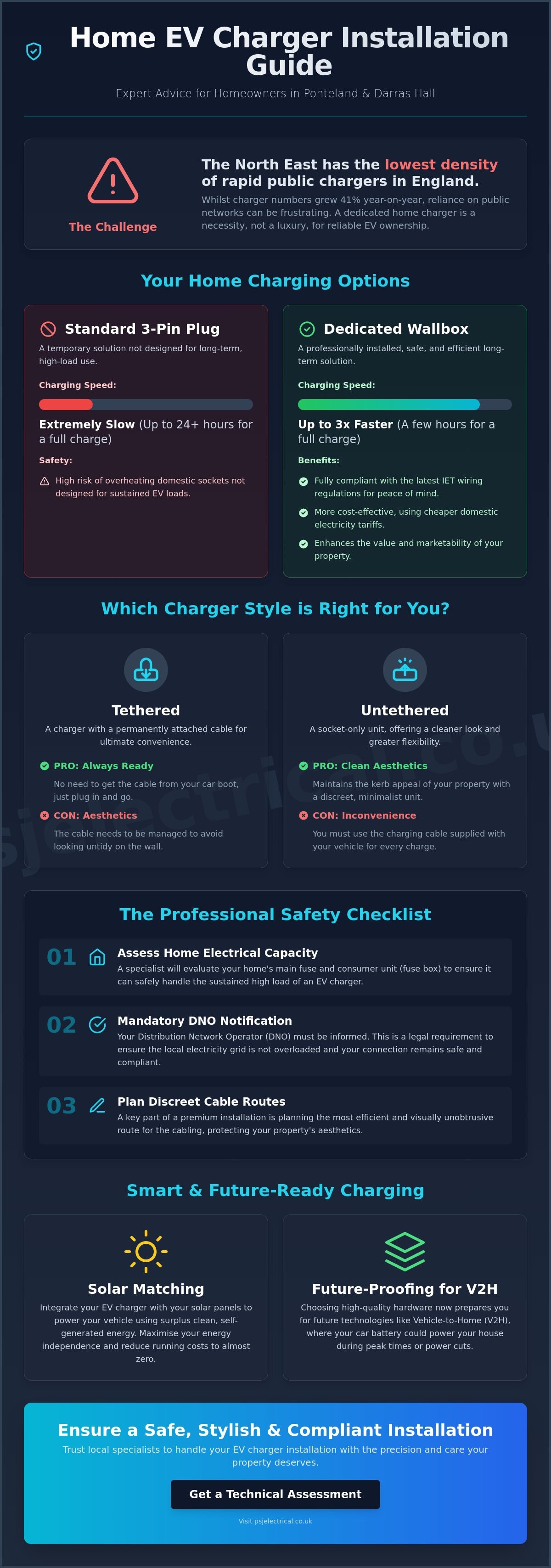
Many new EV owners initially attempt to use a standard 3-pin “granny cable” for charging. This is rarely a long-term solution. A dedicated wallbox is typically three times faster than a domestic socket, reducing a full charge from an entire day to just a few hours. Safety is the primary concern here. Standard domestic sockets aren’t designed for the sustained high-load draw required by an EV, which can lead to overheating. A professionally installed unit is a permanent asset that can enhance the marketability and property value of homes in central Ponteland. Investing in a specialist EV charger installation Ponteland ensures your equipment is installed to the latest IET wiring regulations, providing peace of mind for years to come.
Future-Proofing Your Home for 2026 and Beyond
Modern charging technology is evolving to do more than just deliver power. Current smart charging regulations already mandate features that help balance the grid, but the next step involves deeper integration with your home’s energy ecosystem. By choosing high-quality hardware now, you prepare your property for future advancements like vehicle-to-home (V2H) technology, where your car battery could potentially power your house during peak times. This approach works best when aligned with broader renewable energy solutions North East homeowners are adopting, such as solar panels. Integrating these systems allows you to charge your vehicle using clean, self-generated energy, providing a level of energy independence that was previously impossible.
Assessing Your Property: Technical Requirements for a Safe Installation
Before the first cable is laid, a successful EV charger installation Ponteland project begins with a thorough evaluation of your property’s electrical infrastructure. Unlike smaller domestic appliances, an electric vehicle charger draws a significant, sustained current for several hours. This puts a unique level of stress on your home’s wiring. For the established properties found throughout Ponteland and Darras Hall, this often means checking that the existing system is robust enough to handle the increased demand without compromising safety or reliability.
One primary concern for homeowners is the risk of overloading the main house fuse. Professional installers use a technique called load balancing to manage this. By installing a smart sensor at your incoming power supply, the charger can automatically reduce its output if other high-power appliances, such as electric showers or ovens, are in use. This prevents the main fuse from tripping, ensuring your home remains powered whilst your vehicle charges in the background. If you’re unsure about your current capacity, you can get in touch for a technical assessment of your home’s readiness.
Consumer Unit Capacity and Upgrades
Your consumer unit, or fuse box, is the heart of your electrical system. Many older properties in the North East may still rely on outdated boards that lack modern safety features. To meet current standards, your system must include a Surge Protection Device (SPD) and a Type A RCD capable of detecting DC leakage from the car battery. If your current board is full or lacks these protections, you might consider replacing old fuse boards Newcastle homeowners often find necessary before adding high-load technology. A modern, compliant consumer unit provides the essential foundation for a safe, long-term charging solution.
The DNO Notification Process Explained
The Distribution Network Operator (DNO), which is Northern Powergrid in our region, is responsible for the cables and towers that bring electricity to your door. They must be informed of any EV charger installation Ponteland to ensure the local grid can cope with the cumulative load of multiple EVs in the neighbourhood. For most standard installations, we follow a “Connect and Notify” process after the work is complete. However, larger homes with high power demands may require an “Apply to Connect” procedure beforehand. Following the IET Code of Practice for EV Charger Installation, we handle all this technical paperwork on your behalf, ensuring your installation is fully authorised and recorded with the authorities.
Choosing Your Charger: Functionality, Aesthetics, and Smart Features
Selecting the hardware for your EV charger installation Ponteland project is a decision that affects both the daily usability and the visual profile of your driveway. There are two primary configurations to consider: tethered and untethered. A tethered unit comes with a permanently attached cable, offering the convenience of simply plugging in without retrieving a lead from your boot. Conversely, an untethered unit features a discreet socket, allowing you to use your own cable whilst maintaining a cleaner, more minimalist appearance on the exterior of your property. For many residents in Darras Hall, the untethered option is often preferred for its ability to blend into the architecture of premium homes. Before committing to any hardware, it’s worth consulting our guide to evaluating EV charging station contractors to ensure you’re selecting both the right equipment and the right installation team for your property.
Durability is another critical factor when choosing a unit. The North East climate, characterised by driving rain and coastal winds, requires hardware with high IP (Ingress Protection) ratings. We ensure that the units we recommend are built to withstand these conditions, preventing moisture ingress and ensuring the internal electronics remain protected for the long term. This focus on caliber ensures your investment remains functional regardless of the Northumberland weather.
Integrating Solar PV with Your EV Charger
If your property already benefits from renewable generation, you can significantly enhance your return on investment through solar matching. This technology allows your charger to communicate with your solar array, directing only the “excess” energy, which is power that would otherwise be exported to the grid, directly into your vehicle’s battery. By working with experienced solar panel installers Newcastle specialists, you can create a closed-loop energy system where your car is powered entirely by the sun. This synergy reduces your reliance on the national grid and ensures your driving is as carbon-neutral as possible.
Smart Features and Mobile App Connectivity
Since June 2022, all new domestic chargers must be “smart” by law to help manage grid stability. These regulations ensure that units can default to off-peak charging times, typically avoiding the high-demand periods between 8 am and 11 am, and 4 pm to 10 pm on weekdays. Modern app connectivity allows you to manage these schedules with precision. You can easily:
- Optimise Costs: Schedule charges to coincide with low-cost overnight tariffs like Octopus Agile.
- Track Usage: Monitor real-time energy consumption for personal budgeting or business expense claims.
- Enhance Security: Utilise features such as RFID card access or remote app-locking to prevent unauthorised use.
This level of control ensures your EV charger installation Ponteland is not just a power source, but a sophisticated energy management tool that fits your lifestyle.
The Professional Installation Journey: What to Expect on the Day
Understanding the chronological steps of a professional EV charger installation Ponteland project helps ensure the process is as smooth as possible. A typical installation is not a mere “plug and play” exercise; it is a structured engineering task that requires precision to maintain the safety and integrity of your home’s electrical system. From the moment our engineers arrive, the focus is on a methodical approach that prioritises technical standards whilst respecting the aesthetics of your property.
Site Survey and Cable Routing
The journey begins with a final site survey to confirm the most efficient and discreet cable route. For premium properties in areas like Darras Hall, the visual impact of the installation is often a primary concern. We discuss various options with you, such as burying cables beneath driveways or utilizing high-quality, colour-matched conduit for surface-mounted runs. This stage also involves assessing the Wi-Fi signal strength at the proposed charger location. Since 2026 smart charging regulations require units to be constantly connected for software updates and grid management, a stable data connection is just as vital as the power supply itself.
Once the route is agreed upon, the physical work commences. This includes mounting the unit securely to an external wall or a dedicated pedestal and drilling any necessary entry points for the cabling. Our engineers take great care to ensure these penetrations are fully weather-sealed, preventing any moisture ingress. The internal work involves integrating the new circuit with your consumer unit, often requiring the addition of dedicated safety breakers that we discussed in previous sections regarding property assessments.
Testing and Certification Requirements
Commissioning the unit is perhaps the most critical phase. This involves more than just checking if the car starts charging. We perform a series of rigorous safety tests to ensure the earthing system is adequate and that the RCD protection trips correctly under fault conditions. These results are recorded as part of a formal electrical installation condition report eicr or a specific minor works certificate. This documentation is essential for your home insurance and provides proof that the work complies with Part P of the Building Regulations.
The final step is the handover. We guide you through the mobile application setup, ensuring you can manage your charging schedules and take advantage of off-peak energy rates. We also explain the mandatory smart features, such as the randomized delay function, which is designed to prevent local grid spikes. To ensure your home is ready for the future of electric driving, you can book your professional installation survey today and speak with one of our qualified engineers.
PSJ Electrical: Your Local Experts for EV Charging in Ponteland
PSJ Electrical brings over 19 years of specialist electrical engineering experience to every project we undertake. For a high-quality EV charger installation Ponteland residents require a team that understands the nuances of local infrastructure, particularly in established areas like Darras Hall. We don’t view a charger as a standalone appliance. Instead, we treat your property as a single, integrated ecosystem. Our comprehensive expertise allows us to manage everything from fuse box replacements to full re-wires, ensuring that your home’s foundation is ready for the demands of modern electric driving.
Our local knowledge is a significant advantage when navigating the specific requirements of the Northumberland grid. We’ve built our reputation on a foundation of quiet confidence and professional reliability, avoiding the high-pressure tactics often found in the industry. By choosing a specialist with deep roots in the North East, you’re investing in a partner who understands the long-term value of your property and the technical precision required to maintain it. Homeowners across the wider region can also benefit from our detailed overview of electric car charger home installation Newcastle residents use to understand the full scope of 2026 wiring regulations and compliance requirements.
Our Commitment to Quality and Safety
We believe that safety should never be sacrificed for speed. Every installation we perform is built to last, utilising premium components and adhering strictly to the latest wiring regulations. We refuse to cut corners on essential elements like cable sizing or the integration of advanced protective devices. This commitment to caliber provides you with the peace of mind that your system is robust enough for daily use over many years. As a local firm, we pride ourselves on transparency and reliability. You’ll always have access to direct, professional support from engineers who value craftsmanship as much as you value your home.
Bespoke Solutions for Commercial and Domestic Clients
Our services are tailored to meet the specific needs of both domestic and commercial clients. We understand that a multi-car household in Ponteland has different requirements than a small business looking to provide staff charging. For those managing larger fleets or office car parks, we also serve as workplace EV charger installers Durham and Northumberland organisations trust for complex, multi-socket deployments. We handle the entire project lifecycle, including the administrative burden of local authority and DNO notifications. If you’re ready to move forward with a methodical, professional approach, please contact our team to arrange your initial site survey.
Secure Your Home’s Energy Independence
Transitioning to an electric vehicle is a significant step towards a more sustainable lifestyle, but it requires an electrical system that is up to the task. From ensuring your consumer unit can handle the load to choosing a unit that complements the aesthetic of your property, the details matter. A professional EV charger installation Ponteland project provides more than just a place to plug in; it offers the peace of mind that your home remains safe and efficient whilst you enjoy the benefits of cheaper, cleaner driving.
As NAPIT-approved contractors with over 19 years of specialist engineering experience, we’re here to guide you through every stage of the process. Whether you’re looking to integrate your charger with solar panels or require a full re-wire to support new technology, our team delivers the high-calibre workmanship your property deserves. You can Book Your Ponteland EV Site Survey with PSJ Electrical today to begin your journey with a methodical, expert assessment. We look forward to helping you make the switch with confidence.
Frequently Asked Questions
Do I need to upgrade my fuse box to install an EV charger in Ponteland?
You don’t always need a full upgrade, but your consumer unit must have sufficient spare capacity and modern safety features to handle the load. A professional EV charger installation Ponteland requires a Type A RCD and surge protection to comply with current wiring regulations. If your current board is outdated or lacks these specific safety devices, we’ll recommend a fuse box replacement to ensure your home’s electrical system remains stable.
How long does a typical EV charger installation take to complete?
A standard installation usually takes between three and five hours to complete. This timeframe includes the physical mounting of the unit, the cable routing, and the final commissioning of smart features and safety tests. If your property requires more complex cable runs or a consumer unit upgrade, the process may take slightly longer. We always provide a clear estimate of the expected duration following your initial site survey.
Can I install an EV charger if I have solar panels on my roof?
Yes, and integrating these systems is one of the most efficient ways to power your vehicle. By selecting a charger with solar matching capabilities, you can prioritise using excess energy generated by your panels rather than drawing from the national grid. This synergy maximises the return on your solar investment whilst significantly reducing your daily driving costs and overall carbon footprint.
Is there still a government grant available for home EV chargers in 2026?
As of June 2026, the EV chargepoint grant provides up to £500 for specific groups, including renters and flat owners. Landlords can also claim up to £500 per socket for up to 200 sockets across their portfolio. These grants are currently scheduled to remain available until March 31, 2027. We can help you determine if your specific property and tenure status qualify for this financial support during our consultation.
Can I charge my electric car using a standard 3-pin outdoor socket?
Whilst you can use a standard socket for occasional emergency charging, it’s not a recommended long-term solution. Standard domestic sockets aren’t designed for the sustained high loads required to charge an EV battery, which can lead to overheating or circuit failure. A dedicated wallbox is far safer, more durable, and provides significantly faster charging speeds, making it the standard choice for daily use.
What is a DNO notification and do I have to do it myself?
A DNO notification is a formal process of informing Northern Powergrid that a new high-load device has been added to the local network. This ensures the regional grid can manage the cumulative demand effectively and maintain stability. You don’t need to handle this yourself; as part of a professional EV charger installation Ponteland, we manage all necessary paperwork and notifications on your behalf to ensure full compliance.
What is the difference between a tethered and an untethered EV charger?
The primary difference lies in the cable configuration. A tethered charger has a permanently attached cable, offering the convenience of a “grab and go” system without needing to retrieve a lead from your boot. An untethered charger features a socket where you plug in your own separate cable. Many homeowners prefer the untethered option because it looks neater on the property’s exterior and provides flexibility if you change car models.