
Choosing the wrong installer for your electric vehicle charger isn’t just a minor inconvenience; it’s a risk to your property’s entire electrical infrastructure. Many North East property owners feel a genuine sense of hesitation when navigating OZEV grant eligibility or worrying if a new charger might overload their existing fuse box. It’s natural to feel overwhelmed by the technical jargon surrounding hardware brands and the latest safety standards. Finding reliable ev charging station contractors who understand the specific requirements of local electrical systems is the most vital step in your transition to electric driving.
You deserve the peace of mind that comes from a certified installation that protects your home whilst powering your vehicle efficiently. This guide will teach you how to evaluate and select the right professionals to ensure your setup is safe, compliant with the latest regulations, and future-proofed for years to come. We will examine how to identify quality workmanship, choose the best hardware for your specific car, and ensure your property remains perfectly balanced under its new electrical load.
Key Takeaways
- Distinguish between a basic hardware fitting and a professional engineering solution by understanding the unique role of specialist ev charging station contractors.
- Identify the essential NICEIC and OZEV credentials that guarantee a safe installation whilst ensuring you remain eligible for available government grants.
- Master the five-step selection process to evaluate your home’s electrical capacity and determine the most efficient charging speeds for your specific vehicle.
- Address specific North East environmental factors, including grid capacity in residential areas and the necessity for durable, weatherproof hardware.
- Learn how a comprehensive approach to installation, including potential fuse box upgrades, ensures your property remains safe and future-proofed against rising electrical demands.
Why You Need Specialist EV Charging Station Contractors
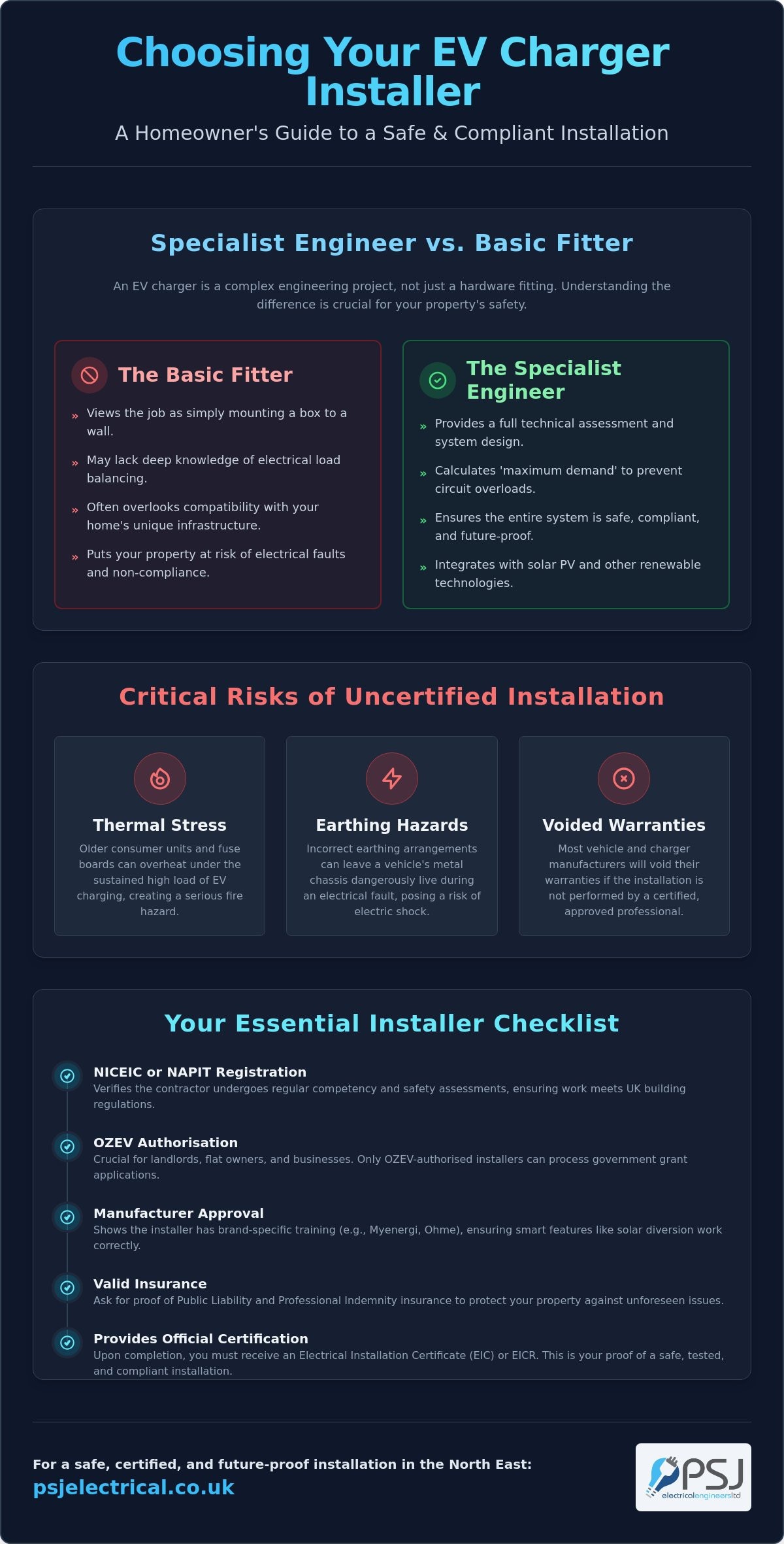
A specialist contractor provides the essential technical assessment, hardware procurement, and certified installation of Electric Vehicle Supply Equipment (EVSE). Whilst it might be tempting to view this as a simple task of mounting a box to a wall, it is actually a complex engineering project that requires a deep understanding of load balancing. There is a profound difference between a basic “fitter” and an electrical engineer with over 19 years of experience. A fitter might simply install the hardware you’ve purchased, but an engineer ensures that the EV charging station technology is fully compatible with your home’s unique infrastructure.
General electrical knowledge often falls short because EV charging represents a continuous, high-load demand that most domestic circuits weren’t originally designed to handle. When you engage professional ev charging station contractors, they begin by scrutinising your property’s current state. This often involves a detailed look at your consumer unit and an assessment of whether you need a full house rewiring North East before adding such a significant new load to your system.
The Risks of Non-Specialist Installation
Hiring someone without specific EV credentials carries significant physical and financial risks. These include:
- Thermal Stress: Older consumer units and fuse boards can easily overheat under the sustained pressure of a long charging cycle.
- Earthing Hazards: Incorrect earthing arrangements, such as confusing TT and TN-S systems, can leave a vehicle chassis live during a fault.
- Warranty Issues: Many manufacturers will void your vehicle or charger warranty if the installation isn’t performed by certified ev charging station contractors.
Beyond the Plug: System Integration
Professional contractors look at the bigger picture through “maximum demand” and “diversity” calculations. They determine if your home can run a power-hungry electric shower, an oven, and a car charger simultaneously without tripping the main house fuse. This level of planning is even more vital when integrating chargers with renewable energy solutions North East, such as solar PV arrays. By ensuring every connection meets the latest IET Wiring Regulations (BS 7671), a specialist provides a system that is as durable as it is efficient. They don’t just provide a plug; they provide a gateway to sustainable transport that won’t compromise your home’s safety.
Essential Credentials to Check Before Hiring
Hiring a contractor based on a low quote alone is a gamble that rarely pays off in the long term. For a safe and compliant installation, you must verify that your chosen ev charging station contractors hold the correct professional registrations. A reputable professional will hold either NICEIC or NAPIT registration, which confirms they undergo regular assessments for competency and safety. These bodies ensure that the work carried out on your property meets the rigorous standards of the UK building regulations.
Beyond general electrical registrations, specific manufacturer-specific training is vital. When a contractor is an “approved installer” for brands like Myenergi or Ohme, they have direct access to technical support and understand the nuances of that specific hardware. This expertise ensures that smart features, such as solar diversion or off-peak scheduling, actually work as intended. Before work begins, you should also confirm the contractor holds valid public liability and professional indemnity insurance to protect your property against any unforeseen issues during the installation process.
Once the physical work is complete, a professional must provide you with a formal electrical installation condition report eicr or an Electrical Installation Certificate. This document is your proof that the new circuit is safe and has been tested under load.
OZEV Approval and Grant Eligibility
If you are a landlord or a business owner, OZEV (Office for Zero Emission Vehicles) authorisation is perhaps the most critical credential to check. Only authorised ev charging station contractors can help you access government funding, such as the EV infrastructure grant. As of June 2026, many federal and local incentives are reaching critical deadlines. For example, the Section 30C tax credit for commercial installations is set to expire on June 30, 2026. A qualified contractor will manage the complex paperwork on your behalf, ensuring you don’t miss out on these significant cost-saving opportunities. If you are unsure about your eligibility, you can speak with our team for professional advice on current funding cycles.
Technical Competency and Certifications
The technical landscape is shifting rapidly. The 2026 NEC regulations, which become effective on September 1, 2026, mandate that hardwired EVSE must be installed by a “qualified person.” This professionalisation of the industry aligns with global standards such as EV charging installer certification programs. Contractors must demonstrate a clear understanding of load-balancing technology to prevent your main fuse from tripping. In many older North East properties, this technical assessment often reveals the need for replacing old fuse boards Newcastle to ensure the system can handle the 5-milliamp Class A GFCI protection now required for modern charging circuits. Always ask to see a portfolio of similar local installs to verify their experience with these specific technical challenges.
The Contractor selection Process: A 5-Step Guide
Selecting ev charging station contractors requires a methodical approach to ensure the final result is both safe and convenient. The process is not merely about the day of the installation; it is about the technical diligence that precedes it. A structured journey from the first enquiry to the final handover ensures that your property’s electrical integrity remains intact whilst providing a reliable power source for your vehicle.
The standard professional engagement follows five distinct stages:
- Initial Consultation: This involves a thorough discussion regarding your specific vehicle type, your average daily mileage, and your preferred charging speeds to determine the most suitable hardware.
- The Physical Site Survey: An engineer visits your property to inspect the consumer unit and calculate the distance to the parking area.
- Custom Quote and Design: You will receive a bespoke proposal that details the cable routes and helps you decide between tethered units, with a permanent cable, or untethered units that require your own lead.
- Professional Installation: Whilst the physical mounting of the unit may only take a few hours, the careful routing of cables and connection to the mains is the result of hours of prior planning.
- Commissioning and Handover: The final stage includes rigorous safety testing and a demonstration of the smart-charging application.
The Importance of a Physical Site Survey
Whilst some ev charging station contractors offer “remote surveys” via smartphone photographs, these often fail to identify critical complications. In larger properties across Yarm or Durham, a physical inspection is necessary to assess the need for civil works, such as trenching for underground cables. An engineer must evaluate the condition of the main incoming supply and meter tails to ensure they can handle the sustained load. Missing these details at the start can lead to unexpected costs or delays on the day of installation. For Newcastle homeowners specifically, understanding the full scope of a professional electric car charger home installation in Newcastle before committing to a contractor can help you ask the right questions and avoid costly surprises.
Smart Features and Software Setup
Modern charging is as much about software as it is about hardware. Your contractor should take the time to organise your charging schedule, allowing you to take full advantage of off-peak energy tariffs that can significantly reduce your running costs. They will ensure the unit is integrated with your home Wi-Fi for essential firmware updates and demonstrate how to use load-management features. This ensures that your car charges efficiently without ever putting your home’s main fuse at risk of blowing during periods of high domestic demand.
Local Considerations for North East Installations
Installing infrastructure in our region requires an understanding of specific electrical and environmental variables. Professional ev charging station contractors must evaluate local grid capacities, particularly in high-density residential areas where the adoption of electric vehicles is accelerating. Beyond the internal circuitry, the external hardware must be durable enough to withstand the North East climate, from the exposed elevations of Consett to the variable conditions found across Stocksfield and Wynyard. Ensuring that the charging unit is rated for high-impact weather is essential for long-term reliability in these more challenging environments.
Planning permissions are a vital consideration for property owners in historic market towns like Yarm or the cathedral city of Durham. If your property is situated within a conservation area, the installation strategy must respect local heritage guidelines to maintain the aesthetic integrity of the neighbourhood. This often involves discreet cable management and specific hardware placement to minimise visual impact. Choosing ev charging station contractors based within the region, such as in Newcastle or Consett, ensures you are partnering with engineers who possess first-hand experience navigating these local planning nuances and building regulations.
Serving Darras Hall and Ponteland
Large residential estates in Darras Hall and Ponteland present unique infrastructure challenges. Our EV charger installation Ponteland service is designed to manage the high-capacity requirements of multi-car households. In these areas, the cumulative demand of several high-power chargers can occasionally approach the limits of the standard domestic supply. We act as the primary liaison with Northern Powergrid, the local Distribution Network Operator (DNO), to facilitate necessary supply notifications or upgrades. This proactive approach ensures your home’s electrical balance is maintained even during peak evening charging hours when domestic demand is at its highest.
Workplace Charging in Durham and Newcastle
For commercial entities, the deployment of charging points is a strategic move towards meeting Environmental, Social, and Governance (ESG) targets. Our workplace EV charger installers Durham team provides scalable solutions for local firms expanding their electric fleets. This process requires a careful navigation of commercial lease agreements and obtaining the correct permissions from landlords for external modifications. By implementing intelligent load-management systems, we allow businesses in Newcastle and Durham to offer reliable charging without interrupting daily operations. If you are ready to enhance your commercial property’s infrastructure, contact our regional specialists for a tailored site evaluation.
Why PSJ Electrical Engineers Ltd is the Preferred North East Contractor
Choosing between various ev charging station contractors often comes down to a balance of technical trust and local reputation. With over 19 years of engineering excellence, PSJ Electrical Engineers Ltd has built its name on professional reliability and a refusal to cut corners. We serve a vast area across Newcastle, Durham, and the wider North East, providing property owners with the security of a long-standing local presence. Our approach is grounded in the traditional values of craftsmanship, yet we remain at the forefront of modern electrical innovation and environmental standards.
We offer a transparent, fixed-fee quoting structure that removes the fear of hidden “call-out” surprises or unexpected costs. Every project begins with a thorough understanding of the client’s specific needs, ensuring that the hardware we recommend is the perfect match for their vehicle and lifestyle. By managing every aspect of the project, from the initial engineering design to final certification, PSJ Electrical Engineers Ltd provides a seamless experience that prioritises the longevity and safety of your home’s electrical system.
A Holistic View of Home Electrics
Our engineers take a holistic view of your property’s electrical health because we don’t believe in simply “fitting” a charger and moving on to the next job. Instead, we ensure your entire system is safe, modern, and capable of handling the sustained high-load demands of EVSE. This is particularly vital in our region’s many period properties, where modern EV technology must be safely integrated with older wiring. Whether your project requires a fuse box replacement or you are looking for solar panel installation to power your car with renewable energy, PSJ Electrical Engineers Ltd has the technical proficiency to deliver a comprehensive solution. Our commitment to the highest standards of workmanship means you can charge your vehicle with complete confidence, whilst knowing your home is fully protected.
Get Your Professional EV Quote
If you are a property owner in Yarm, Stocksfield, or Wynyard, our Consett-based team is ready to help you transition to electric driving. We provide detailed property assessments that identify the most efficient and cost-effective way to install your new charging point, taking into account your home’s unique layout and existing capacity. Our local knowledge allows us to anticipate regional infrastructure challenges and provide solutions that national companies might overlook. To take the first step toward a safer, smarter home, you can Request your specialist EV installation survey from PSJ Electrical Engineers Ltd and benefit from our decades of engineering expertise.
Secure Your Property’s Future with Professional Installation
Transitioning to electric transport is a significant investment in your property’s value and long-term sustainability. By prioritising certified credentials and a thorough physical site survey, you protect your home from the risks of electrical overload whilst ensuring your vehicle charges at peak efficiency. Selecting experienced ev charging station contractors is the most effective way to navigate the complexities of modern wiring and regional grid capacity.
PSJ Electrical brings over 19 years of industry experience to every project, ensuring that your installation is handled with technical precision. As a NICEIC Approved Contractor, we specialise in the unique requirements of North East property types, from electric car charger home installation in Newcastle to modern Ponteland estates. We focus on providing a safe, durable solution that integrates perfectly with your existing infrastructure, giving you total peace of mind.
Book your expert EV charger installation survey with PSJ Electrical today to begin your journey towards a smarter, greener home with the support of a trusted local specialist.
Frequently Asked Questions
Do I need to notify my energy provider before hiring an EV contractor?
You don’t usually need to notify your energy provider, but your contractor must notify the Distribution Network Operator (DNO). In the North East, this is Northern Powergrid. They assess whether the local grid can handle the additional load from your vehicle. Professional ev charging station contractors handle this paperwork as part of the service, ensuring your property remains compliant with local infrastructure requirements without you having to manage the technical liaison.
Can any electrician install an EV charging station in the UK?
Whilst any qualified electrician can technically perform electrical work, only those with specific EVSE training and NICEIC or NAPIT registration should be considered. To access government grants, a contractor must be OZEV-authorised. Specialist training ensures the installer understands the unique earthing requirements and load-balancing technologies required for a safe, long-term installation that won’t compromise your home’s safety standards or void your vehicle’s warranty.
How much does it typically cost for a professional EV charger installation?
The total investment for a professional installation varies based on several site-specific factors. These include the distance between your consumer unit and the charging point, the need for any groundworks or trenching, and the specific hardware model you choose. A specialist will provide a fixed-fee quote after a physical site survey, ensuring there are no hidden costs for cable runs or essential safety upgrades to your existing system.
What is the difference between a specialist EV contractor and a general electrician?
Specialist ev charging station contractors possess deep expertise in load management and smart-charging integration that general electricians may lack. They perform complex maximum demand calculations to ensure your car doesn’t trip the main fuse whilst other appliances are running. Their familiarity with specific hardware brands also means they can provide better guidance on software setup and firmware updates for a more reliable, future-proof user experience.
Will my home electrical system need an upgrade for a 7kW charger?
It depends on your property’s current maximum demand and the rating of your main incoming fuse. Many older homes in the North East have 60-amp fuses that may require an upgrade to 80 or 100 amps to support a 7kW charger safely. Your contractor will assess your fuse board and meter tails during the initial survey to determine if a fuse box replacement or supply upgrade is necessary before work begins.
How long does a standard home EV charging station installation take?
A standard installation typically takes between three and five hours to complete. This timeframe assumes a straightforward cable run and a modern consumer unit that doesn’t require significant remedial work. If your property requires extensive trenching or a full fuse box upgrade, the process will naturally take longer. Your engineer will provide a more precise estimate after evaluating the physical layout of your home and the intended parking area.
Are there still grants available for EV charging station contractors to claim?
Yes, whilst the grant for single-unit domestic houses ended, funding remains available for landlords, business owners, and residents in flats or rental properties. These OZEV grants can significantly reduce the cost of infrastructure for workplaces and multi-unit dwellings. It’s vital to check current eligibility criteria, as many incentives have specific expiry dates, such as the June 30, 2026 deadline for certain commercial tax credits and federal incentives.
What happens if my charger fails; who provides the maintenance?
If your charger fails, the first point of contact is usually the contractor who performed the installation. Most reputable hardware comes with a three-year manufacturer warranty, but having a local contractor provides the added benefit of rapid onsite support. They can diagnose whether the fault lies with the hardware, the software, or your property’s internal wiring, ensuring a swift resolution to get you back on the road as quickly as possible.