
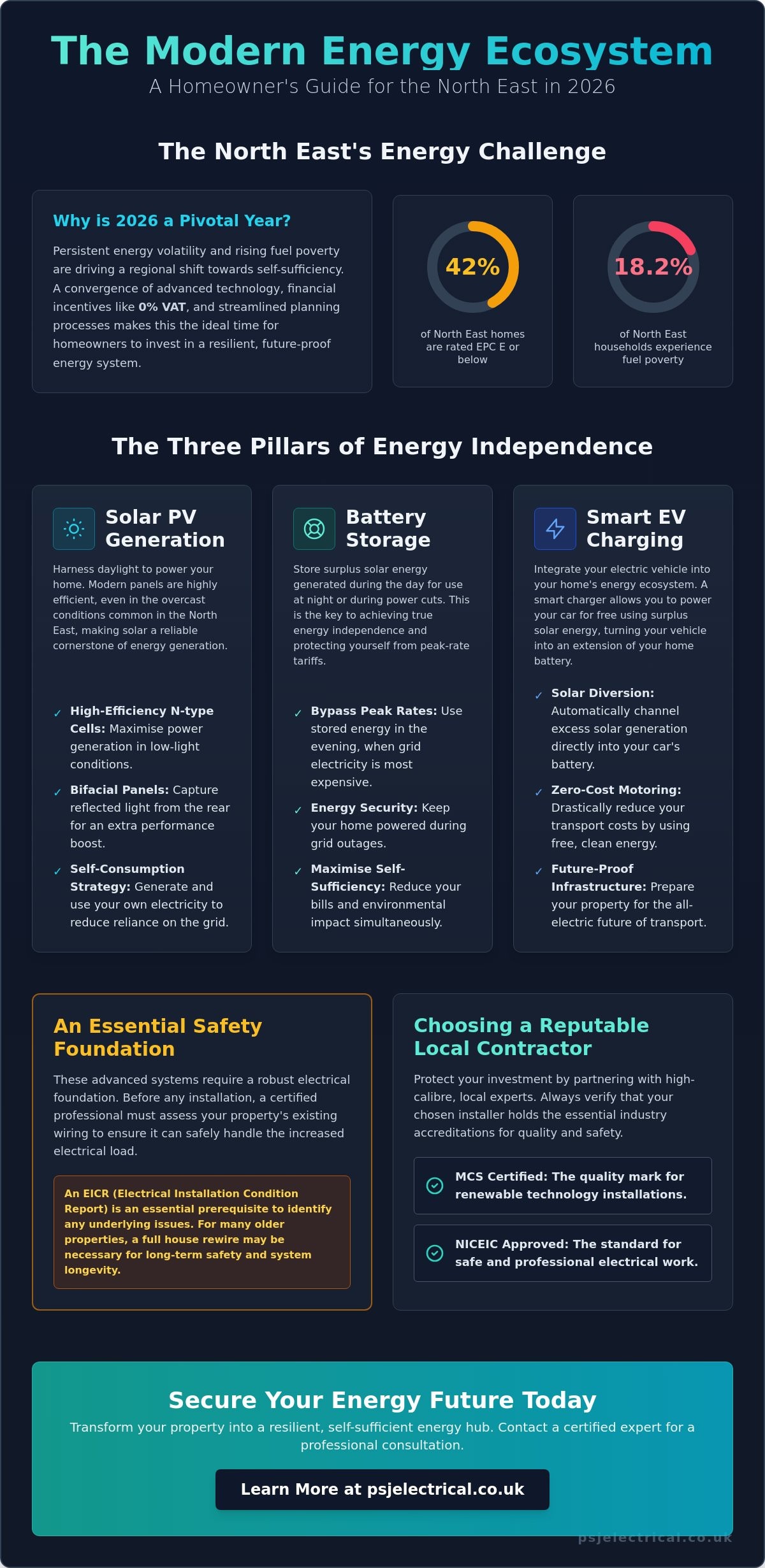
Did you know that 42% of homes in the North East are still rated EPC E or below, even as we move through 2026? It’s a sobering statistic that highlights why so many residents are seeking reliable renewable energy solutions North East to protect themselves against persistent energy volatility. You’ve likely grown tired of unpredictable monthly bills and the confusion surrounding which technologies actually perform in our specific regional climate. It’s natural to feel cautious, especially when trying to distinguish between high-calibre local workmanship and the less reputable installers who often appear during green energy booms.
We understand that you want peace of mind and a system that’s built for longevity rather than a quick fix. This guide will show you how modern solar panel installation, battery storage, and smart EV chargers can transform your property into a resilient, self-sufficient energy hub. We’ll explore the latest trends that allow you to lower your bills and increase your property value by building a modern electrical ecosystem that starts with a safe, professional foundation. You’ll learn how to navigate the current 0% VAT incentives and Smart Export Guarantee rates to ensure your home is ready for a greener future.
Key Takeaways
- Learn how the latest N-type solar cells and battery storage systems are designed to provide consistent performance within the specific climate of the North East.
- Explore the synergy between solar panel installation and EV chargers, including how solar diversion allows you to power your vehicle using surplus domestic energy.
- Understand why an EICR is an essential safety prerequisite for any homeowner considering integrated renewable energy solutions North East in 2026.
- Discover the practical steps for adapting period properties and traditional estates to modern energy standards without compromising their structural integrity.
- Learn how to identify reputable local contractors by verifying essential industry standards such as MCS and NICEIC to ensure a high-calibre installation.
The Shifting Landscape of Renewable Energy Solutions in the North East
The North East has long been defined by its industrial past, but the region is now undergoing a profound transformation. Where coal once powered the nation, a new era of decentralised power is taking hold. In 2026, renewable energy solutions North East encompass more than just standalone solar panels; they represent a sophisticated integration of generation, storage, and smart management. This shift is driven by a collective desire for energy security in an era of fluctuating global markets. As 44.9% of the UK’s energy mix now comes from renewables, local homeowners are increasingly looking to secure their own slice of this UK renewable energy landscape to protect their finances and the environment.
Energy security has become the primary motivator for residents from Teesside to Tyneside. With 18.2% of households in the North East experiencing fuel poverty, the ability to generate and store your own electricity isn’t just a green choice; it’s a practical financial strategy. Local electrical engineers play a vital role in this transition. They provide the technical expertise needed to bridge the gap between complex new technologies and the traditional architecture of our local towns. By ensuring that every installation meets rigorous safety standards, these professionals provide the peace of mind that homeowners need when investing in their property’s future.
Why 2026 is the Turning Point for Local Energy
Several factors have converged to make 2026 a pivotal year for regional energy. Smart grid technology, managed by Northern Powergrid, has matured to allow more efficient two-way energy flows. Local councils have also streamlined planning processes, making it easier for homeowners to install green technology under permitted development rights. Whilst energy price caps continue to fluctuate, the reduced costs of hardware and the 0% VAT incentive on energy-saving materials have significantly shortened the payback period for most domestic installations. It’s now a matter of when, not if, a home should make the switch.
The Core Components of a Sustainable Home
A modern sustainable home relies on three pillars: Solar PV for generation, battery storage for retention, and EV infrastructure for mobility. However, these advanced systems require a robust electrical foundation to operate safely. For many older properties in Durham or Northumberland, a full house rewiring North East is a sensible first step to ensure the existing cables can handle the increased load of high-capacity batteries and fast EV chargers. Relying on MCS-certified professionals ensures that every component is installed to the highest safety standards, providing the longevity and reliability that North East homeowners expect. This methodical approach ensures your investment is protected for decades to come.
Solar PV and Battery Storage: Harnessing Power in the Northern Climate
A common misconception amongst homeowners in Newcastle and Sunderland is that our northern skies are simply too overcast for solar power to be effective. This myth often deters people from exploring renewable energy solutions North East, yet the reality in 2026 is quite different. Modern solar technology doesn’t require direct, scorching heat; it requires daylight. Advancements in high-efficiency N-type solar cells have significantly improved low-light performance, whilst bifacial panels can capture reflected light from the rear, making them exceptionally efficient even on typical grey days in the North.
The strategy for 2026 has shifted from merely exporting energy to the grid to prioritising self-consumption. By integrating battery storage, you can retain the energy generated during the day and use it throughout the evening, effectively bypassing peak-rate electricity costs. This shift is a key part of the broader homeowner trends for 2026, where energy independence is valued just as highly as environmental sustainability. Storing your own power ensures that your home remains a self-sufficient hub, regardless of how the national grid fluctuates.
Optimising Solar for North East Latitudes
Achieving the best results in our region requires a methodical approach to installation. Whilst a south-facing roof remains the gold standard, east-west configurations are increasingly popular for providing a steady stream of power from dawn until dusk. Coastal properties in areas like South Shields or Tynemouth must account for higher wind loads and salt air durability, whereas inland homes might deal with more persistent morning mists. We often use micro-inverters to ensure that if one panel is shaded by a passing cloud or a chimney, the rest of the system continues to operate at peak capacity. For context, solar irradiance in Newcastle refers to the specific amount of solar power per unit area that reaches your roof, which remains more than sufficient to power a modern household.
The Critical Role of Home Battery Storage
Battery storage is the component that turns a collection of panels into a true energy ecosystem. These systems allow you to store surplus generation and even top up from the grid during off-peak hours using smart Time of Use tariffs. This ensures that your home runs on the cheapest, cleanest energy possible, even whilst the sun is down. It’s for this reason that many solar panel installers Newcastle now advocate for battery-first designs, ensuring the storage capacity matches your household’s unique consumption patterns. If you’re unsure about the technical requirements for your property, you can speak with our team to discuss a tailored solution that provides long-term reliability.
The Synergy of Integrated EV Charging and Home Power Systems
While standalone solar panels provide the generation, an electric vehicle (EV) acts as the ultimate extension of your home’s storage capacity. In 2026, we’ve moved beyond treating the car and the house as separate entities. An EV is essentially a large battery on wheels, often holding five to ten times the capacity of a standard domestic wall battery. By integrating these systems, you can achieve a level of energy independence that was previously impossible. This integration is a cornerstone of modern renewable energy solutions North East, allowing homeowners to manage their power with unprecedented precision.
Solar diversion is perhaps the most effective way to maximise your investment. Instead of exporting surplus green energy back to the grid for a few pence, smart controllers automatically divert that excess power into your vehicle’s battery. This means you’re effectively driving on sunshine, bypassing the cost of public charging networks entirely. According to the latest UK regional renewable energy data, the North East continues to expand its capacity, making these domestic integrations even more valuable as our local infrastructure evolves.
We’re also seeing the emergence of Vehicle-to-Home (V2H) technology as a standard feature in 2026. This allows your car to feed electricity back into your home during peak evening hours when grid prices are highest. However, drawing such significant power requires a professional touch. It’s vital to ensure your domestic circuits are up to the task, as the continuous high-amperage draw of a charger can easily overwhelm older electrical systems if they aren’t correctly assessed and modernised.
Smart Charging: Beyond the Simple Wallbox
Modern charging isn’t just about plugging in; it’s about intelligent management. AI-driven apps now track local energy prices in real-time, automatically pausing your charge if prices spike or resuming it when wind generation in the North Sea brings costs down. Load balancing is another essential feature that ensures you can charge your car at full speed whilst simultaneously using high-power appliances like electric ovens or showers. A modern consumer unit equipped with dedicated circuit protection is essential for safely managing these heavy EV loads without risking a domestic power failure. If your property still relies on an ageing fuse board, replacing old fuse boards in Newcastle is a critical prerequisite before installing any high-amperage EV charging equipment.
Future-Proofing Your Driveway
In affluent areas like Darras Hall and Wynyard, we’re increasingly seeing households transition to multiple electric vehicles. Planning for this shift now is far more cost-effective than retrofitting later. Whether you prefer a tethered unit with a permanent cable or an untethered socket for a cleaner aesthetic, the choice should reflect your long-term plans. Beyond the daily savings, a professionally installed charging system has become a key selling point. In a green-conscious market, North East buyers prioritising efficiency will see a home with an integrated energy ecosystem as a far more desirable and secure investment.
This commitment to efficiency often extends beyond the property itself to the vehicles parked on the driveway. For residents looking to optimise their car’s fuel economy and engine performance alongside their home energy upgrades, you can visit Naked Frog Vehicle Tuning for specialist mobile remapping services available throughout Northumberland and the North East.
Assessing Property Suitability: From Newcastle Terraces to Durham Estates
The North East is home to a diverse range of architecture, from the compact Victorian terraces of Jesmond to the sprawling stone estates of rural Durham. Before committing to renewable energy solutions North East, it’s essential to understand that your property’s age and location dictate the technical approach. A period home in Tynemouth presents different challenges than a modern build in Wynyard, particularly regarding structural weight limits for solar arrays and the capacity of the existing internal wiring to manage new, high-amperage loads.
Energy security starts with a robust foundation. In 2026, the Smart Export Guarantee (SEG) continues to provide a financial incentive for those with surplus power, with rates from providers like Octopus reaching approximately 15p/kWh. However, to access these tariffs and ensure your system is safe, a professional assessment of your home’s current electrical health is the first step. This ensures that your transition to green energy is both legally compliant and technically sound.
Electrical Health: The Foundation of Renewables
Building a 2026 energy system on a 1970s fuse box is neither safe nor efficient. Modern renewable technologies require precise control and protection that older consumer units simply cannot provide. Before any installation, an EICR acts as a vital health check, identifying any underlying issues that could be exacerbated by the addition of solar or EV charging loads. Most home insurance providers now require proof of a satisfactory report before they will cover properties with significant renewable upgrades. A professional engineer will assess your system’s spare capacity, ensuring your home can handle the simultaneous demands of generation and storage without compromising safety. For Newcastle homeowners whose assessment reveals an outdated fuse board, understanding the process of replacing old fuse boards Newcastle properties rely on is an essential next step before any renewable upgrade can proceed safely. Homeowners who want a comprehensive overview of the wiring and consumer unit work involved should also review our dedicated guide on upgrading your electrical system for solar, which covers exactly what infrastructure changes are required to meet 2026 compliance standards.
Overcoming Grid Constraints in Rural Areas
In more exposed or rural locations like Consett or Stocksfield, the local grid infrastructure may differ significantly from the robust networks found in Newcastle city centre. Northern Powergrid, our regional Distribution Network Operator (DNO), must be notified of all new generation sources. Whilst city dwellers might find connections straightforward, certain areas like the Hartlepool corridor have notable grid constraints that might limit how much power you can export. G98 is a standard notification for small systems under 3.68kW, whereas G99 is a formal application required for larger installations that could impact the local grid’s stability. For homeowners in these areas, working with professional solar panel fitters Stocksfield residents trust ensures that all DNO requirements and the latest MIS 3002 V6.0 standards are correctly met from the outset. If you’re planning a significant upgrade, you can book a professional site survey to determine exactly what your local infrastructure will permit.
Future-Proofing Your Investment: Choosing Local Expertise for 2026
Investing in renewable energy solutions North East is a decision that impacts your home for decades. While the technology has matured significantly by 2026, the quality of the installation remains the most critical factor in determining long-term reliability. Many homeowners have been lured by “cheap” national offers, only to find themselves without support when a component requires adjustment or a warranty claim arises. Choosing a contractor with a permanent local presence ensures that you aren’t just a number in a database; you’re a neighbour who can rely on prompt, professional aftercare.
Verifying credentials is the simplest way to protect your investment. In the 2026 market, an installer must hold MCS certification for you to access the Smart Export Guarantee and other financial incentives. Equally, NAPIT or NICEIC registrations confirm that the engineer is qualified to handle the complex electrical integration required for high-capacity systems. There is a distinct advantage in using a single, multi-disciplinary engineer who can manage everything from a fuse box replacement to solar panel installation and EV chargers. This holistic approach eliminates the risk of different trades blaming one another for technical issues, ensuring your entire energy ecosystem works in perfect harmony.
The 5-Step Process to a Renewables Upgrade
A professional installation follows a methodical path to ensure safety and efficiency. We don’t believe in guesswork. The process begins with a comprehensive electrical health check and EICR assessment to confirm your home can handle the new loads. Following this, a custom design is created, tailored specifically to your roof’s orientation and your household’s unique energy usage patterns. We then handle the administrative burden, including DNO applications and local authority notifications. The actual installation is performed by a multi-disciplinary team, followed by rigorous testing and a thorough handover to ensure you’re confident in managing your new system. For a detailed breakdown of what this preparatory work involves, our guide on upgrading your electrical system for solar explains each stage of the infrastructure assessment process in full.
Why PSJ Electrical is the North East’s Trusted Partner
With over 19 years of dedicated experience across Newcastle, Durham, and the wider region, we’ve built our reputation on a foundation of quiet confidence and technical precision. We don’t use aggressive sales tactics or make unrealistic promises; instead, we focus on high-calibre workmanship and a “safety first” philosophy that protects your family and your property. Our long-standing presence in the community means we’ll be here to support you long after the initial installation is complete. If you’re ready to secure your energy future, you can contact PSJ Electrical to discuss your 2026 renewable energy project and receive a professional assessment tailored to your home.
Securing Your Home’s Energy Future in the North East
The transition toward a cleaner, more independent home requires a methodical approach that prioritises safety and long-term performance. We’ve explored how the integration of solar generation, battery storage, and smart charging can mitigate energy volatility whilst adding tangible value to your property. It’s clear that the success of these renewable energy solutions North East depends on a robust electrical foundation, starting with a professional assessment of your current installation to ensure it can handle modern demands. To explore the technical specifications of high-performance system design, you can read more about specialist solar and battery storage solutions.
At PSJ Electrical, we bring over 19 years of local electrical engineering experience to every project. As specialists in both integrated property re-wires and modern renewables, we ensure your home is technically capable of supporting the high-capacity systems required in 2026. Our full MCS and NAPIT accreditation provides the peace of mind that your system is installed to the highest industry standards. By choosing a partner with deep roots in Newcastle and Durham, you’re investing in a relationship that offers reliable aftercare and technical precision.
Get a Professional Quote for Renewable Energy Solutions in the North East and take the first step toward a self-sufficient, green-conscious home. We look forward to helping you modernise your property with the care and expertise it deserves.
Frequently Asked Questions
Do solar panels actually work in the North East during the winter?
Solar panels remain functional throughout the North East winter because they generate electricity from daylight rather than direct heat. Whilst generation is naturally lower during the shorter days of December and January, modern high-efficiency panels are designed to capture a broader spectrum of light. This ensures your system continues to contribute to your home’s energy needs even during typical overcast northern winters.
Will I need to upgrade my fuse box to install an EV charger or solar panels?
You will likely need to upgrade your fuse box if your current unit lacks the necessary safety features to manage high-amperage renewable loads. A modern consumer unit with Surge Protection Devices and RCD protection is essential for the safe operation of EV chargers and solar inverters. We always conduct a thorough assessment of your existing system to determine if a replacement is required to meet current 2026 safety standards.
How much can a typical Newcastle home save with a solar and battery system in 2026?
A typical Newcastle household can achieve substantial reductions in monthly electricity bills by prioritising self-consumption through a combined solar and battery system. By storing daytime generation for evening use, homeowners can avoid peak-rate grid prices and maximise their renewable energy solutions North East. Exact savings vary based on your specific tariff and consumption patterns; however, reducing grid reliance significantly is a common benchmark for well-optimised systems in 2026.
What is the “Smart Export Guarantee” and how does it work in Durham?
The Smart Export Guarantee is a government-backed initiative that requires energy suppliers to pay you for any surplus solar electricity you export back to the grid. In Durham, this allows you to generate a modest income from energy you don’t use or store. You must have an MCS-certified installation and a smart meter to access these tariffs, with 2026 rates varying between 15p and 24p per kWh depending on your provider.
Is my roof suitable for solar panels if I live in a conservation area?
Most solar installations are considered “permitted development,” but properties within conservation areas or listed buildings often require specific planning permission from the local authority. Councils in the North East are increasingly supportive of green energy, but you should always verify local restrictions before proceeding. We recommend a professional site survey to assess the visual impact and ensure your installation complies with regional heritage guidelines.
Can I charge my electric car using only solar energy?
You can charge your electric vehicle using only solar energy by utilising a smart charger equipped with solar diversion technology. This system monitors your domestic generation and automatically directs any surplus power into your car’s battery instead of the grid. Whilst this is highly effective during the summer months, you may still need to supplement with off-peak grid power during the darker winter periods to maintain a full charge.
What maintenance do renewable energy solutions require in the North East?
Renewable energy systems are generally low-maintenance, but they do require occasional checks to ensure peak efficiency. Solar panels in the North East benefit from an annual cleaning to remove salt spray or debris, especially in coastal areas like South Shields. We also recommend a professional electrical inspection every few years to verify that the inverter, battery storage, and wiring remain in safe, optimal condition.
How long does it take to install a full solar PV and battery system?
A standard domestic solar PV and battery installation typically takes between two and three days to complete. This timeframe includes the safe erection of scaffolding, the mounting of the panels, and the internal electrical work required to connect the battery and inverter. Larger projects or those requiring a full house re-wire alongside renewable energy solutions North East may take longer, depending on the complexity of the property’s existing infrastructure.