
Can a 200-year-old Yarm townhouse truly power itself with the same efficiency as a new build on the edge of town? Many homeowners across our community are eager to lower their energy bills but feel hesitant about how modern technology might clash with heritage aesthetics or older wiring. It’s a common concern, especially when considering residential solar PV systems Yarm households need to be both high-performing and visually discreet. You shouldn’t have to choose between preserving the character of your property and embracing a more sustainable, cost-effective future.
This article explores how professional engineering expertise allows you to integrate solar energy into Yarm’s unique mix of properties without compromising on safety or style. We’ll discuss how to ensure your installation meets strict MCS standards for longevity and how to navigate the specific planning nuances of local conservation areas. You will learn how a correctly specified system can increase your property value whilst providing reliable, clean power for over 25 years. From assessing your current electrical setup to avoiding unreliable installers, we provide the clarity you need to make an informed investment in your home’s energy independence.
Key Takeaways
- Learn why a detailed physical site survey is essential for assessing the structural integrity of older roof timbers and electrical compatibility in Yarm’s unique properties.
- Understand the specific planning requirements for installations within or near the Yarm High Street conservation area to ensure your project respects local heritage.
- Discover how residential solar PV systems Yarm homeowners invest in during 2026 can maximise financial returns through the 0% VAT rate and the Smart Export Guarantee.
- Explore the importance of a bespoke engineering approach that prioritises system longevity and safety over generic, one-size-fits-all installations.
- Gain peace of mind by partnering with established electrical professionals who bring nearly two decades of local expertise to your renewable energy transition.
Understanding Residential Solar PV Systems in Yarm (2026)
Solar Photovoltaic (PV) technology has transitioned from a niche environmental choice into a fundamental part of local home infrastructure. For those Understanding Residential Solar PV Systems, the core concept is the conversion of daylight into usable household electricity. This differs fundamentally from solar thermal systems, which are designed solely for heating water; solar PV generates the versatile electrical energy required to power your entire home, from essential appliances to electric vehicle chargers.
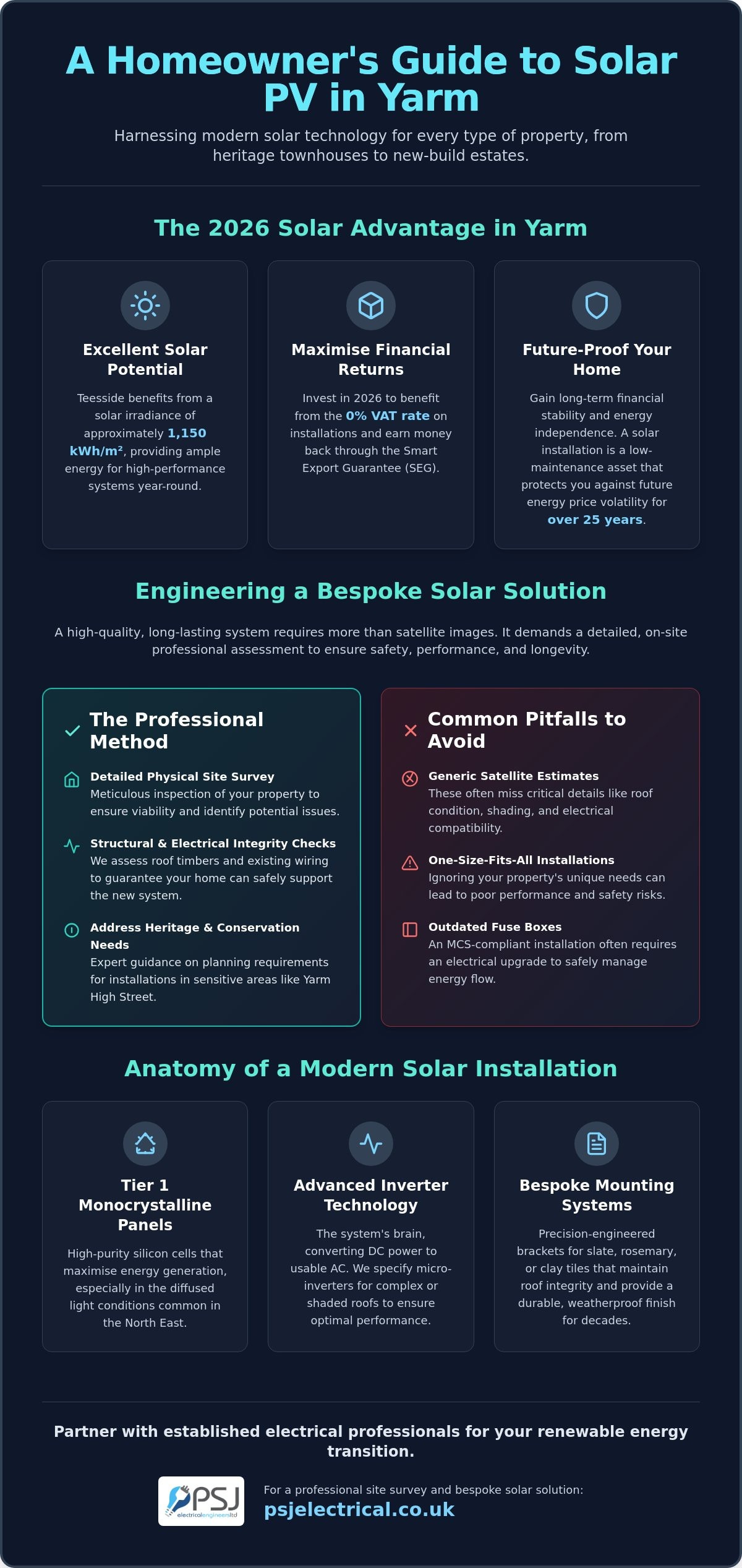
Whilst some believe the North East lacks sufficient sunlight, Teesside actually benefits from a solar irradiance of approximately 1,150 kWh/m². This provides ample energy to drive high-performance systems even during our shorter winter days. 2026 is a particularly strategic time for installing residential solar PV systems Yarm wide, as it allows homeowners to take advantage of the current 0% VAT rate whilst securing protection against future energy price volatility.
The Components of a Modern Solar Installation
A reliable system relies on high-quality hardware tailored to the specific property. Quality matters. We prioritise Tier 1 monocrystalline panels because they offer superior efficiency in the diffused light conditions often found in the North East. The choice of inverter is equally critical. A standard string inverter works well for clear, south-facing roofs, but we often specify micro-inverters for Yarm’s heritage properties where complex rooflines or chimneys might cause shading.
- Tier 1 Monocrystalline Panels: High-purity silicon cells that maximise energy harvest in low-light conditions.
- Inverter Technology: The system’s brain, converting DC power to AC for home use.
- Bespoke Mounting: Specialised brackets for slate, rosemary, or clay tiles to maintain roof integrity.
Our mounting systems are precision-engineered to fix securely to everything from traditional slate to modern clay tiles. This ensures a durable, weatherproof finish that lasts for decades without compromising the structural integrity of your roof timbers.
Why Yarm Households are Leading the Energy Transition
Homeowners in the TS15 area are increasingly moving toward energy independence to gain long-term financial stability. Safety is paramount. We’ve noticed a trend where residents combine solar installations with broader electrical upgrades, such as full re-wires or fuse box replacements, to ensure their home can handle modern demands safely. This holistic approach reflects a desire for longevity and precision in workmanship. Solar PV is a silent, low-maintenance asset for the modern home that works quietly in the background to reduce your carbon footprint and your monthly outgoings.
Engineering a Bespoke Solar Solution for Your Property
Effective engineering begins on the ground, not through a computer screen. Whilst many national providers rely on generic satellite estimates to quote for residential solar PV systems Yarm residents invest in, these often fail to account for the physical realities of the town’s varied housing stock. A physical site survey is the only way to ensure your roof is actually viable for a long-term installation. We meticulously inspect the structural integrity of your roof timbers, particularly in older properties where rafters may require strengthening to safely support the weight of a solar array for the next 25 years.
The electrical heart of your home requires equal attention. A solar installation is a high-load addition to your domestic circuit, and outdated fuse boxes often lack the necessary safety components to manage this bi-directional energy flow. We often find that a modern fuse box replacement is a prerequisite for a safe, MCS-compliant installation. This technical foundation also allows for the seamless integration of EV chargers, enabling you to divert surplus solar energy directly into your vehicle rather than exporting it to the grid for a lower return.
Roof Orientation and Shading Analysis
Yarm’s geography and architecture present specific challenges. Whilst a south-facing roof remains the gold standard for peak generation, east-west arrays are becoming increasingly popular for households wanting a consistent spread of power throughout the day. In areas like Leven or Egglescliffe, mature trees can cast significant shadows that diminish system performance. To counter this, we utilise power optimisers on each panel. These devices ensure that if one panel is shaded by a chimney or a branch, the rest of the array continues to operate at its maximum potential without being “dragged down” by the underperforming unit.
Battery Storage: The Key to Energy Independence
Generating power is only half the battle; capturing it for later use is what truly delivers value. Statistics from early 2026 suggest that approximately two-thirds of new solar installations in the Teesside area now include a battery, reflecting a shift toward total energy independence. Without storage, a typical household might waste up to 50% of their generated energy because they aren’t home during peak daylight hours.
Adding a battery allows you to store that “daylight power” for use during Yarm’s winter evenings. For a deeper look at the economics of these systems, The Financial and Regulatory Framework provided by the Energy Saving Trust offers impartial guidance on potential savings. When paired with smart tariffs like Octopus Flux, your battery can even automatically charge from the grid during off-peak hours when prices are lowest. If you’re unsure about your home’s current electrical capacity, you can request a professional assessment from our engineering team.
Yarm Property Analysis: Heritage Character vs. Modern Estates
Yarm is defined by its architectural contrast, where centuries-old Georgian townhouses sit just a short distance from sprawling modern executive developments. This diversity means that residential solar PV systems Yarm residents choose must be tailored specifically to the building’s era and construction. A one-size-fits-all approach fails here because the engineering requirements for a property on the High Street differ vastly from those in a new build in Kirklevington or Castle Levington.
Aesthetics play a significant role in preserving the town’s character. For many homeowners, the visual impact of solar panels is a primary concern. We often specify all-black monocrystalline panels for these properties because they offer a sleek, uniform appearance that blends more naturally with traditional slate or dark rosemary tiles. When Engineering a Bespoke Solar Solution, we also account for strict planning regulations. Whilst solar is often permitted development, properties within the Yarm High Street conservation area cannot have panels on a roof slope that fronts a highway. Navigating these nuances requires local knowledge to ensure your installation is both compliant and sympathetic to its surroundings.
Solar for Yarm’s Period and Georgian Homes
Installing modern technology on a period property requires a high degree of craftsmanship. We use discreet mounting techniques that minimise the profile of the panels, ensuring they sit as flush to the roof as possible. Internal cabling is another area where precision is vital. In homes with lath and plaster walls or original timber features, we take extra care to route cables invisibly and safely. If your property is Grade II listed, we can assist in providing the technical documentation required for listed building consent, ensuring the proposed array meets the stringent requirements of local planning authorities.
Maximising Output for Modern Executive Estates
Newer developments in areas like Kirklevington or Wynyard often provide the ideal canvas for high-output solar arrays. These homes typically feature large, unobstructed roof spaces that allow for larger systems with higher peak generation. For homeowners undertaking a full house rewiring North East project, integrating solar PV at the same time is highly efficient. This allows us to modernise the entire electrical infrastructure at once, ensuring the consumer unit and internal circuits are perfectly optimised for energy management. By preparing your home now, you create a future-proof environment ready for the next generation of smart home technology and increased electrical demands.
The Financial and Regulatory Framework for 2026
The current financial landscape for residential solar PV systems Yarm households are installing is exceptionally favourable. A key driver is the 0% VAT rate on residential solar and battery storage, which is confirmed to remain in place until 31 March 2027. This incentive significantly reduces the initial capital outlay for homeowners. Beyond the installation cost, the Smart Export Guarantee (SEG) allows you to sell surplus electricity back to the National Grid. With flat rates in June 2026 reaching approximately 15p per kWh, your system actively generates revenue whilst you are away from home. Eligible low-income residents in the Stockton-on-Tees area may also access the “Warm Homes: Local Grant” for fully funded solar upgrades.
Choosing an MCS-certified installer is a non-negotiable requirement for accessing these benefits. Without this certification, energy suppliers won’t accept your SEG application, and most home insurance providers will refuse to cover the installation. There is also a critical connection between these upgrades and electrical testing for insurance purposes. A professional engineering firm ensures that your new renewable system is fully integrated into your home’s safety certification, protecting your property’s long-term value and ensuring your policy remains valid.
Calculating Your Return on Investment (ROI)
A typical 4kWp system in the North East generally offers a payback period of between 6 and 10 years, depending on your household’s energy behaviour. Whilst the initial cost for a system without a battery averages between £6,500 and £7,800 in the Teesside area, adding storage can accelerate your ROI. By capturing energy that would otherwise be exported for 15p and using it later to avoid buying grid power at a higher rate, you maximise every kilowatt generated. Solar ROI is a combination of bill savings and exported energy payments.
Preparing Your Home: The “Solar-Ready” Electrical Check
Before panels ever reach your roof, upgrading your electrical system for solar is the smartest first step you can take. We ensure your consumer unit meets the latest 18th Edition Amendment 2 standards, which include essential surge protection and fire safety components required for modern high-load systems. We also manage the G98 or G99 grid application process on your behalf. This formal notification to Northern Powergrid is essential for any Yarm resident looking to connect a generating system to the local network safely and legally.
If you’re ready to secure your home’s energy future, book your professional solar assessment today to discuss your specific requirements.
Why PSJ Electrical is Yarm’s Professional Solar Partner
Choosing the right team for residential solar PV systems Yarm households depend on is a decision that impacts your property for decades. Our 19+ years of industry experience across Teesside has taught us that solar success is built on an “engineers first” mentality. We aren’t just fitters who install panels; we are qualified electrical engineers who prioritise the safety and stability of your home’s entire electrical infrastructure. This comprehensive approach ensures that every component, from the mounting brackets on your roof to the surge protection in your fuse box, is installed with precision and care.
Transparency is the cornerstone of our service. We don’t employ aggressive sales tactics or high-pressure closing techniques. Instead, we offer technical-led consultations where we explain the logic behind our engineering choices. Every installation concludes with a full handover pack, including all necessary MCS certifications and technical documentation. This ensures you have everything required for your Smart Export Guarantee application and future property valuations. Safety is a standard. It isn’t an optional extra.
Our Local Commitment to Yarm and the North East
Our presence in the region means we understand the specific challenges posed by local architecture and weather conditions. Understanding how a professional solar fitter benefits your home in Stocksfield and Yarm equally highlights our commitment to consistent, high-standard workmanship across the North East. Our “Right First Time” philosophy is designed to give you peace of mind, knowing that your system is built to last. We don’t just complete a job and disappear; we remain available for long-term support and maintenance to ensure your investment continues to perform at its peak.
Start Your Yarm Solar Project Today
The process of transitioning to renewable energy for your TS15 property is straightforward and methodical. It begins with a technical site survey where we assess your roof’s orientation, structural integrity, and current electrical capacity. Once the design is finalised, most installations are completed within a two-day window, minimising disruption to your daily routine. We take pride in leaving every site clean, tidy, and fully operational. If you are ready to explore the benefits of high-efficiency energy for your home, Contact PSJ Electrical for a professional solar PV consultation and take the first step toward long-term energy independence.
Securing Your Home’s Energy Independence in Yarm
Integrating renewable technology into Yarm’s diverse property landscape requires more than just standard installation; it demands an engineering-led approach that respects the town’s heritage whilst embracing modern efficiency. By understanding the specific needs of your property, whether it’s a Georgian townhouse or a contemporary estate, you can secure a system that provides reliable power and long-term financial returns. Implementing residential solar PV systems Yarm residents can trust involves careful planning, from navigating conservation area rules to ensuring your electrical infrastructure is fully compliant with modern standards.
With over 19 years of specialist electrical engineering experience, we provide the technical expertise necessary to bridge the gap between traditional craftsmanship and modern renewables. As an MCS Certified and NAPIT Registered firm, we ensure every installation meets the highest safety benchmarks for your peace of mind. We invite you to Request a Professional Solar PV Survey for Your Yarm Home to begin your journey toward a more sustainable and cost-effective future. Taking control of your energy costs is a practical step that adds lasting value to your home.
Frequently Asked Questions
Do solar panels work in the cloudy North East weather?
Yes, solar panels generate electricity from daylight rather than direct heat or constant direct sunlight alone. Modern monocrystalline cells are specifically designed to harvest energy from the diffused light common in the North East. Whilst peak generation occurs on clear days, your system will remain active and productive even during the overcast conditions typical of the Teesside climate.
Do I need planning permission for solar panels in Yarm?
Most installations fall under “permitted development” and don’t require formal planning permission from the local authority. However, specific restrictions apply to properties within the Yarm conservation area, particularly regarding panels visible from the highway. If you live in a listed building, you’ll almost certainly need listed building consent before proceeding with any work on the property.
How much can I actually save on my energy bills with solar PV?
A typical 3.5kWp system can save a household between £450 and £600 per year on electricity bills, depending on your energy usage patterns. These savings are further enhanced by the Smart Export Guarantee, which provides payments for surplus energy sent back to the grid. Your total return depends on how much generated power you consume at home versus how much you export.
Is my roof strong enough for a residential solar PV system?
Most UK roofs are structurally capable of supporting residential solar PV systems Yarm homeowners choose, but a professional assessment is vital. During our site survey, we inspect the condition of your rafters and tiles to ensure they can handle the additional static load. If reinforcements are required, we identify these technical requirements before any installation work begins.
What happens to my solar panels during a power cut?
Standard solar systems automatically shut down during a power cut to prevent “islanding,” which could endanger engineers working on the local grid. If you require power during an outage, you’ll need a specific battery storage system with an “emergency power supply” (EPS) function. This allows your home to operate independently of the National Grid during a local power failure.
How long does a typical solar installation take in Yarm?
A standard domestic installation in Yarm typically takes two days to complete from start to finish. The first day generally focuses on the roof mounting and panel placement, whilst the second day is dedicated to the internal electrical wiring and system commissioning. We ensure all work is completed efficiently with minimal disruption to your household routine.
What maintenance do solar PV systems require?
Solar PV systems are remarkably low-maintenance because they have no moving parts that are prone to wear. The panels are generally self-cleaning if installed at an angle of 15 degrees or more, as rainwater will wash away most dust and debris. We recommend a professional electrical inspection every few years to ensure the cabling and inverter remain in peak condition.
Can I add a battery to my existing solar system later?
You can certainly add battery storage to an existing system at a later date to increase your self-consumption. This is usually achieved by installing an AC-coupled battery, which works alongside your current solar inverter. It’s an excellent way to increase your energy independence if your household’s power demands grow or if you decide to switch to a time-of-use tariff.